Our marketing blog.
Observations, commentary, and editorial on everything digital marketing, from the Growth Friday team. From tips and advice, the latest trends, AI, and how this is affecting marketing, we have you and your practice covered!

Employment Law Marketing: A Practical Guide for Growth-Focused Firms in 2026
The employment law marketing landscape has shifted dramatically since 2020, and so has the way clients find and choose their attorneys. Whether your firm represents workers facing wrongful termination or advises employers on compliance, the rules of client acquisition have changed. This guide is designed for employment law firm partners, marketing managers, and legal professionals seeking to grow their practice through effective, compliant marketing strategies in a rapidly evolving legal landscape. This guide breaks down exactly how employment law firms can build a marketing system that generates consistent, qualified leads in 2026 and beyond.
Key Takeaways
- A modern employment law marketing strategy must blend search engine optimization, content marketing, Google Ads, reviews, and UX into one integrated system-not isolated tactics that compete for budget.
- Effective marketing for employment lawyers requires separate strategies for employees and employers. The messaging, channels, conversion paths, and economics differ significantly between these two audiences.
- Most employment law firms that invest in SEO see 38–61% of new client inquiries come from organic search within 12 months, making it the most sustainable lead generation channel available.
- Growth Friday (founded 2017, based in Los Angeles with offices in Santa Barbara and Miami) builds integrated, AI-powered marketing systems specifically for professional service firms, including employment law practices.
- If you're evaluating your marketing efforts right now, request a discovery call. We'll audit your current presence and map out the next 6–12 months with clear benchmarks.
Understanding the Employment Law Market in 2026
Post-2020 workplace changes-remote work, waves of layoffs in tech and finance, and a surge of new state regulations around pay transparency, AI governance, and worker classification-have pushed search volume for employment law topics to new highs. People are searching for legal help in greater numbers, and the queries are more specific than ever.
Employment law firms typically serve two core audiences. On one side, individual employees (a B2C relationship) seek urgent relief after adverse events like wrongful termination, workplace discrimination, or wage disputes. On the other, employers, HR leaders, and in-house counsel (a B2B relationship) need ongoing legal counsel for compliance, workplace investigations, training, and risk management. Many firms serve both, often requiring entirely separate teams and messaging.
Common high-value matters in 2026 include wrongful termination after layoffs, wage-and-hour class actions, harassment and discrimination claims, non-compete and trade secret litigation, misclassification of contractors (where misclassifying freelancers as independent contractors can lead to penalties from the Department of Labor), and EPLI defense for employer-side practices. Under the National Labor Relations Act, employees have the right to discuss wages and working conditions, which continues to generate employment disputes and search demand.
Digital marketing is now the primary discovery path for most employment clients. Prospective clients start with Google Search, check the local map pack, then validate a firm through its Google Business Profile and reviews before making contact. Referrals still matter, but they're almost always researched online before conversion.

Define Your Employment Law Marketing Goals and Ideal Clients
Many employment law firms in 2026 still lack clear marketing goals. The result: scattered spend across random SEO projects, unfocused paid ads, and no line of sight from marketing dollars to signed cases. Employment law firms must identify their target audience clearly before any campaign launches.
Set concrete goals. For example:
- Add 8–10 new plaintiff-side wrongful termination cases per month in California.
- Sign 3 new mid-market employer clients per quarter in healthcare and SaaS.
- Generate 20 qualified leads per month for wage-and-hour consultations in South Florida.
The difference between B2C employment law clients (employees) and B2B employment law clients (employers, HR directors, in-house counsel) is significant. Targeting employees requires empathetic and educational content-plain language, reassurance, confidentiality. Employer-side clients prioritize legal compliance and risk management. Content should address specific legal concerns of potential clients on each side, and promoting employment law services requires a focus on trust and empathy throughout.
Segment your target audience further by geography (Los Angeles County vs. statewide California), industry (tech, healthcare, hospitality), and case type (harassment, wage-and-hour, executive contracts). At Growth Friday, we typically run a 60–90 minute discovery session to clarify revenue targets, average matter value, and ideal client mix before proposing any digital marketing plan.
Build an Employment Law Website That Converts Visitors into Consultations
Your law firm website is the hub of all online marketing. It must be fast, mobile-first, and unmistakably clear within five seconds about who you help and what you do.
For anxious employment law clients-whether an employee just fired or an HR director facing a complaint-design matters. Use a calm color palette, plain language headlines, and prominent "confidential, no-obligation consultation" messaging. Avoid legal jargon that alienates the people you're trying to serve.
If your employment law practice serves both employees and employers, the site architecture should include separate navigation paths and practice area pages for each audience. Mixing the two confuses prospective clients and dilutes conversion rates.
Essential pages include:
- Wrongful termination
- Workplace discrimination and harassment
- Wage-and-hour claims
- Non-compete and trade secret disputes
- Executive contracts and severance
- Employer counseling, handbook review, and training
- Workplace investigations and EPLI defense
Every page needs a clear phone number, contact button, embedded scheduling, and mobile-optimized intake forms. Growth Friday's UX team typically runs user testing and heatmaps for employment law sites to refine layout, calls-to-action, and content structure over the first 90 days.
SEO for Employment Law Firms: From Local Visibility to Authority
Organic search is often the largest and most profitable channel for employment law firms. Data from AuthoritySpecialistshows firms with mature SEO programs receive 38–61% of new client inquiries from organic search. Comprehensive organic search strategies increase your website's visibility on search engines and, when done well, produce leads at a fraction of the cost of paid campaigns over time.
SEO strategies include on-page, off-page, and local optimization. For employment lawyers, this means a combination of local SEO (for "employment lawyer near me" queries), practice area SEO (claim-type pages), and authority-building content on employment law topics. High-quality content improves search rankings and attracts leads consistently.
A realistic SEO roadmap runs 6–12 months: technical cleanup in month one, on-page optimization and local service pages in months two through four, and consistent content publishing targeting real search demand from month three onward. Growth Friday's Growth 360 system includes AI-SEO modules that monitor rankings, featured snippet opportunities, and content gaps for employment law clients monthly.
Local SEO for Employment Lawyers
Local SEO helps law firms appear in local search results-the map pack that dominates high-intent queries like "employment lawyer Los Angeles" or "wrongful termination attorney Miami." Local SEO improves visibility for employment law firms more than almost any other single tactic.
Optimize your Google Business Profile thoroughly: select the right categories (Employment Attorney, Labor & Employment Attorney), add keywords to your description, keep office hours current, list all services, and upload frequent photo updates. Profiles with over 100 photos earn significantly more calls.
Create city-specific or county-specific landing pages (e.g., "Los Angeles Wrongful Termination Lawyer" or "Santa Barbara Workplace Harassment Attorney") with localized content and FAQs. These local service pages capture search behavior tied to specific geography and boost your local market presence.
Consistent NAP (Name, Address, Phone) across legal directories like Avvo, Justia, FindLaw, and state bar listings is essential. Discrepancies damage local rankings. Firms that reach the top 3 map pack positions typically see a measurable jump in consultation volume-some reporting 40–60% increases in inbound calls.

On-Page SEO and Website Structure
Each practice area and sub-topic-wrongful termination, whistleblower retaliation, sexual harassment, unpaid overtime, misclassification, employer counseling-should have its own optimized page with clear H1/H2 structure. SEO-driven articles answer common legal queries and build credibility with both search engines and human readers. Backlinks from reputable sites enhance your site's credibility and domain authority over time.
Incorporate keywords naturally in titles, meta descriptions, headers, and URLs while keeping language plain and empathetic. Internal linking between related topics (harassment page linking to retaliation page, employer training page linking to workplace investigations page) supports both UX and search rankings.
Technical basics matter: fast page load (Core Web Vitals), mobile responsiveness, secure HTTPS, and schema markup for legal services and FAQs. Growth Friday routinely audits employment law sites for technical issues affecting local and organic rankings within the first 30 days of every engagement.
Content Libraries and Topic Clusters
SEO content builds searchable libraries for employment law firms that compound in value over time. Structure your content library by claim type (harassment, wage theft), jurisdiction (California, Florida, New York), and audience (employees vs. employers).
Build pillar pages (e.g., "California Wrongful Termination Guide 2026") supported by cluster articles answering specific questions about deadlines, documentation, and damages. Strategic content attracts clients searching for specific legal issues and keeps your site relevant as laws change.
Use FAQs, checklists, and timelines (e.g., "Steps to Take in the First 7 Days After Being Fired") that rank for long-tail searches and can be repurposed for email and social media. Growth Friday's content marketing team often plans 3–6 months of employment law content at a time, guided by search data, seasonality (year-end layoffs spike search volume), and regulatory changes.
Paid Media: Google Ads and Retargeting for Employment Lawyers
Paid search and paid social give employment law firms immediate visibility for high-intent queries while SEO ramps up. In competitive metros like Los Angeles, Miami, and New York, specialized digital marketing for law firms is often essential during the first 6–12 months of a marketing engagement. PPC campaigns connect firms with clients ready to act-people actively searching for a wrongful termination lawyer or employment attorney right now.
Google Ads is the primary paid channel for both employee-side and employer-side campaigns. LinkedIn Ads offer an additional option for B2B employer outreach to HR consultants, founders, and in-house counsel.
Structure campaigns by audience and case type to avoid mixing very different cost-per-case profiles. Robust conversion tracking-phone calls, form submissions, booked consultations, and signed retainer events-is non-negotiable for calculating real cost per signed case. Growth Friday's paid media team manages and optimizes Google Ads and Meta retargeting as part of an integrated system with transparent monthly reporting.
Google Ads Strategy for Employment Law Firms
For employee-side audiences, focus on keywords such as "wrongful termination lawyer near me," "hostile work environment attorney," and "California wage and hour lawyer." For employer-side clients, target phrases like "employment law firm for employers," "HR compliance attorney," and "EPLI defense counsel." Use both exact and phrase match keywords while implementing aggressive negative keyword lists (e.g., "free advice," "labor board phone number," "EEOC complaint form") to minimize wasted spend. Average cost-per-click (CPC) for employment law keywords typically ranges from $25 to $65, with some high-intent terms reaching $80 to $150 or more in large metropolitan areas. Craft ad copy that clearly differentiates between the two audiences: use empathetic, reassurance-focused messaging for employees and emphasize risk management and compliance for employers and HR leaders. Each ad group should have a dedicated landing page featuring tailored headlines, concise forms, trust signals such as bar memberships, verdicts, and client testimonials, along with clear calls to action.
Growth Friday manages marketing budget dynamically, shifting spend toward keywords and campaigns that generate signed matters at or below target acquisition cost.
Retargeting and Multi-Touch Journeys
Many potential employment law clients visit a site multiple times before contacting a lawyer, especially executives and employer-side prospects. Retargeting captures this delayed decision-making.
Set up retargeting campaigns on Google Display and Meta (Facebook/Instagram) to show helpful content and gentle calls-to-action to previous visitors. Segment retargeting audiences by behavior-people who visited wage-and-hour pages see different creative than those who explored employer training or workplace investigations pages.
Use retargeting windows of 7, 30, and 90 days with frequency caps to prevent ad fatigue while keeping your law firm top of mind. Growth Friday treats retargeting as part of a full-funnel system, not an isolated tactic, to support both immediate and delayed legal journey decisions.

Content Marketing and Social Media for Employment Lawyers
Content marketing builds authority and trust with potential clients before they're ready to pick up the phone. It's how employment law firms demonstrate expertise and show up in search results and social feeds at the exact moment someone needs legal guidance.
Content marketing includes blogs, videos, and educational resources. Topics should be driven by actual client questions from intake calls, consultations, and search data-not abstract legal theory. Align content cadence (2–4 SEO articles per month, 1–2 videos, weekly social posts) with internal capacity and social media marketing strategy and budget.
LinkedIn works best for employer-side work (HR leaders, founders, in-house counsel). Facebook, Instagram, and YouTube serve employee-side awareness and education. Note that employees must disclose their employment relationship when endorsing products on social media, and using personal social media for company marketing risks ownership disputes over content. Growth Friday's holistic digital marketing approach and content marketing pillar tie long-form articles, email campaigns, and organic social together around clear quarterly themes.
Educational Content on Employment Law Topics
Educational content is crucial for building trust with employment law clients. High-quality content improves search rankings and attracts qualified leads when it answers the real questions people are searching.
Specific, evergreen article ideas include:
- "What to Do If You Were Fired After Reporting Harassment in California"
- "How Wage-and-Hour Class Actions Work in Florida"
- "2026 Update: Non-Compete Agreements in New York"
Combine plain language explanations with clear disclaimers that content is not legal advice and may vary by jurisdiction. Use visual aids like timelines, flowcharts, and tables for complex processes (e.g., EEOC filing steps or internal investigation protocols). Marketing materials must avoid discriminatory language and comply with equal employment opportunity laws.
Update core guides when laws change to maintain accuracy and SEO performance. Content marketing builds authority and educates potential clients over time. Growth Friday often repurposes long-form guides into shorter FAQs, checklists, and social posts to maximize ROI on each employment law topic.
Video Marketing and Webinars
Video marketing humanizes brands and reduces client hesitation. Short, clear videos featuring real employment lawyers build trust faster than stock images and generic slogans. Encourage potential clients to see the actual attorneys who will represent workers or advise employers.
Effective video formats include:
- 2-minute answers to common employment law issues
- Attorney introductions and "what to expect" explainers
- Client story overviews (with consent)
- Consultation process and fee breakdowns
Post videos on YouTube, embed them on relevant practice area pages, and clip segments for LinkedIn and Instagram. Host quarterly webinars for employers (e.g., "2026 California Employment Law Updates for HR Teams") and nurture attendees via email afterward. Growth Friday supports script development, basic video guidelines, and promotion strategies so firms can record efficiently with local resources.
Email Marketing and Lead Nurturing
Create lead magnets tailored to employment law: downloadable guides on wrongful termination timelines, employer compliance checklists, or handbook audit templates. These free resources and educational resources encourage potential clients to share their contact information in exchange for genuine value.
Segment email lists into employees, employers, and referral partners. A basic drip sequence looks like this:
- Welcome email with the downloaded resource
- Educational FAQ addressing top employment law questions
- Anonymized case study showing process and outcome
- Explanation of your consultation process and fees
- Reminder nudge after 7–14 days
Respect ethical rules: no overpromising outcomes, clear unsubscribe options, and careful handling of sensitive information. Client confidentiality must be maintained throughout. Agencies must comply with local State Bar rules regarding advertising materials. Growth Friday integrates email and customer relationship management tools so employment law firms can see which topics educate potential clients effectively and lead to booked consultations and signed retainers.
Reputation Management and Social Proof for Employment Law Practices
Employment law clients-both employees and employers-look for reassurance that a firm is responsive, respectful, and experienced with similar cases. Client reviews are essential for establishing social proof online. Verified reviews significantly influence prospective clients' decisions, often making the difference between a phone call and a bounce.
Online reviews, client testimonials, case results, media quotes, and bar association memberships all serve as social proof. A structured review strategy helps maintain visibility and public trust while keeping your firm competitive in search results.
Build a consistent review collection process post-matter, mindful of confidentiality, state bar rules, and client comfort levels. Highlight selected testimonials and anonymized case studies on key practice pages with clear disclaimers about past results not guaranteeing future outcomes. Client testimonials can enhance credibility but must comply with legal marketing ethics at all times.
Growth Friday typically sets up review request workflows and monitors key platforms (Google, Yelp, Avvo) as part of ongoing reputation management for employment law practices.
Client Reviews and Ethics Considerations
Request reviews soon after a favorable resolution, via email or SMS with direct links to your Google Business Profile. Encouraging satisfied clients to leave feedback builds online trust and directly impacts your local search visibility. Aim for 100+ Google reviews at a 4.8+ star rating with steady velocity of 8–15 fresh reviews per month.
Include language reminding past clients not to reveal sensitive details and acknowledging that results vary by case. Responding to reviews professionally enhances client trust-both positive and negative reviews deserve a professional, non-specific response that protects confidentiality and complies with bar guidelines.
Create internal guidelines for who can respond to reviews and maintain standard response templates reviewed by firm leadership. Businesses must protect intellectual property created by employees, and employment contracts and NDAs dictate copyright ownership of marketing materials. Employment agreements must include intellectual property assignment clauses when staff or contractors create content on behalf of the firm. Intellectual property assignment clauses are provisions in employment contracts or NDAs that specify the ownership of marketing materials and other content created by employees or contractors, ensuring the firm retains copyright and control over these assets. Restrictive covenants can also prevent employees from sharing advertising strategies with competitors if they leave.
Growth Friday helps employment law firms craft compliant review outreach templates and response frameworks aligned with local rules.

Data, Technology, and Integrated Systems: How Growth Friday Supports Employment Law Firms
Scattered vendors-one for SEO, one for PPC, one for web design-often lead to gaps in tracking and inconsistent results for employment law firms. When one agency doesn't know what the other is doing, messaging conflicts, leads fall through cracks, and nobody can tell you what a signed case actually cost to acquire. Labor disputes within the same company or between vendors can also impact how companies manage public relations and marketing continuity.
Growth Friday's Growth 360 model coordinates four pillars: Organic Search (SEO), Content Marketing, Paid Media (Google Ads, Meta, LinkedIn), and User Experience (web design and UX), all supported by a practical, transparent tech stack. This integrated approach ensures every marketing channel reinforces the others.
A shared analytics setup is critical: Google Analytics 4, call tracking, form tracking, and CRM integrations so you can see which channels drive signed employment law clients-not just clicks or form fills.
Key performance indicators (KPIs) are essential for measuring the success of your employment law marketing efforts. Important KPIs include keeping the cost per signed wrongful termination case under $800 in mid-size markets and achieving 12 to 20 new employer-side consultations per quarter. Ranking within the top three positions in the map pack for searches like "[city] + employment lawyer" significantly boosts visibility. Maintaining a steady review velocity of 8 to 15 new reviews per month helps build trust and local authority. Organic traffic growth of 15 to 25 percent quarter over quarter indicates healthy online presence and engagement.
Growth Friday provides transparent monthly reporting and strategy calls, often with performance-based commitments, allowing employment law partners to focus on practicing law while the marketing system runs efficiently. Additionally, community involvement and a strong local presence—such as sponsoring local bar events, speaking at industry conferences, or contributing to local media—can amplify your firm's brand within your local market and competitive region.
FAQ
How long does it take for employment law SEO to start generating new clients?
Employment lawyer marketing through SEO usually takes 3–6 months to show early movement in search rankings and 6–12 months to become a consistent source of new consultations in competitive markets. Timing depends on current domain authority, local competition, content volume, and whether technical issues are resolved early. Most firms pair SEO with Google Ads and retargeting in the first 6 months to avoid relying on organic marketing alone during ramp-up. In less competitive markets, some firms see map pack movement as early as month two, but sustainable lead generation requires at least 12 months of consistent investment.
Should an employment law firm prioritize employees or employers in its marketing?
Many firms perform best when they choose one primary audience-or at least build clearly separate brands, pages, and funnels. The search intent, language, conversion path, and matter value differ so substantially that blending them confuses potential clients and dilutes results. Before deciding, evaluate your current revenue mix, lawyer experience, and local demand. Growth Friday often conducts a short market and profitability analysis to recommend whether an employment law practice should lean B2C (employees) or B2B (employers). Employers search for different terms, expect different content, and convert through longer cycles than employee-side leads.
What marketing budget should a small employment law firm expect to invest?
For solo and small law firms, a realistic monthly range is $3,000–$10,000 depending on geography and goals, excluding internal staff costs. Break that down roughly:
- Website/UX improvements: $500–$2,000/month (higher in early months)
- SEO and content: $1,500–$4,000/month
- Google Ads: $1,000–$5,000/month
- Reputation management: $200–$500/month
Budget should be tied to target case volume and typical matter value, with a focus on sustainable ROI rather than short bursts of spend. A law firm marketing company or legal marketing agency can often help stretch these dollars further through integrated execution.
How can employment law firms stay compliant with advertising rules while marketing aggressively?
Review your state bar advertising rules carefully, especially regarding testimonials, case results, and statements about specialization or success rates. Use clear disclaimers, avoid guarantees of outcomes, and keep client-identifying details confidential unless explicit, written consent is obtained. Marketing materials must avoid discriminatory language and comply with equal employment opportunity laws. Growth Friday builds compliance review into copywriting, ad creation, and website design workflows for every law marketing engagement. Intellectual property considerations also apply-businesses must protect intellectual property created by employees and ensure proper assignment clauses in employment agreements.
Is it worth hiring a specialized agency instead of handling marketing in-house?
Many employment law firms start with DIY marketing efforts but quickly hit limits on time, technical skills, and integrated tracking. A specialized agency like Growth Friday brings dedicated SEO, content, paid media, and UX experts plus AI tools and industry benchmarks across multiple professional service firms. Partners and associates typically see better ROI by focusing on legal work while an integrated marketing team manages strategy, execution, and reporting. The key advantage is coordination: when your paid search, organic search, content, and website all work as one system, new clients arrive more predictably and cost per acquisition drops over time.
Employment law marketing doesn't need to be complicated. It needs to be integrated, measured, and built to convert.
If your firm is ready to stop guessing and start building a marketing system that delivers real, trackable growth, schedule a complimentary discovery call with Growth Friday. We'll audit your current presence, identify quick wins, and map out the next 6–12 months with clear benchmarks tied to signed cases-not vanity metrics.
Recent blog posts

SEO Los Angeles: A 5-point checklist for professional service firms when choosing a LA SEO company.
Search engine optimization in Los Angeles is not for the faint of heart. The city is home to some of the most competitive industries in the world, from law to luxury travel to cutting-edge marketing services. For professional service firms, the right SEO partner can mean the difference between steady, high-quality lead flow and a digital presence that barely registers on the map.
The challenge is that many businesses know they need SEO, but they struggle to find an agency that understands both the technical and strategic side of ranking in Los Angeles. Too often, they end up with a provider who focuses on vanity metrics, does not understand their market, or works in silos that limit long-term growth and organic traffic.
At Growth Friday, SEO is never treated as a standalone tactic. It is the foundation of our Growth 360 system, designed specifically for professional service firms that want consistent, measurable growth. Growth 360 connects four core marketing pillars - organic search, content marketing, paid media, and user experience - into a single, coordinated strategy. By aligning these pillars, we ensure that every channel reinforces the others: SEO drives qualified traffic, content builds authority, paid media scales reach, and user experience converts visitors into clients. The result is a cohesive growth engine that delivers visibility, trust, and tangible business results.
If you are evaluating an LA SEO company, this guide will walk you through five essential traits to look for - along with real case studies from our work with Los Angeles clients who saw transformational results and achieved their desired outcomes.
1. Look for proven local market expertise.
An agency might have excellent technical skills, but that does not guarantee success in Los Angeles. The local market is unique, with search behavior that often comes down to neighborhood-level differences. In practice, that means the agency must know how to target hyper-local keywords, optimize Google Business Profiles for location relevance, and build citations that match the exact name, address, and phone number (NAP) format across directories. This aligns with national best practices learnings unified with local insights.

Case study: Peck Law Corporation.
Peck Law Corporation is a respected elder abuse and personal injury firm serving Southern California. When they came to Growth Friday, they had strong legal credentials but were nearly invisible in local searches. Their website was outdated, their Google Business Profile was under-optimized, and their citations were inconsistent.
Our Growth 360 campaign for Peck Law started with a complete website redesign focused on both user trust and search performance. We conducted detailed geo-specific keyword research, optimized landing pages for key service areas, and built or corrected over 50 local citations. We also overhauled their Google Business Profile with updated images, service descriptions, and ongoing posts.
Within six months, Peck Law saw a more than 300+ percent increase in top 10 keyword rankings. They now dominate the local pack for terms like “elder neglect attorney Palm Desert” and appear in AI Overviews and Featured Snippets - all of which drive higher-quality inquiries and real results.
See how Peck Law Corporation quadrupled their local rankings -and continues working with Growth Friday to expand their legal market reach. Read their case study here.
What to ask your SEO partner.
- How do you research and target hyper-local keywords for Los Angeles?
- What is your process for optimizing Google Business Profiles for both relevance and conversions?
- How do you approach citation building and consistency across directories?
2. Choose a partner with a holistic growth strategy.
One of the most common mistakes professional service firms make is hiring an agency that focuses only on SEO. While SEO can generate organic traffic, it is rarely enough to build sustainable growth on its own. In a competitive city like Los Angeles, your SEO must be supported by brand authority, multi-channel visibility, and content that builds trust.
Our Growth 360 methodology is built on four interconnected pillars:
- Organic search: Local SEO, national SEO, and AI SEO (GEO) to improve discoverability
- Content marketing: Social media, public relations, syndicated news, and email marketing to build authority and trust
- Paid media: Google Ads, Meta Ads, and LinkedIn Ads to expand reach and drive targeted traffic
- User experience: Website design and UX optimization to engage visitors and convert them into clients

These channels work together. Public relations coverage earns backlinks that strengthen your SEO. SEO improvements make your paid ads more cost-effective. Social media content reinforces your brand to people who have already visited your site through search. The result is a compounding effect that single-channel marketing cannot match.
Case study: Naos Yachts.
Naos Yachts is a premier yacht charter company and sailing school in Marina del Rey. Despite having one of the best fleets on the coast, they were buried in search results for terms like “sailboat rental Los Angeles” and “ASA classes near me.” Their Google Business Profile was underused, and they had minimal backlink authority.
We began with a location-first SEO strategy, optimizing high-intent service pages, building structured citations, and improving internal linking through content clusters. We paired this with a public relations campaign that placed Naos in marine publications, travel blogs, and lifestyle media. Each placement included a high-quality backlink that boosted domain authority.
Within twelve months, Naos Yachts ranked on page one for over 30 high-intent boating keywords, saw a 73 percent increase in keyword rankings across the top 10, and tripled their organic leads. Just as importantly, they became a trusted name for sailing and charter services across the Los Angeles area.
Learn how Naos Yachts tripled organic leads, and continues to grow with Growth Friday at the helm. Naos Yachts case study is available here.
What to ask your SEO partner.
- How do you integrate SEO with other channels to maximize results?
- Can you share examples of how PR or paid ads have supported SEO performance?
- How do you ensure that all marketing channels are working together rather than competing for budget?
3. Demand demonstrated results in competitive niches.
If an agency can succeed in a highly competitive niche, that is a strong sign they can deliver results for your business. Look for examples where they have ranked clients for high-intent, high-difficulty keywords — especially in industries that attract national or global competition.

Case study: Open Influence.
Open Influence is a global leader in influencer marketing with headquarters in Los Angeles. They had strong brand equity and a sophisticated offering, but they were not ranking on page one for lucrative terms like “best influencer marketing agency” or “fashion influencer marketing.” In a market saturated with agencies and platforms, this was a missed opportunity.
Our Growth 360 campaign for Open Influence focused on three fronts:
- SEO and link building — We optimized underperforming high-potential pages and secured backlinks from industry-relevant media and creator economy publications
- Digital PR — We pitched and placed thought leadership content in influencer marketing outlets and brand-side media, ensuring these placements linked back to priority pages
- LinkedIn advertising — We targeted brand CMOs and agency leaders with campaigns that showcased case studies and downloadable guides tied to specific verticals
Within just 30 days, Open Influence was ranking on page one for multiple conversion-critical terms. Their domain’s national visibility rose by 25 percent, and their LinkedIn ad cost per lead dropped by 47 percent.
Discover how Open Influence claimed Page 1 for competitive terms, and keeps partnering with Growth Friday to scale globally. Full case study available here.
What to ask your SEO partner.
- Have you ranked clients for competitive, high-intent keywords in my industry?
- What is your approach to earning backlinks from credible, niche-relevant sources?
- How do you turn competitive wins into long-term search equity?
4. Prioritize agencies that build authority through E-E-A-T.
Google’s ranking systems now place significant weight on signals of Expertise, Experience, Authority, and Trust (E-E-A-T). For professional service firms, this is an opportunity to stand out — but only if your agency knows how to build and communicate these qualities.
An authority-first SEO strategy includes:
- Creating content that showcases first-hand expertise and practical insights
- Earning backlinks from trusted industry publications and associations
- Optimizing author bios and About pages to highlight credentials
- Maintaining consistent, accurate brand signals across the web
At Growth Friday, every Growth 360 campaign includes a digital PR component. We make sure that client wins, media features, and case studies are published in authoritative outlets and linked back to the client’s site. This not only improves rankings but also builds trust with prospects before they ever reach out.
5. Insist on transparency and collaboration.
The fastest way to waste an SEO budget is to work with an agency that keeps you in the dark. You should know exactly what is being done, why it is being done, and how it is performing. That means educational strategy calls, clear deliverables, and reporting that ties activity to business outcomes.

At Growth Friday, we give every client:
- Educational onboarding and monthly strategy calls
- Live dashboards showing keyword rankings, traffic, and leads
- Detailed reporting on all deliverables and campaign progress
- A clear point of contact who understands the full scope of the account
As Spencer Peck, founder of Peck Law Corporation, told us:
Growth Friday did not just give us a new website. They gave us an online presence we are proud of. Clients trust us faster, and we are getting found in more cities than ever before.
Final checklist for choosing an LA SEO company.
- Understands the Los Angeles market at a neighborhood level
- Integrates SEO into a multi-channel Growth 360 strategy
- Has proven results in competitive industries
- Builds E-E-A-T through PR and backlinks
- Operates with transparency and collaboration
If you want an SEO partner who can turn visibility into measurable business growth, our Growth 360 system is designed for exactly that. We have helped Los Angeles-based firms like Naos Yachts, Open Influence, and Peck Law Corporation not only rank higher but also convert more of the right prospects.
Book your complimentary Growth 360 SEO consultation today and discover how we can help you dominate Los Angeles search results while building a brand your clients trust.

Boost your online visibility: The ultimate guide to website content optimization.
Sixty-eight percent of all online experiences begin with a search engine. That means most people’s first interaction with your brand will happen through a search result. If your website content optimization strategy is not dialed in, you are not just lagging behind. You are invisible to the people searching for what you offer.
At Growth Friday, we believe visibility is not the finish line. It is the first step. True visibility is about relevance, resonance, and results. Through our Growth 360 service, we unite organic search, content marketing, paid media, and user experience campaigns into one connected system. This approach ensures your brand shows up in the right searches, earns trust with your target audience, and turns that attention into measurable business growth.
In this guide, you will learn how modern website content optimization works, why it is more important than ever, and how to integrate it into a complete growth system that delivers lasting results.
Why website content optimization matters for online visibility.
Website content optimization is the backbone of digital marketing success. When done correctly, it aligns your message with how people actually search, matching their needs and intent with content that is both discoverable and persuasive.
[INSERT IMAGE HERE]
This is about more than sprinkling keywords into a page. It is about structuring your site and your content so that it serves your audience first while sending strong signals to search engines. Understanding search engine algorithms, SERP features, and title links can strengthen your strategy.
For example, imagine a local bakery that uncovers high-intent keywords like “freshly baked pastries” and “artisan bread” through keyword research. If they pair those keywords with clear page structure, well-written title tags, and logical internal linking, they are not just appearing in search engine results. They are winning clicks, visits, and new customers.
In Growth 360, this optimization is never a one-time project. It is an ongoing cycle where content creation, on-page refinements, authority building, and performance tracking all work together to create momentum.
Understanding SEO in the context of Growth 360.
Search engine optimization is often misunderstood as a race to the top of google search results. While ranking well is important, the real goal is to earn and maintain a position that delivers qualified visitors who take action.
Growth 360 treats SEO as part of a larger system. This system combines technical precision, high-quality content, and credible off-page signals. Each channel supports the others. Your blog content fuels PR mentions. PR mentions drive backlinks. Backlinks strengthen SEO. Every element is tracked against the metrics that matter most to your business goals.
[INSERT IMAGE HERE]
This approach ensures that your visibility is sustainable, not fleeting. It also means your SEO efforts are directly connected to revenue, not just traffic.
Keyword research as a strategic growth lever.
Strong website content optimization begins with keyword research. This is not a random list of search terms. It is a blueprint for content creation, campaign planning, and brand positioning.
Using tools such as Google Keyword Planner, Ahrefs, and SEMrush, we identify high-value keywords, long-tail phrases, and semantic variations. The goal is to understand how your ideal audience searches at each stage of their decision-making process. These insights inform everything from blog topics to ad copy, ensuring a consistent message across all touchpoints.
In Growth 360, keyword research is not a quarterly task. It is a continuous process that evolves as your market shifts and as search behavior changes.
On-page SEO optimization that delivers performance.
On-page SEO is where your web content becomes a high-performing asset. It covers everything from how your titles are written to how your images are tagged with image tags.
Key actions include:
- Structuring content with clear H1, H2, and H3 tags
- Writing good titles and introductions that match search intent
- Breaking up long paragraphs with bullet points, visuals, and highlighted information
- Optimizing images with descriptive file names and alt tags for image SEO
- Creating internal links that guide visitors to related content and keep them engaged
In Growth 360, on-page optimization is connected to the rest of your marketing system. A blog post is linked to a related landing page. That landing page offers a lead magnet. That lead magnet triggers an email sequence. Every click moves the visitor closer to becoming a client.
Off-page SEO that builds lasting credibility.
If on-page optimization builds structure, off-page SEO builds authority. It tells search engines that your site is trustworthy and worth ranking.
The cornerstone of off-page SEO is backlinks. These are endorsements from other sites, ideally from reputable sources within your industry. Earning them requires more than outreach. It means creating great content worth linking to, building relationships with other publishers, and getting your brand mentioned in the right conversations.
[INSERT IMAGE HERE]
In Growth 360, we integrate link building with PR and social media strategies so that your authority grows in multiple directions at once.
Technical SEO as the foundation for scalability.
A website can only perform as well as its technical foundation allows. Technical SEO ensures that your site is built for both search engine crawlers and human users.
This includes:
- Fixing crawl errors and improving indexation
- Optimizing site speed and mobile responsiveness
- Ensuring accessibility for all users
- Removing duplicate content that confuses search engines
Growth 360 includes ongoing technical monitoring. This way, your site content efforts are always supported by a healthy, scalable infrastructure.
Creating content that connects and converts.
High-quality content is the fuel for every part of your marketing engine. It builds trust, answers your audience’s questions, and guides them to take action.
Effective website content optimization means every piece you publish is built for both search visibility and audience value. This could be a blog post, a case study, a landing page, or a video script. We also incorporate visuals, infographics, and short videos to make important information more engaging.
[INSERT IMAGE HERE]
In Growth 360, content is not created in isolation. It is part of a connected strategy where each piece supports broader campaigns, reinforces your positioning, and drives measurable outcomes.
Local SEO strategies for targeted impact.
If your business serves a geographic area, local SEO can be one of your most profitable channels. It helps you show up in Google Maps, local directories, and “near me” searches.
Key actions include:
- Optimizing for location-specific keywords.
- Managing your Google Business Profile.
- Collecting and responding to customer reviews.
- Maintaining consistent information across all online listings.
When local SEO is connected to the Growth 360 system, it becomes a steady driver of foot traffic and qualified local leads.
Social media’s role in website content optimization.
Social media is more than an awareness tool. It can be a significant driver of SEO performance.
Sharing optimized content on platforms like LinkedIn, Instagram, and YouTube increases its reach, generates shares, and encourages backlinks. These activities send positive signals to search engines, helping your content rank higher.
In Growth 360, social media distribution is planned alongside content creation. That way, every new piece is amplified across multiple channels.
Measuring and refining for continuous growth.
SEO is not a “set it and forget it” process. It requires ongoing measurement and refinement.
We track:
- Keyword rankings and movement over time.
- Click-through rates and engagement metrics.
- Conversion rates from organic traffic.
- Technical health indicators.
With Growth 360, these insights feed directly back into the system, allowing us to double down on what works and improve what does not.
Turning website content optimization into a growth engine.
Website content optimization is essential for visibility. But the real wins happen when it is part of a connected, multi-channel growth system.
That is exactly what Growth 360 delivers. By integrating organic search, content marketing, paid media, and user experience into one cohesive strategy, we help you increase visibility, authority, and conversions all at once.
If you are ready to stop guessing, start ranking, and scale with confidence, book your free Growth Strategy Call today. Let us build your growth engine.
Growth Friday has a new look and a bigger mission.
Growth Friday has always stood for clarity, performance, and trust. However, the growth marketing digital landscape and the expectations of growth marketers and our clients have evolved. Today, we’re proud to introduce a bold new identity and a sharper strategic focus designed to meet that evolution head-on.
This isn’t just a new logo (although yes, we gave that a serious upgrade). This is a reintroduction to what Growth Friday has become: a full-suite growth marketing partner for professional service firms who are serious about scale and allergic to generic solutions.
Oh, and speaking of upgrades: we also finally retired those original three headshots we took on a borrowed iPhone in 2019. With a team that’s grown from three scrappy operators (Daniel, Sage, and David) to six seasoned pros across strategy, content, design, and media, it was time to give our site the face it deserves, literally. The new team page doesn’t just look better. It reflects who we are now, ready to address customer needs and customer feedback more efficiently.

We’ve welcomed new senior talent like Michelle Cope (Content Writer), Jenifer Golden (Marketing Adviser), and Damien Bastin (Technology Adviser), who bring deep domain expertise and a fresh perspective. While they’re just part of the expanded crew, they reflect the caliber and focus of where we’re headed next, ensuring enhanced user engagement and meeting the demands of growth marketers.
Why the rebrand?
After six years of helping firms grow through SEO and content strategy, we recognized that our most successful clients shared a similar approach: they weren’t relying on siloed tactics. They needed cohesive, omnichannel campaigns and a partner capable of architecting, running, and refining them across every touchpoint.
So we evolved. We invested. We built systems. Today, Growth Friday offers something far more powerful than an “affordable marketing service” - a transformative partnership. We offer Growth 360, a full-stack, full-funnel approach to growth, powered by expert execution and intelligent automation, designed to attract, convert, and scale service firms. This shift is central to our commitment to innovation and meeting the dynamic needs of potential customers.
Our rebrand reflects both a mindset shift and a service evolution. We’re no longer a single-channel shop. We’re a strategy-first growth partner, built around four interconnected pillars of modern marketing:
What powers Growth 360.
At the heart of our Growth 360 model are four strategic pillars that work together to drive visibility, credibility, and conversion. Each one is powerful on its own, but when integrated, they create the kind of growth momentum most firms only dream of. Here’s how we help professional brands build a marketing system that actually works:
The four pillars of Growth 360.
Organic search.
Organic search is the bedrock of your visibility. We help you dominate local, national, and AI-powered search results. That means ranking in Google and being cited, surfaced, and recommended inside AI tools like ChatGPT and Perplexity. Whether it’s Local SEO, National SEO, or LLM (AI SEO) optimization, we engineer visibility where it matters most to engage loyal customers and captivate a target audience.
Content marketing.
Content marketing is more than just blogging - it’s authority, distribution, and IP that works for you. We translate your expertise into thoughtful content, email marketing, social media, and PR that position you as the go-to in LinkedIn feeds, inboxes, and top-tier publications. We’re not here to “post consistently.” We’re here to ensure brand awareness and make you impossible to ignore.
Paid media.
Some doors open faster with a key, and that’s what paid media is. We build strategic campaigns across Google Ads, Meta, and LinkedIn that amplify your message, convert high-intent leads, and compound your organic wins. It’s fuel on the fire, but only when the engine is built right, ensuring more sales and extended customer lifetime value.
User experience.
Because your website isn’t just a digital brochure; user experience matters. It’s your best salesperson. We design, build, and maintain high-performing websites that are fast, functional, and conversion-obsessed. Clean UX, mobile-first design, and technical SEO are all baked in so you can make a killer first impression, every time, which reduces the churn rate and supports customer loyalty.
Each pillar is potent on its own. But together, they create the flywheel of strategic growth, and that’s what Growth 360 is all about.
What else is new?
- A modern visual identity that reflects our professional, forward-thinking clients
- AI-supported SEO and GEO strategies boosting visibility at scale, including optimization for AI-powered platforms
- Integrated PR, content, ads, and social built around your core IP
- Transparent strategy and execution with a senior team at every step
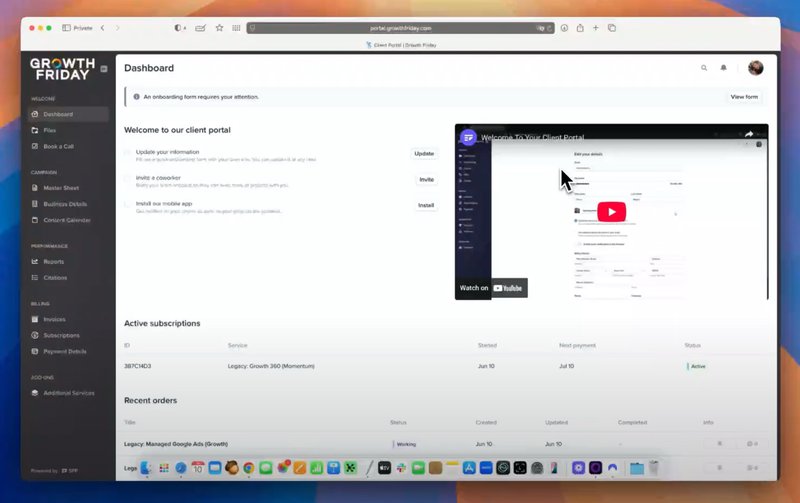
- Upcoming launch of our new Growth Friday Client Portal for enhanced customer support
That last one deserves more than a bullet point. We’re launching a brand-new, custom-built client portal to give you total transparency into your campaigns. KPIs, timelines, messaging calendars, content drafts, asset approvals, it’s all there. Real-time clarity, without the inbox chaos. Here’s a sneak peak:
To our existing clients.
If you’re already a Growth Friday client, first off - thank you. You’ve been part of the journey that got us here, and everything we’re building next is because of the work we’ve done together.
Your current services and campaigns will continue uninterrupted. Our team remains fully committed to delivering the same level of care, performance, and transparency you’ve come to expect. Nothing is being taken away.
That said, if you’re curious about how to get more out of your marketing, whether it’s leveling up visibility, introducing new strategies, or tying everything together under one plan - Growth 360 might be your next move. We’re happy to explore what an upgrade could look like if the timing and budget align.
We’ll be reaching out to you over the coming weeks to walk you through what’s new and how it could support your evolving goals.
The growth engine for professional firms.
If you’re a consultant, attorney, architect, or service firm tired of “random acts of marketing,” you’re not alone. Too many agencies pitch partial solutions: just SEO, just ads, just social. Others promise full-service but hand you off to an intern and disappear after onboarding.
Growth Friday is different. We’re equal parts strategist, operator, and long-term growth partner. Our Growth 360 model means every campaign works together and every dollar works harder.
Whether you’re looking to:
- Reduce reliance on referrals
- Scale content without bottlenecks
- Turn your expertise into leads
- Rank nationally in high-intent categories
- Show up in AI tools before your competitors
We’re built to help you get there.
What comes next.
We’re rolling out new service pages, smarter offers, fresh case studies, and new client resources to make working with us even easier. But most importantly, we’re doubling down on what built Growth Friday in the first place:
- Delivering clarity in a confusing industry
- No gimmicks. No fluff. Just real growth, built on a real strategy
If you’re ready to scale and want a partner who sees the big picture, not just the pixels, let’s talk.
LinkedIn profile optimization tips that actually work.
Your LinkedIn profile isn’t just a résumé. It’s a powerful, underused search asset. With the right LinkedIn profile optimization, you can turn a static page into a lead-generating, authority-building platform that surfaces in search results and earns more profile views.
Whether you're positioning for new opportunities, aiming to reflect deeper expertise, or trying to stand out in your industry, optimizing areas like your job title, professional experience section, and personal branding makes a measurable difference.
In this post, we’ll break down essential LinkedIn profile optimization tips, from choosing the right profile picture to crafting an engaging summary, so your profile doesn’t just show up, it stands out.
Unlock the Power of a Perfect LinkedIn Profile
Your LinkedIn profile page is often the first stop for prospective clients, collaborators, and partners. With proper LinkedIn profile optimization, it becomes a personal brand asset that works 24/7.
A truly optimized LinkedIn profile highlights your work experience, showcases your expertise, and positions you for more potential opportunities. Whether you're updating your job title, refining your professional experience section, or adding an engaging summary, small changes can lead to big gains in profile views and visibility in search results.
If you're ready to make a better profile that performs (not just exists), this guide will walk you through proven LinkedIn profile optimization tips to help you stand out, show up, and spark meaningful connections.
Why Ignoring LinkedIn Optimization Is Holding You Back
Simply having a profile isn’t enough. Without intentional LinkedIn profile optimization, you're missing real opportunities to grow your reputation, attract talent, and boost visibility in search results.
Enhance Your Professional Reputation and Visibility
A polished, optimized LinkedIn profile gives your brand an edge. Regularly update your professional experience section, share relevant milestones, and include an engaging summary that highlights your expertise. This transforms your profile into a dynamic, credible presence that stands out in your industry and earns more profile views.
Attract Exceptional Talent to Your Business
A polished, optimized LinkedIn profile gives your brand an edge. Regularly update your professional experience section, share relevant milestones, and include an engaging summary that highlights your expertise. This transforms your profile into a dynamic, credible presence that stands out in your industry and earns more profile views.

Maximize Your Reach: Proven LinkedIn Profile Optimization Strategies
Here are some proven strategies for optimizing your profile. Compare them against your current profile’s settings. Make any changes that will help you more effectively use the social media channel.
Selecting The Best Profile Picture
Your photo is the first thing people notice. It sets the tone for your entire LinkedIn profile page. For effective LinkedIn profile optimization, a polished, professional headshot is essential.
Choose a high-resolution image that clearly shows your face and shoulders. Skip selfies, group shots, or overly casual outfits. Dress to match expectations in your industry. Your goal is to convey confidence, friendliness, and credibility. A clean, uncluttered background helps keep the focus where it belongs: on you.
This simple but strategic LinkedIn profile optimization tip can immediately improve profile views, increase trust, and move you closer to the top LinkedIn profiles in your niche. It’s often the first impression that leads to new opportunities.
Using the Background Photo Effectively
Choose a background photo that represents your brand.
- Use high-quality and high-resolution images
- Keep it simple
- Tell a story
- Update it regularly
- Showcase your unique selling points
Create a Winning Profile Headline
A strong headline is one of the fastest ways to level up your LinkedIn profile optimization. It appears in search results, previews, and connection invites, so make it count. Use relevant industry terms, your job title, and key phrases that speak to your expertise. Keep it tight, clear, and benefit-driven to increase profile views and attract more potential opportunities.
Craft a Compelling “About” Section
Your “About” section is prime space for storytelling. Done right, it sets you apart from other top LinkedIn profiles. Start with a professional intro, outline what you do, and touch on your proudest milestones. A strong engaging summary backed by results gives your personal profile depth and direction. Keep it short, focused, and location-specific, so you connect faster with the right people.
Add Media Content
Want a quick win for your LinkedIn profile optimization? Upload rich media. Videos, images, or product demos can turn a static personal profile into an interactive brand experience. Whether you're a Java developer or business owner, use media to showcase process, results, or client impact. LinkedIn supports unlimited uploads, so let your work speak visually.
Organize Your Endorsements & Recommendations
Endorsements build authority fast. Pair them with specific job descriptions and real recommendations to reinforce your expertise. Whether it's a former manager or a happy client, testimonials boost trust and signal credibility, critical components of any strong professional social profile.
Include Every Aspect of Your Work Experience
Don’t skim over the professional experience section. List your most relevant roles, and keep each one aligned with your next job goal. Include educational background, key achievements, and any standout projects. A focused work history tells the algorithm, and your visitors, you’re legit. One bonus LinkedIn profile optimization tip: use concise, keyword-driven bullet points to align with linkedin search optimization best practices.
Highlight Skills and Education
Brag about your education and skills. Use keywords relevant to your field. List at least three primary skills in this section. As well, don't forget about certifications and licenses.
Use All Relevant Languages
Bilingual or multilingual? You can build your personal profile in multiple languages while keeping English as the default. Click “Add profile in another language” under your settings to appeal to global audiences and boost more potential opportunities.
Change Your Profile's URL
Your default LinkedIn profile URL is forgettable. Editing it takes seconds and instantly upgrades your professional social profile. Aim for a clean, branded URL that aligns with your name, role, or personal branding.
Take a Skills Assessment
Want to stand out in search results and boost your credibility? Take LinkedIn’s built-in skills assessments. Once you pass, your verified badge signals authority and commitment. It’s a fast, effective LinkedIn profile optimization tip that adds depth to your Linkedin profile page and can give you an edge in your next job search.
Watch Out for Buzzwords
Generic language doesn’t win attention or LinkedIn profile optimization points. Words like “results-driven” or “expert” are so overused they’ve lost meaning. Instead, focus on relevant content that reflects your actual value.
Use specifics. Speak directly to your strengths. This simple LinkedIn profile optimization tip can instantly improve how both people and search engines perceive your personal brand.
Use the Name Pronunciation Feature
If your name gets mispronounced often, use LinkedIn’s name pronunciation feature. It’s a low-effort, high-impact way to encourage connection and make outreach more human. Especially helpful when networking tips turn into real leads, this feature helps you build more potential opportunities with ease. And yes, it’s a standout move for general LinkedIn profile optimization.
Use the Article Feature
Publishing articles on LinkedIn is a great strategy. It’s one of the smartest moves you can make for LinkedIn profile optimization. Long-form posts help establish thought leadership, build authority, and unlock more potential opportunities.
Whether you're in creator mode or just getting started, use this space to share relevant content that resonates with your audience. Think “10 actionable tips” or behind-the-scenes insights your clients care about. Articles also give search engines more to index, which improves your overall LinkedIn search optimization and helps you show up more often in the right feeds.
One underrated LinkedIn profile optimization tip? Add a headline and preview that hooks. Because value isn’t just in what you say; it’s in how you deliver it.
Take Your Social Media Campaign to the Next Level
In a digital world with nearly 4 billion active users, social media is a growth engine. And when it comes to B2B visibility, LinkedIn profile optimization is the smartest place to start.
By applying the actionable tips above, from thoughtful headlines to curated media and strategic posting, you’re setting your brand up to engage the right people. With tools like LinkedIn profile analysis and even an AI-powered LinkedIn optimization tool, you can identify what’s working and where to improve.
Whether you're driven by passion, performance, or pipeline, optimizing your LinkedIn content helps the search algorithms work for you. Publish collaborative articles, align with high-intent keywords, and let your keywords power LinkedIn visibility. The payoff? More reach, more conversations, and more opportunities that convert.
Ready to Grow Your Brand with Confidence?
If you're serious about making LinkedIn (and social media at large) a strategic growth channel, not just a checkbox, Growth Friday is here to help. Our fully managed, data-backed campaigns are designed to attract high-quality leads, elevate your online presence, and drive measurable ROI.
Want to see how we can tailor a plan to your goals? Book a strategy call with our Founder, Daniel Harman. No fluff, no sales pitch; just expert insight and real direction.

Hiring a law firm SEO company? What to know before you sign.
In legal marketing, visibility equals viability. If your firm isn’t showing up where high-intent clients are searching, you're leaving signed cases on the table. That’s where the right law firm SEO company comes in.
Forget templated tactics. Today’s SEO for attorneys means aligning your website performance, local search presence, and content strategy with how clients actually search, from Google Business Profiles to organic search results. The right agency won’t just chase rankings. They’ll help you earn relevance in your specific practice areas and convert attention into action.
Not all SEO partners are built for law. In this guide, we’ll break down how to vet a strategic partner who can help your firm build real online visibility and deliver more than just traffic.
Local or National SEO?
Before partnering with a law firm SEO company, it's crucial to determine whether your firm needs local or national SEO strategies to attract potential clients effectively.
Local SEO is ideal if your firm primarily serves clients within a specific geographic area. It focuses on optimizing your law firm site for local search results, ensuring your services appear prominently when potential clients search for legal assistance in your vicinity. This includes managing your Google Business Profile, garnering positive online reviews, and ensuring your firm's information is consistent across local directories.
On the other hand, national SEO targets a broader audience across the country. If your firm offers specialized legal services that aren't confined to a single location, national SEO strategies can enhance your online visibility on a larger scale. This involves optimizing your website for broader keywords, creating high-quality content, and building backlinks from reputable websites to improve your search engine rankings.
Ultimately, the choice between local and national SEO depends on your firm's specific goals and the audience you aim to reach. A reputable law firm SEO company will assess your needs and develop a tailored strategy to maximize your firm's online presence and attract the right clients.
The importance of SEO for law firms
In today's digital landscape, potential clients increasingly turn to search engines to find legal services. If your firm isn't prominently visible in search engine results, you're missing opportunities to connect with those in need of your expertise.
Partnering with a reputable law firm SEO company can significantly enhance your firm's online presence. Here's how:
- Increased Website Traffic: By implementing a good SEO strategy, your firm's website can achieve higher rankings, attracting more visitors seeking legal assistance.
- Enhanced User Experience: Optimizing your website ensures faster load times and intuitive navigation, leading to improved website performance and user satisfaction.
- Elevated Brand Credibility: Consistent visibility in top search results builds trust, positioning your firm as a leader in the legal field.
Investing in SEO isn't just about rankings; it's about establishing authority, building trust, and ultimately driving growth for your firm.
SEO services available to law firms
Partnering with a specialized law firm SEO company can significantly enhance your firm's online presence. Tailored SEO services address the unique challenges of the legal industry, ensuring your firm stands out in a competitive digital landscape.
Key SEO services include:
- Keyword Research & Strategy: Identifying and targeting the most relevant terms that potential clients use when searching for legal services, ensuring your law firm site appears prominently in search results.
- On-Page Optimization: Enhancing website elements like meta descriptions, headers, and content to improve website visibility and align with best practices.
- Technical SEO: Addressing backend aspects such as site speed, mobile responsiveness, and crawlability to boost overall website performance.
- Content Marketing: Developing informative and engaging content that resonates with your audience, establishing authority and driving organic traffic.
- Local SEO Services: Optimizing your presence in local search results, including managing Google Business Profiles and building local citations to attract clients in your area.
- Website SEO Audit: Conducting comprehensive evaluations to identify areas for improvement, ensuring your SEO strategy remains effective and up-to-date.
By leveraging these services, your law firm can achieve higher rankings, increased traffic, and ultimately, more client engagements.
Find the right agency for your law firm
Choosing the right law firm SEO company is pivotal to enhancing your online presence and attracting more clients. With numerous agencies offering varied services, it's essential to identify one that aligns with your firm's specific needs and objectives.
Understand your requirements
Begin by assessing your current digital footprint. Are you aiming to improve your website rank, enhance optimized website content, or require comprehensive SEO support? Determine the areas needing attention, whether it's a thorough website SEO audit or targeted content creation.
Clarifying your goals will streamline the selection process, ensuring you partner with an agency that offers a tailored SEO strategy suited to your practice areas and business aspirations.
Remember, a strategic partnership with the right SEO team can significantly impact your firm's growth and visibility in the competitive legal landscape.
Look for a proven track record & results
The right law firm SEO company doesn’t just claim success; it shows it. Ask for case studies or metrics from similar legal websites. Have they helped a criminal defense lawyer increase qualified traffic? Did they lift website rank for a personal injury attorney in a saturated market?
Reputation matters, too. Check online reviews, client feedback, and even platforms like Clutch or Google Business for social proof. These real-world results will tell you more than any polished pitch.
Consider cost & payment plans
Not every firm needs the same SEO support or the same scope. That’s why top agencies offer flexible, scalable packages. Your investment should match your firm’s business goals, not someone else’s template.
Make sure pricing is transparent, payment plans are clearly defined, and you’re not locked into deliverables that don’t move the needle. A strategic partner will help you prioritize, not overpay.
What to expect from an SEO agency for a small law firm
A credible law firm SEO company won’t just offer a plug-and-play package. They’ll come in with a tailored SEO strategy rooted in your firm’s goals, niche, and competitive landscape.
From conducting a full website SEO audit to optimizing core service pages and refining your Google Business posts, the right partner should understand the nuances of legal websites. Whether you’re a criminal defense lawyer, personal injury attorney, or multi-practice firm, expect a team that delivers not just SEO support, but measurable improvements in website rank and lead quality.
In short: they won’t just know SEO. They’ll know your practice, too.
Competitor analysis & market research
Effective law firm SEO doesn’t happen in a vacuum. Competitor analysis and market research give you the clarity to move with purpose, not guesswork. It’s how we uncover the keywords, content gaps, and SERP positioning that your top competitors are leveraging and where they’re falling short.
We look at what drives visibility for similar attorney websites, from backlink profiles to search engine rankings, and we layer in market intelligence: what your prospective clients are searching, what answers they expect, and how they make decisions.
The result? A data-backed roadmap that sharpens your message, elevates your organic presence, and aligns your SEO efforts with actual business goals.
On-page & off-page optimization
Any law firm SEO company worth considering should talk to you about both on-page and off-page optimization, because without both, your visibility won’t stick.
On-page optimization means making sure the content and structure of your website are set up for success. This includes titles, meta descriptions, internal links, page speed, and the actual text on your service pages, especially if you're targeting terms like criminal defense lawyer or personal injury attorney. These elements help online search engines understand what your pages are about, so they can match you with the right searches.
Off-page optimization, on the other hand, focuses on building your reputation and reach beyond your site. Think of high-authority backlinks, media mentions, and even social proof. Done right, these signals show Google that your firm is credible, not just another listing on a lawyer search engine optimization results page.
Here’s the bottom line: a great SEO strategy balances both on-page best practices and off-page authority-building. If an agency is only talking about backlinks or only updating your blog, you’re not getting the full picture.
When we work on client websites, we treat SEO as one integrated system because that’s how Google sees it, too.
Link building & content creation services
If you’re comparing law firm SEO companies, ask them how they approach link building and content creation. The best agencies (not just the search engine guys) will tell you: these two tactics are most powerful when they work in tandem.
Link building is all about earning high-quality backlinks from credible sources—think legal directories, industry blogs, or local media. Each link acts like a digital referral, telling online search engines your site is trustworthy and worth ranking.
Content creation, meanwhile, is your firm’s opportunity to stand out. We’re not talking about generic blog posts written by other SEO agencies using AI on autopilot. We mean original, well-researched content that speaks directly to your ideal clients and aligns with website best practices.
Together, these two tactics build long-term equity for your site. You’ll gain more visibility in local search results, attract better-fit leads, and establish your firm as an authority.
Consistency is key. When we develop SEO strategies for our clients, content and links aren’t afterthoughts. They’re core pillars of a growth system designed to earn attention, build trust, and drive results.
Google My Business optimization & management
If you want to show up when someone types “lawyer near me,” your Google Business Profile (formerly Google My Business) better be working hard for you.
This free but often underutilized tool is one of the most direct ways to increase your law firm’s local visibility. And when managed well, it helps you stand out.
We help clients optimize every detail: from posting professional images and videos to updating services, hours, and legal specialties. We also monitor and respond to reviews (yes, even the awkward ones), track engagement, and publish regular posts that highlight your expertise.
Why does this matter? Because local search is where high-intent leads start. And your profile isn’t just a listing; it’s your firm’s first impression.
Don’t let a half-complete or out-of-date profile cost you clicks, calls, or consultations. With the right strategy behind it, your Google Business Profile becomes a quiet engine of visibility, reputation, and lead flow.
Monthly performance reports
A good law firm SEO company doesn’t just deliver results. They help you understand them.
Monthly performance reports shouldn’t be a confusing spreadsheet of numbers. They should give you a clear, strategic view of what’s working, what’s not, and what’s next. At Growth Friday, we track key metrics like organic traffic, search rankings, click-through rates (CTR), and engagement, all tied back to your firm’s goals.
But here’s the real value: we don’t just report data, we interpret it. We’ll show you how your performance stacks up against previous months and industry benchmarks, then pinpoint exactly where to adjust, from refining content for better local rankings to identifying new topic opportunities based on trending search behavior.
Too many other SEO agencies hide behind dashboards or flood you with vanity metrics. We do the opposite: clear, candid insights you can act on, delivered in plain English.
Because data is only powerful if it helps you make smarter decisions and that’s what we’re here to support.
Benefits of law firm SEO services
Let’s be clear: SEO isn’t a magic bullet. But when done right, by a law firm SEO company that understands your practice, your market, and your compliance needs, it can become your most cost-effective, high-performing growth channel.
Here’s why firms like yours keep investing in SEO with us:
1. More visibility where it counts most
When someone searches for a criminal defense lawyer or personal injury attorney in your area, being on page one matters. Smart SEO ensures your firm shows up in the right places, without relying solely on paid ads or expensive lead-gen platforms.
2. Higher-quality traffic (and more of it)
Not all clicks are created equal. We optimize for intent-rich searches, so the people finding you are already looking for legal help, not just browsing lawyer directories. That’s how SEO becomes a steady pipeline of real prospects.
3. Stronger lead quality and conversion
By aligning your content with what potential clients are actually searching for, you naturally attract better-fit leads. These aren’t cold contacts; they’re people already in decision mode. With a properly optimized site, you’ll see not just more traffic, but more qualified inquiries.
4. A meaningful edge over local competitors
Most small firms either don’t invest in SEO or they trust the wrong agency (the “search engine guys” promising page-one rankings in 30 days). Doing it right gives you a sustained, defensible advantage, especially in a saturated legal market.
5. Long-term growth, not short-term gimmicks
Unlike ads that stop the moment your budget does, SEO delivers compounding results. When built on website best practices and a strategy rooted in real data, your search presence becomes an asset that keeps paying dividends.
6. ROI you can actually measure
SEO isn’t just for big firms with massive budgets. When guided by the right team, it’s one of the most cost-effective marketing strategies available to small law firms. And with clear monthly reporting (yes, we do that), you’ll always know where your investment is going and what’s coming back.
Ultimately, law firm SEO services can provide an effective return on investment for any firm looking to increase its reach. If you're looking to improve your law firm's online presence, SEO is a powerful tool that can help you achieve your goals.
Boost your law firm's online presence with Growth Friday
The right SEO strategy doesn’t just get you more traffic. It delivers more of the right leads, strengthens your reputation, and compounds your ROI over time.
At Growth Friday, we specialize in helping law firms like yours unlock predictable, high-quality growth. From local and national SEO to Google Ads, social media, PR, website design, and more, our 360° marketing approach is designed to deliver real results, not just reports.
We’re here to make digital marketing feel less overwhelming and a lot more effective. Book a strategy call today to get started.

Top 10 local SEO strategies for more local leads.
When a qualified lead searches for a solution in their area, showing up in the local search results is only the beginning. What really drives action is relevance to your local intent, your business location, and your target audience’s actual needs.
Whether you're a law firm in Miami or a med spa in Malibu, the goal is the same: dominate visibility in specific geographic areas and convert that visibility into tangible business results. Effective local SEO work is more than optimizing a few pages. It’s about showing up at the right moment, for the right search, in the right zip code.
In this post, we’ll break down 10 proven local SEO strategies that do more than improve your local search rankings; they help you own your local market.
Keyword research and optimization.
Strong local SEO starts with understanding how your target audience actually searches. It’s not just about stuffing in location-specific keywords. It’s about matching real intent in real time.
To do that, you need to identify the terms tied to your services and your specific geographic areas. These are the phrases that drive clicks in the local search results, especially when combined with service type, need, or urgency.
Here’s how to approach it:
- Use tools like Google Keyword Planner, Semrush, or Ahrefs to uncover high-intent, geo-targeted queries.
- Build localized landing pages for each key city, region, or service area.
- Optimize title tags, H1s, and meta descriptions with relevant keywords tied to both service and location.
- Prioritize intent over volume. These are terms that reflect buying behavior, not just browsing.
Get this right, and you’re not just showing up. You’re showing up where it matters most.

On-page SEO techniques.
Think of your business website as your digital storefront. Every page needs to clearly tell search engines and your potential customers who you are, where you operate, and why they should trust you.
Strong on-page SEO is foundational to local search visibility. It improves your chances of appearing in map pack results and earns credibility with both Google and your local audience.
Key elements to optimize:
- Title tags and meta descriptions should include location-specific keywords and your core offering.
- Use schema markup to highlight business details like hours, address, and service areas.
- Add embedded maps and internal links to your localized landing pages.
- Keep content clear, relevant, and conversion-focused, not just optimized for bots.
It’s not about keyword stuffing. It’s about creating relevant content that reflects how your target audience searches and what drives them to act.
Building high-quality backlinks.
If content is what earns attention, backlinks are what build trust. And for local SEO, trust equals visibility. Getting featured on local citation websites, online directories, and industry-relevant publications strengthens your business online authority and signals to Google that you're legit in your space.
But it’s not just about quantity. You want links from sources that matter to your local community and reflect your niche.
Here’s how to build smart backlinks:
- Collaborate with similar local businesses for co-marketing or guest posts.
- Contribute insights to local news outlets or industry roundups.
- List your business details accurately across top local business directories.
- Look for local link opportunities on event sites, nonprofit partners, or regional chambers.
The payoff? More trust, better local search rankings, and ultimately, tangible business results.
Google Business Profile (GBP) optimization.
Your Google Business Profile (GBP) is often the first thing potential customers see, and it directly influences your appearance in map pack results and local search results. Done right, it becomes a high-impact driver of local search visibility and foot traffic.
To optimize effectively:
- Keep all business details accurate and consistent, from your name and address to hours and business categories.
- Post regularly using Google Posts to highlight updates, offers, or events.
- Encourage customer reviews and respond authentically to build social proof. Regular Google reviews not only build trust with potential clients but also signal credibility to search engines, improving visibility in local search results.
- Add photos, services, and FAQs to strengthen relevance and trust.
For service-driven businesses, your GBP isn’t just a listing; it’s a localized sales engine. The result? More clicks, more calls, and more business success from nearby searchers ready to convert.
Mobile optimization and user experience.
If your website loads slowly or fumbles on mobile, your local search rankings will suffer, no matter how optimized your content is. Today’s potential customers expect fast, frictionless access to business info on the go.
Mobile optimization supports both search engine results and user action. Google favors mobile-friendly pages, especially in map pack results, and mobile users are more likely to convert when UX is seamless.
What to focus on:
- Ensure responsive design across all devices for every business website page.
- Make contact buttons, directions, and key business details easy to find and click.
- Optimize load speed, minimize clutter, and use mobile-first layouts for relevant content and CTAs.
The payoff? Better visibility, better engagement, and tangible business results that start with one tap.
Content creation and optimization.
Effective local SEO is about saying the right things to the right people. Creating relevant content that aligns with local intent signals helps both search engines and your local audience recognize you as the go-to expert in your area.
From service pages to blog posts and FAQs, your content should be built around what your target audience is actually searching for in your specific geographic areas.
Here’s how to elevate your local content:
- Incorporate location-specific keywords naturally into headlines, meta tags, and body copy.
- Create localized landing pages for each service region or office location.
- Address local pain points, community events, or FAQs to build trust and local search visibility.
When done right, local content boosts rankings, nurtures trust, and drives tangible business results — without ever feeling forced.
Tracking and analyzing SEO performance.
If you're not measuring, you're guessing. And in local SEO, guessing wastes time and traffic. Real tangible business results come from ongoing performance analysis tied to visibility and user behavior.
To understand what’s working and where to double down track key indicators across your local search results:
- Monitor local search rankings for core services and location-specific keywords.
- Use platforms like Google Search Console and GA4 to assess online visibility, traffic, and conversion paths.
- Segment data by specific geographic areas to spot strengths, gaps, and emerging opportunities.
- Analyze relevant content performance: which pages attract traffic, drive calls, or generate form submissions?
SEO isn’t static. The best-performing brands evolve based on data, not assumptions.
Staying updated with SEO trends and algorithm changes.
Local SEO is evolving fast, and visibility depends on your ability to evolve with it. Algorithms no longer just reward keyword density or backlinks. Today, they prioritize relevance, context, and how well your content aligns with local intent.
That’s why staying current isn’t just good practice; it’s mission-critical. Businesses that monitor SEO shifts are more likely to sustain local search rankings, reach their target audience, and drive tangible business results.
Recent changes such as AI overviews, core updates, and features like Google Posts weighing heavier in the map pack results prove the point:
Bottom line? If you’re not optimizing for the way Google works today or how your local audience searches now, you’re falling behind. The strongest local strategies are built to flex: responsive, data-backed, and deeply connected to what drives discovery in your local area.
Final take: Local SEO Isn’t just tactics — It’s traction
The most effective local SEO strategies generate momentum. They elevate your business website from invisible to indispensable in specific geographic areas. They make your brand the one that shows up, stands out, and earns trust with both algorithms and potential customers.
Whether you're refining localized landing pages, optimizing your Google Business Profile, or pursuing smarter local link opportunities, every move should support one goal: real visibility that leads to real growth.
Not sure where your gaps are? Let’s map them out and turn your local presence into a competitive advantage. Book your strategy call with Growth Friday today!
Ready to finally grow with confidence?
At Growth Friday, we simplify digital marketing so you can focus on growing your professional service firm. Our team combines a full-channel, expert-led strategy with clear, actionable metrics to drive real results fast. Ready to transform your digital presence? Book your free strategy call today and discover 2–3 actionable wins to accelerate your growth.