Our marketing blog.
Observations, commentary, and editorial on everything digital marketing, from the Growth Friday team. From tips and advice, the latest trends, AI, and how this is affecting marketing, we have you and your practice covered!

Employment Law Marketing: A Practical Guide for Growth-Focused Firms in 2026
The employment law marketing landscape has shifted dramatically since 2020, and so has the way clients find and choose their attorneys. Whether your firm represents workers facing wrongful termination or advises employers on compliance, the rules of client acquisition have changed. This guide covers practical marketing strategies for employment law firms in 2026.
I'm Daniel Harman, Founder and CEO of Growth Friday. Our Growth 360 system is built specifically for professional service firms like law firms that need an integrated approach to client acquisition.
Why employment law marketing is different.
Employment law clients are different from other legal clients. They are often in distress, searching urgently for help after a workplace incident. They research extensively before choosing an attorney. They are influenced heavily by reviews, credentials, and case results. And they often have a narrow window in which they need to act.
This means employment law marketing needs to be both highly visible (to capture urgent searches) and highly trustworthy (to convert researchers into clients).
The core channels of employment law marketing.
Local SEO: being found when clients search.
For most employment law firms, local SEO is the highest-ROI marketing channel. When someone searches "employment lawyer near me" or "wrongful termination attorney in [city]," they are ready to hire. The foundation of employment law local SEO is your Google Business Profile. For more local SEO strategies, read our guide on Top 10 Local SEO Strategies for More Local Leads.
Content marketing: building authority and trust.
Employment law clients research extensively before choosing an attorney. Content marketing is how you answer their questions and build trust before they ever contact you. Effective employment law content includes:
- Educational guides explaining employment law concepts in plain language
- FAQ pages addressing common client questions
- Case result summaries (where permitted by bar rules)
- Blog posts explaining recent changes in employment law
For a deeper dive into content strategy, read our guide on cluster content strategy.
Paid media: capturing urgent searches.
Our Google Ads service is built to drive new client inquiries, not just clicks. For employment law firms, Google Ads are particularly effective for capturing urgent searches like "wrongful termination lawyer" or "employment discrimination attorney." For more on Google Ads management, read our guide on Google Ads management services.
Website UX: converting visitors into consultations.
Your website needs to be built to convert visitors into booked consultations. Our Website Design and UX services are built to maximize conversion rates for professional service firms. For more on building trust through your digital presence, read our guide on how to build brand trust.
AI visibility: the new frontier of legal marketing.
As AI assistants become more prevalent in the client research process, appearing in AI-generated responses is becoming a new form of visibility. Our AI SEO service helps law firms build the kind of authority that earns mentions in AI responses.
Building an integrated employment law marketing system.
At Growth Friday, our Growth 360 system integrates local SEO, content marketing, paid media, and user experience into one unified strategy. See how we've helped law firms grow in our client showcase. Ready to build an employment law marketing system that drives consistent new client acquisition? Book your Growth Strategy Call today.
Recent blog posts

Pasadena's digital pulse: exploring Facebook Ads and local presence.
Facebook ads Pasadena campaigns offer local businesses the best opportunity to reach their ideal customers right where they spend their time. Here's what you need to know:
- Hyper-local targeting: Reach Pasadena residents by zip code, interests, and behaviors
- Cost-effective reach: A $50 daily budget can expose your ad to approximately 10,000 people
- Proven influence: 57% of consumers say social media influences their shopping decisions
- Multiple ad formats: Choose from photo, video, carousel, lead generation, and more
With more than 65% of U.S. adults using Facebook, and social media directly influencing over half of all shopping decisions, Pasadena businesses can't afford to ignore this channel. Facebook ads show up on a user's feed based on their interests and web activity, targeting users who have already shown interest in your business or similar companies.
Growth Friday offers holistic, AI-powered digital marketing systems and human-led strategy for professional service firms and local businesses. To explore how paid social can amplify your local presence, learn more about our Paid Media services and specifically our Meta Ads management.
Why Your Pasadena Business Needs Facebook Ads
For Pasadena businesses, Facebook advertising is a strategic imperative. One of the most compelling benefits is hyper-local targeting. Unlike traditional advertising's wide net, Facebook allows us to pinpoint your ideal audience with precision based on location (down to specific Pasadena zip codes), demographics, interests, and behaviors.
Beyond direct sales, Facebook ads build community credibility and drive foot traffic. By consistently appearing in local residents' feeds with engaging content, your brand becomes familiar and trustworthy. Leveraging Facebook ads provides a significant competitive advantage in Pasadena's busy marketplace. To explore how paid social can amplify your local presence, learn more about our Paid Media services.
Connecting with the Pasadena Community
Effective Facebook ads Pasadena campaigns start with understanding the local community. Pasadena has unique demographics, cultural touchpoints, and events that shape residents' interests. Facebook's targeting capabilities allow us to define your audience with incredible granularity — targeting by zip code, interests, and behaviors that resonate with residents, such as people who follow the Rose Bowl, Pasadena Playhouse, or local art festivals.
The Power of Social Proof and Influence
What people say about your business online often holds more weight than what you say about yourself. This is the power of social proof, and Facebook ads are an excellent vehicle for using it. A compelling statistic: 57% of consumers say social media influences their shopping. We leverage customer testimonials within your Facebook ad campaigns to dramatically increase conversion rates by building trust and demonstrating real-world value.
Getting Started: Your First Facebook Ad Campaign
The core components involve defining what you want to achieve, who you want to reach, and how much you're willing to spend. A crucial technical step is setting up the Facebook Pixel. This small piece of code, installed on your website, allows Facebook to track user activity, which is vital for optimizing your ads and retargeting efforts. Facebook itself offers a comprehensive Guide to Facebook Ads Manager that can help you navigate the platform.
Defining Your Target Audience in Pasadena
The magic of Facebook ads Pasadena lies in its unparalleled ability to target specific audiences:
- Core Audiences: Built using demographic data (age, gender, location in Pasadena), interests, and behaviors.
- Custom Audiences: Created from data you already own — customer lists, website visitors (via the Facebook Pixel), or people who engaged with your Facebook or Instagram page.
- Lookalike Audiences: New people on Facebook who share similar characteristics with your existing customers.
Setting Clear Objectives and Budgets
Facebook ads operate on a flexible budget, with a minimum daily spend of just $5. For a deeper dive into how we manage and optimize paid advertising, explore our services related to Meta Ads.
Crafting Effective Facebook Ads Pasadena Campaigns
An effective Facebook ad is more than just an image and text. A critical component is A/B testing — creating multiple ad versions with slight variations and running them simultaneously to see which performs best. Retargeting strategies are also indispensable for bringing interested prospects back to your site.
Strategies for Lead Generation and Conversion
For many Pasadena businesses, the goal is to generate qualified leads and drive conversions. One effective method is using Facebook Lead Forms — integrated into the ad, allowing users to submit contact information without leaving Facebook. We also create excitement by offering special offers for Pasadena residents and promoting local events. For more strategies on how to integrate your social media efforts, check out our insights on social media content marketing.
Measuring Success and Avoiding Common Mistakes
Running Facebook ads Pasadena campaigns is only half the battle; the other half is measuring their success and learning from the data. Key metrics we focus on include:
- Cost Per 1,000 Impressions (CPM): The cost to show your ad to 1,000 people.
- Click-Through Rate (CTR): How often people click on your ad after seeing it.
- Cost Per Lead (CPL): How much it costs to acquire a single lead.
- Return On Ad Spend (ROAS): The revenue generated for every dollar spent on ads.
The Synergy of Paid and Organic Social Media
Many businesses ask if they should focus on paid Facebook ads or organic social media content. Our answer? Both! For Pasadena businesses, a holistic digital strategy integrates the best of both worlds. Organic social media content is vital for building a loyal and engaged audience, while paid Facebook ads provide the necessary boost to ensure your valuable organic content gets seen by more people. For more strategies on integrating your social media efforts, check out our insights on social media content marketing.
Conclusion
Strategic Facebook ads Pasadena campaigns offer unparalleled hyper-local targeting, the ability to connect with niche communities, and the power to influence purchasing decisions. At Growth Friday, we blend holistic, AI-powered digital marketing systems with human-led strategy to ensure your Facebook ads efforts deliver 360° growth and earn lasting trust.
Ready to unlock the full potential of Facebook advertising for your Pasadena business? Contact our Pasadena team to start your campaign today, or book your Growth Strategy Call.

Master BigCommerce design and create an online experience your customers will love.
BigCommerce web design is the art and science of creating an online store that delivers a compelling user experience, showcases your brand, and drives conversions. It combines visual appeal with intuitive navigation, mobile responsiveness, fast performance, and trust-building elements to guide customers toward a purchase.
Effective design encompasses everything from theme customization and UX optimization to performance tuning, SEO-friendly architecture, and strategic integrations. The numbers prove its importance: 48% of internet users say design is the most important factor in judging a business's credibility, and 57% won't recommend a company with a poorly designed mobile site.
Great design isn't just about aesthetics; it's about creating a cohesive experience that anticipates customer needs and removes every obstacle to buying. The stores that win have logical navigation, fast load times, and checkout processes that inspire confidence. Whether you're launching, migrating, or refreshing your site, effective web design will directly impact your revenue and customer loyalty.
Core Principles of Effective BigCommerce Web Design
Effective BigCommerce web design is built on core principles that create a storefront that connects with customers and drives sales. A user-centric approach is paramount. Designing with your customer's journey in mind makes every interaction seamless and enjoyable, which directly impacts credibility. For a deeper dive into user experience, you can find more info about UX on our site.
Creating User-Friendly Navigation
Intuitive navigation is the backbone of a successful BigCommerce web design. It ensures customers can easily find what they're looking for, reducing friction and encouraging exploration. Key elements include:
- Simple Menus & Logical Categories: Keep navigation concise and organize products into intuitive groups.
- Breadcrumbs & Search: Use breadcrumbs to show users their location and provide a prominent search bar for direct access.
- Clear CTAs & Footer: Employ visually distinct calls to action (CTAs) and use the footer for secondary links like "About Us," "Contact," and policies.
The Impact of Mobile Responsiveness
Mobile responsiveness is a necessity. Your BigCommerce web design must adapt seamlessly to any screen size, from desktops to smartphones. A true mobile-first approach involves ensuring a consistent brand experience, using CSS to optimize layouts for different devices, and designing touch-friendly elements. We test our designs rigorously across devices to guarantee a flawless user experience, no matter how customers access your site.
Building Your Store: Themes, Customization, and Key Features
BigCommerce provides a robust foundation for building an online store with powerful tools for creating a unique presence. At its heart are BigCommerce themes, the visual starting point for your site. These can be customized using the Page Builder, a drag-and-drop interface for designing pages without code. For more insights, check out our website design services.
Custom vs. Pre-Made Themes: A BigCommerce Web Design Dilemma
Choosing between a pre-made theme and custom development is a key decision in your BigCommerce web design journey:
- Pre-Made Themes: These are budget-friendly and allow for a fast launch. They are a great starting point and can be customized using the Page Builder. However, your design won't be entirely unique, as other stores may use the same theme.
- Custom Development: This path offers complete creative control, allowing you to build a store that perfectly aligns with your brand vision and integrates unique features. Custom builds require a larger budget and a longer timeline, but the result is a one-of-a-kind, high-performance storefront.
Advanced Customization and Integrations
BigCommerce's true power is its extensibility. Its open API allows for seamless integrations with third-party applications and business systems (ERP, CRM), making your store a fully integrated part of your operations. For businesses with specific needs like product configurators, B2B features, or a desire for a lightning-fast headless commerce architecture, custom apps and integrations are essential.
Optimizing for Performance, SEO, and Trust
A beautiful BigCommerce web design is just the start. To succeed, your store must perform flawlessly, rank high in search results, and earn customer trust. Site speed is a perfect example. Slow loading times kill conversions and harm search rankings. For ongoing support, learn more info about Website Maintenance.
How BigCommerce Web Design Contributes to SEO
A well-structured BigCommerce web design is the foundation of your SEO. It helps your site rank higher and attract more organic traffic in several ways:
- Technical SEO: A good design facilitates clean code, logical URL structures, and fast load times. Mobile-friendliness is also a major ranking factor that's built-in with responsive design.
- User Engagement: An intuitive design keeps users on your site longer, reducing bounce rates. These positive engagement signals tell search engines your site is valuable, boosting its authority.
- Content & Data: Design allows for the effective placement of on-page SEO elements (titles, meta descriptions) and the implementation of structured data (Schema Markup), which can create eye-catching rich results in search. Learn more with our Content Marketing Company Complete Guide.
Building Trust and Credibility
In e-commerce, trust is the currency of conversion. We build trust by integrating key elements into your design:
- Social Proof: Prominently display customer reviews and testimonials.
- Transparency: Make contact information and an "About Us" page easy to find.
- Security: Use visible security badges and SSL certificates to reassure customers their data is safe.
- Professionalism: A polished, consistent design across all pages reinforces your brand's reliability.
Strategy and Implementation: Bringing Your Vision to Life
A successful BigCommerce web design is about strategic execution that aligns with your business goals. At Growth Friday, our methodology ensures your online store is a powerful engine for growth. This strategic approach is central to our work as a Branding and Web Design Agency.
Choosing the Right BigCommerce Web Design Company
Selecting the right partner for your BigCommerce web design is critical. Here's what to look for:
- Portfolio and Reviews: Review their past BigCommerce projects and client testimonials to gauge quality and reliability. We proudly share our case studies to illustrate our impact.
- Technical Expertise: Ensure they are experts in the BigCommerce Stencil framework, API, and custom development.
- Strategic Approach: Look for an agency that offers strategic guidance on SEO and conversion optimization, not just a website build.
At Growth Friday, we build integrated digital experiences designed for measurable growth. Our holistic, AI-powered systems and human-led strategy focus on delivering 360° growth, not just traffic.
Conclusion
Mastering BigCommerce web design means strategically crafting an online experience that captivates your audience, reflects your brand, and drives conversions. From user-centric principles and mobile responsiveness to the power of themes and custom integrations, every element contributes to SEO, performance, and customer trust.
At Growth Friday, our holistic, AI-powered systems and human-led strategy ensure your BigCommerce web design is a dynamic component of your growth strategy. In a competitive landscape, the right design is an investment in your brand's future, fostering trust, loyalty, and sustainable growth.
Let us help you unlock the full potential of your e-commerce presence. Transform your online store with our expert Website Design services or book your Growth Strategy Call today.
Clustering for clicks: everything you need to know about content strategy.
A cluster content strategy organizes your website's content around central topics (pillar pages) with supporting subtopics (cluster pages) all connected through internal links. This approach helps search engines understand your expertise, improves rankings, and guides users to the information they need.
Key components:
- Pillar page - A comprehensive overview of a broad topic
- Cluster pages - In-depth content on specific subtopics
- Internal links - Connections that tie everything together
- Topical authority - Proof to search engines that you're an expert
Benefits:
- Better search rankings through topical authority
- Improved user experience and navigation
- Higher engagement and longer time on site
- Reduced keyword cannibalization
- Easier content planning and maintenance
Most professional service firms have the same problem: a blog full of scattered posts that don't connect, don't rank, and don't convert. The topic cluster model solves this. It gives your content a logical, scalable structure that helps search engines understand what you're about and helps users find what they need. The result is better rankings, longer time on site, and more qualified leads.
The Foundation: What Are Topic Clusters and Why Do They Dominate SEO?
At its heart, a topic cluster is a set of content semantically organized around a core topic. This core topic lives on a "pillar page," which then links out to various "cluster pages" that dig into subtopics. All content in the set is hyperlinked together, creating a powerful web of interconnected information.
This approach helps establish topical authority, which is a website's perceived expertise and depth of knowledge on a particular subject. When Google sees that you've covered a topic exhaustively and logically, it views your site as a trusted resource. This aligns perfectly with Google's E-E-A-T guidelines (Experience, Expertise, Authoritativeness, and Trustworthiness), which prioritize content that demonstrates clear authority.
The Core Components of a Topic Cluster
Think of a topic cluster like a wheel:
- Pillar Content (The Hub): A comprehensive, high-level overview of a broad subject. It's often long-form (3,000+ words) and acts as the central anchor for both users and search engines. For example, a pillar page for Growth Friday might be "The Ultimate Guide to Digital Marketing for Professional Service Firms."
- Cluster Content (The Spokes): Individual articles, blog posts, or pages that dive deep into specific subtopics. Each cluster page focuses on a narrower aspect of the main topic, targeting long-tail keywords and specific user intents. For example, cluster pages could be "Local SEO Strategies for Law Firms" or "AI-Powered Content Marketing for Financial Advisors."
- Internal Links (The Connections): The hyperlinks that tie your pillar and cluster pages together. Every cluster page links back to the pillar page, and the pillar page links out to all relevant cluster pages.
Your Blueprint for a Winning Cluster Content Strategy
Step 1: Identifying Core Topics and Pillar Pages
The first and most crucial step is to define the broad, overarching topics that will serve as your pillar pages. These should be central to your business, align with your services (like AI SEO or Content Marketing), and address key pain points of your ideal clients.
- Buyer Personas and Business Goals: Start by deeply understanding your target audience. What are their biggest questions? What problems do they need solved? Your pillar topics should directly address these needs and align with your firm's revenue-generating services.
- Keyword Research & Competitor Analysis: Use advanced keyword research tools to identify high-volume, broad keywords that represent significant topics for your business. We often use tools like Answer the Public to uncover a wealth of user questions related to our core topics.
Step 2: Mapping Subtopics and Cluster Content
Once your pillar topics are identified, it's time to brainstorm the supporting cluster content. These are the deeper dives into specific aspects of your pillar topic.
- Long-Tail Keywords and User Questions: Conduct thorough keyword research to find long-tail keywords, specific questions, and related subtopics that branch off your pillar. For instance, if your pillar is "Local SEO for Professional Service Firms," subtopics could include "Top 10 Local SEO Strategies for More Local Leads" or "Optimizing Google Business Profile for Law Firms."
- Content Gap Analysis: Review your existing content and your competitors' content to identify gaps. What specific questions aren't being answered comprehensively?
Step 3: Creating High-Quality Content and Structuring Internal Links
With your topics and subtopics mapped, it's time to create the content and weave it all together with strategic internal linking.
- Using Descriptive Anchor Text: Internal linking is the backbone of a cluster content strategy. When linking from a cluster page back to its pillar, use descriptive anchor text that clearly indicates what the linked page is about.
- Linking from Cluster to Pillar: Every cluster page should link back to its main pillar page, ideally 1-3 times within the content. This reinforces the pillar's authority on the broader topic.
- Linking from Pillar to Cluster: The pillar page should link out to all its supporting cluster pages through a table of contents, a "related topics" section, or contextual links within the pillar's main text.
To learn more about how we can help you craft compelling content, explore our Content Marketing services.
Scaling and Measuring Your Cluster Content Strategy
Auditing and Repurposing Existing Content
Before you start creating entirely new content, look at what you already have. Many firms have a wealth of existing content that can be repurposed or integrated.
- Content Audit Process: Conduct a thorough content audit to inventory all your existing blog posts, articles, and pages. Group them by topic and identify their target keywords.
- Merging Thin Content: You might find several short, similar articles that could be merged and expanded into a more robust cluster page, or even contribute to a new pillar page. This helps prevent keyword cannibalization and consolidates authority.
Measuring Success and Proving ROI
With topic clusters, we focus on several key performance indicators (KPIs):
- Pillar Page Rankings: Monitor the search engine rankings for your pillar pages' primary keywords. As your clusters gain authority, you should see these rankings improve.
- Organic Traffic Growth: Track the overall organic traffic to your website and specifically to your topic clusters.
- Conversion Rates: Track how traffic from your topic clusters contributes to lead generation and sales.
- Backlink Acquisition: As your topic clusters establish authority, they naturally attract high-quality backlinks from other reputable sites.
Common Mistakes to Avoid
- Thin Content: Creating cluster pages that don't add unique value or merely rehash points from the pillar page.
- Ignoring User Intent: Over-optimizing for keywords without considering the user's underlying intent.
- Decaying Internal Links: Letting your internal linking structure fall apart over time. Regularly audit and maintain your links.
- Set-It-And-Forget-It Mentality: Your pillar page isn't a static asset. It should evolve with new information, trends, and user needs. Regularly review and update your clusters (every 6-12 months).
Frequently Asked Questions about Topic Clusters
How many cluster pages should a pillar page have?
There's no magic number, but a good rule of thumb is to aim for five or more subtopic articles for each core topic. Some robust pillar pages can support 20-30 related posts! The key is to have enough cluster pages to thoroughly cover the subtopics and establish comprehensive authority without creating "thin" content.
How long does it take for a topic cluster strategy to show results?
While SEO is a long-term game, we often see positive shifts within 3 to 6 months. The exact timeline depends on factors like your industry's competitiveness, your domain authority, the quality of your content, and the consistency of your implementation. However, the structured, authority-building nature of a cluster content strategy provides a much more predictable path to ranking improvements than scattered content.
Conclusion: Build Authority, Not Just a Blog
The digital landscape is constantly evolving, with search engines growing smarter and user behavior becoming more nuanced. In this environment, a fragmented, keyword-first approach to content simply won't cut it. Our cluster content strategy offers a powerful, future-proof solution, allowing professional service firms to establish unrivaled topical authority and achieve sustainable long-term growth.
At Growth Friday, we understand that you're not just looking for more traffic; you're looking for 360° growth driven by trust and authority. Our expertise in holistic, AI-powered digital marketing systems and human-led strategy helps you implement an effective cluster content strategy that transforms your online presence.
Ready to build a content strategy that drives results? Explore our Content Marketing solutions and let's start building your authority, one cluster at a time. Book your Growth Strategy Call today.

Your guide to choosing the right branding and web design agency.
A branding and web design agency creates the strategic foundation and digital presence that defines how customers perceive and interact with your business.
What a branding and web design agency delivers:
- Brand Strategy – Positioning, messaging, and visual identity that differentiate you in the market
- Web Design & Development – User-focused websites built for conversion and performance
- Integrated Marketing – SEO, content, and paid media that amplify your brand across channels
- Measurable Results – Clear KPIs like conversion rates, traffic growth, and brand recall
Key selection criteria:
- Portfolio with proven results in your industry
- Transparent process and dedicated team structure
- Third-party validation (Clutch reviews, BBB accreditation)
- Full-service capabilities to avoid vendor sprawl
The right agency doesn't just build websites—they turn your digital presence into a revenue-generating asset. Companies that invest in professional branding see an average revenue increase of 23%, while well-designed websites are 60% more likely to attract customers than DIY alternatives.
This guide walks through exactly how branding and web design agencies create lasting value, what services matter most, how to vet potential partners, and what trends are reshaping the industry.
1. The power duo: How branding and web design work together.
Imagine your business as a person. Branding is its personality, values, and how it communicates. Web design is its outfit, how it moves, and how easily you can talk to it. A great branding and web design agency ensures these two aspects aren't just aligned but are deeply integrated, creating a seamless and compelling digital identity. For more insights into creating exceptional digital experiences, explore our resources on UX design.
What is branding?
Branding goes far beyond a logo. It's the strategic process of shaping how your audience perceives your business. This includes crafting your brand identity—your visual elements like logo design, color palette, and typography—and developing your brand's unique voice and messaging. Companies that invest in robust branding strategies often see an average revenue increase of 23%.
What is web design?
If branding is the "why," then web design is the "how." It's the process of creating your website's visual appeal, layout, and functionality. A well-designed website isn't just visually appealing; it performs. This attention to detail is critical, as over 88% of online consumers are less likely to return to a site after a bad experience. Your website isn't just a digital brochure; it's a powerful growth tool.
2. Core services of a full-service branding and web design agency.
Working with a full-service branding and web design agency offers distinct advantages. It means your brand message remains consistent across all touchpoints, from your initial strategy to the final website launch and ongoing marketing efforts.
Foundational branding services.
- Brand Strategy & Positioning: We begin by deeply understanding your business and your customers. This involves in-depth stakeholder and customer research, market analysis, and competitor analysis to define your unique brand strategy and positioning.
- Visual Identity Design: We design compelling logos, select harmonious color palettes, and choose appropriate typography that reflects your brand's essence. We also create comprehensive brand style guides that ensure consistency across all your content marketing efforts.
Web design and development services.
- UX/UI Design: Our approach is user-centric, focusing on reducing friction and increasing adoption. We conduct thorough UX audits to understand user behavior, evaluate site structure, usability, and performance.
- Website Design & Custom Development: We build high-performance, custom websites tailored to your unique business needs, avoiding generic templates. All our designs are responsive, ensuring a seamless user experience across all devices.
- Website Maintenance: Our partnership doesn't end at launch. We offer ongoing support and maintenance to ensure your website remains secure, updated, and performs optimally.
Integrated digital marketing services.
- Search Engine Optimization (SEO): We implement comprehensive SEO strategies that compound growth across your brand, corporate, and product pages. This involves auditing technical health, structuring content around buyer intent, implementing schema markup, and aligning your Google Business Profiles for Local Pack visibility. For more details, check out our Organic Search solutions.
- Paid Media: We develop strategic paid media campaigns, including social media ads, to drive targeted traffic and accelerate your business goals.
3. How to choose the right agency for your business.
Choosing the right branding and web design agency is a critical decision. Here's how to vet potential partners:
Evaluate their portfolio and case studies.
- Industry Experience: Does the agency have a proven track record in your specific industry? An agency with relevant experience will better understand your target audience and market dynamics.
- Measurable Results: Beyond pretty pictures, can they demonstrate how their solutions improved metrics for clients? We proudly share our case studies to illustrate our impact.
Check for accreditation and reviews.
- Client Testimonials & Reviews: Look for genuine feedback from past clients on platforms like Clutch for a balanced perspective.
- BBB Accreditation: An A+ rating with the Better Business Bureau (BBB) can signal a commitment to ethical practices and customer satisfaction.
- Review our client testimonials to understand the real-world impact we've had on businesses like yours.
4. The future of digital identity: trends and measurement.
How a modern branding and web design agency measures success.
- Conversion Rates: Our designs are built with conversion optimization in mind. Websites designed for conversion can see a remarkable 200% increase in conversions.
- Bounce Rate: We optimize for low bounce rates through intuitive UX, fast loading speeds, and engaging content.
- Analytics Tools: We leverage advanced analytics tools like Google Analytics and heatmapping software to gain deep insights into user behavior and identify areas for continuous improvement.
Future trends shaping the role of a branding and web design agency.
- AI-Powered Personalization: Artificial intelligence is revolutionizing user experiences through personalized content and dynamic user interfaces.
- AI SEO: AI is changing how we approach search engine optimization, allowing for more nuanced keyword research, content optimization, and predictive ranking strategies.
- Accessibility (WCAG): Designing for inclusivity is not just a trend but a necessity. We prioritize WCAG compliance to ensure your website is accessible to all users.
Frequently asked questions about branding and web design agencies.
Should I hire a freelancer or an agency?
While a freelancer might be suitable for very small, defined tasks, a branding and web design agency like us offers a comprehensive, integrated approach with a diverse team of experts. We provide structured project management, ensure service quality through regular reviews and testing, and offer post-launch support. This holistic approach is designed for businesses seeking scalable growth and a unified digital strategy.
Conclusion: Building a brand that lasts.
In today's competitive digital landscape, a powerful brand and a high-performing website are indispensable assets. The synergy between branding and web design is essential for creating a cohesive, memorable, and effective digital identity.
At Growth Friday, we pride ourselves on building holistic, expert-led strategies that earn trust and drive scalable growth for professional service firms. We leverage AI-powered digital marketing to differentiate your brand and ensure your online presence isn't just impactful today, but also future-proofed for tomorrow.
Ready to transform your digital identity into a powerful growth engine? Explore our expert website design services or book your Growth Strategy Call today.

Beyond the buzz: what a content marketing company can do for you.
A content marketing company is a specialized agency that helps businesses create, distribute, and optimize content to attract audiences, build trust, and drive measurable business growth.
What they do:
- Develop strategic content plans aligned with your business goals
- Create high-quality content (blogs, videos, infographics, email campaigns)
- Optimize content for search engines and AI platforms like ChatGPT
- Measure performance and adjust strategies based on data
Key benefits:
- Scale content production without hiring full-time staff
- Access to expert strategists, writers, and SEO specialists
- Data-driven approach to maximize ROI
- Integrated strategies across multiple channels (SEO, social, email, PR)
The landscape is changing fast. With AI reshaping search and content discovery, businesses are investing more because strategic content marketing delivers measurable results — not just traffic, but real revenue growth.
Defining a modern content marketing company.
In today's crowded digital landscape, a modern content marketing company is far more than just a content creation factory. For professional service firms looking to build authority and generate qualified leads, this means translating complex services into digestible, valuable content that positions you as the definitive authority in your field. We differentiate ourselves from agencies that merely "sell tactics" by focusing on the holistic picture — how every piece of content contributes to your overarching goals. You can learn more about how we approach Content Marketing here.
The core benefits: moving beyond just traffic.
While increased website traffic is a welcome outcome, it's just one piece of the puzzle. The true value of partnering with a dedicated content marketing company lies in its ability to drive deeper, more meaningful results:
- Scalable Growth: Building a content engine that consistently attracts and converts qualified leads, allowing your business to expand sustainably without constantly pouring money into fleeting ad campaigns.
- Industry Authority: By consistently publishing high-quality, expert-led content, we help establish your firm as a thought leader. This aligns directly with Google's E-E-A-T guidelines, which are crucial for ranking and building credibility.
- Increased Conversions: Our strategies are designed not just to attract eyeballs, but to guide prospects through the buyer's journey, changing casual readers into loyal clients.
- Cost-Effectiveness: Over time, content marketing offers a significantly higher ROI than many traditional marketing channels, as content assets continue to work for you long after publication.
How agencies drive real business growth.
A truly effective content marketing company understands that content plays a vital role at every stage of the customer journey. We carefully plan content to address specific needs at each step:
- Top-of-Funnel Awareness: Informative blog posts, captivating infographics, and engaging social media content that answers common questions and establishes your presence.
- Mid-Funnel Lead Nurturing: In-depth content like whitepapers, case studies, and email marketing campaigns that demonstrate your expertise and build trust.
- Bottom-of-Funnel Sales: Compelling sales collateral, client testimonials, and detailed service pages that showcase your value proposition and encourage conversion.
- Customer Retention & Advocacy: Content that supports existing clients, fostering loyalty through exclusive resources and community-building on social media.
How to choose the right partner for your business.
Choosing the right content marketing company is akin to selecting a strategic partner for your business. Here are the critical factors to consider:
- Industry Expertise: Does the agency truly understand your niche? For professional service firms, generic marketing rarely yields optimal results. Look for a content marketing company that has experience working with businesses similar to yours — for example, a law firm will benefit from a partner experienced in law firm SEO, while a medical spa needs expertise in medical spa marketing.
- Proven Track Record: Ask for concrete examples of their success. A reputable content marketing company should be able to provide detailed case studies demonstrating how they've helped other clients achieve their goals.
- Comprehensive Services: Ensure the agency offers a full suite of services that align with your needs, from strategy development and content creation to distribution, SEO, and analytics.
- Communication Style & Transparency: How do they communicate? Are they proactive, or do you have to chase them for updates? A strong partnership is built on open, honest, and regular communication. Platforms like client portals for marketing agencies can significantly improve transparency and project management.
Red flags to watch out for.
- Guaranteed Rankings: No legitimate SEO or content marketing company can guarantee specific search engine rankings. Promises of "first page in 30 days" are often unrealistic.
- Lack of Transparency: If an agency is vague about their processes, reporting, or pricing, it's a cause for concern.
- One-Size-Fits-All Strategy: Every business is unique, and so should its content strategy. An agency that offers generic solutions without taking the time to understand your specific goals is unlikely to deliver effective results.
- No Data-Driven Approach: Content marketing without data is like sailing without a compass. If an agency can't explain how they measure success, they may be operating on guesswork.
A look inside: services, costs, and measuring success.
Common services offered by a content marketing company.
A comprehensive content marketing company offers a diverse range of services:
- SEO Content Strategy & Creation: Blog posts, articles, and website copy optimized for search engines. Our Organic Search solutions are at the core of this.
- Email Marketing: We develop and execute email marketing campaigns, including newsletters, lead nurturing sequences, and promotional emails.
- Social Media Content & Strategy: Crafting engaging posts for platforms like Facebook, LinkedIn, and Instagram. Explore our Social Media solutions.
- Public Relations (PR) & Thought Leadership: Positioning your firm as an industry leader through press releases and media outreach. Our PR services help amplify your expert voice.
- Website Content & UX Writing: Crafting persuasive and user-friendly content for your website, ensuring a seamless user experience that guides visitors towards your desired actions.
Measuring what matters: key performance indicators (KPIs).
At Growth Friday, we believe that effective content marketing is data-driven. We track performance carefully against clearly defined KPIs:
- Website Traffic: We analyze unique visitors, page views, and traffic sources.
- Conversion Rates: We track how many visitors complete desired actions, such as filling out a contact form or downloading a resource.
- Lead Quality & Quantity: For professional service firms, generating high-quality leads is paramount. We assess not only the number of leads but also their fit with your ideal client profile.
- Search Rankings: We monitor your content's position in search engine results pages (SERPs) for target keywords via our Organic Search service.
- Sales Revenue & ROI: Our goal is to drive tangible business growth. We work to attribute content marketing efforts directly to increased sales revenue and calculate the return on your investment.
The future is now: AI's impact and top agencies to watch.
The landscape of content marketing is evolving at an unprecedented pace, largely driven by advancements in Artificial Intelligence. A forward-thinking content marketing company integrates AI at multiple stages:
- AI-Powered Research & Analysis: AI tools can rapidly analyze vast amounts of data, identifying trending topics, audience intent, competitor gaps, and optimal keyword strategies.
- LLM Optimization (LLMO): With the rise of Large Language Models powering AI search experiences like Google AI Overviews and Perplexity, optimizing content for these new discovery channels is critical. Learn more about our AI SEO Agency approach and our AI SEO service.
To truly stay ahead, continuous learning is vital; we draw inspiration and best practices from experts, including those found at the Content Marketing Institute.
Frequently asked questions about content marketing.
What's the difference between a content marketing agency and a digital marketing agency?
A content marketing company specializes in the strategy, creation, and distribution of content across various formats. A full-service digital marketing agency offers a much broader range of services that encompass the entire digital ecosystem, including Paid Media, technical SEO, web design and development, email marketing, and social media management. At Growth Friday, we combine the best of both worlds, offering comprehensive digital marketing with a strong emphasis on expert-led, AI-powered content strategies.
How long does it take to see results from content marketing?
Content marketing is a marathon, not a sprint. We generally advise clients to expect to see noticeable improvements in organic traffic, lead generation, and brand authority within 6-12 months. Patience and consistency are key to unlocking the long-term benefits of content marketing.
Conclusion: become the signal, not the noise.
In an increasingly noisy digital world, a strategic partnership with a content marketing company is no longer a luxury — it's a necessity for businesses striving for sustainable growth and a commanding online presence. For professional service firms looking to build trust and achieve scalable growth with an AI-powered, expert-led approach, a strategic partnership is key.
Explore our Content Marketing solutions or book your Growth Strategy Call today.

Maximizing local reach through geo targeted Google Ads strategies.
Professional service providers that operate within a defined service area (e.g. home services, boutique law firms, dentists, med spas, pharmacies, chiropractors) win on relevance. Your best prospects are nearby, searching with local intent, and ready to book. This guide gives you a practical, step-by-step playbook for radius targeting and location-based bid adjustments in Google Ads, plus measurement tips and short case studies drawn from home services.
At Growth Friday, our aim is simple: turn proven practice into clear, repeatable playbooks. Use this as a checklist you can implement today and revisit monthly.
Who this guide is for.
- Owners, principals, and marketing leads at small to mid-sized professional service businesses.
- Teams that serve clients in a defined metro or regional footprint.
- Advertisers who want less waste, steadier lead flow, and a clear link between spend and booked jobs.
The local advantage, stated simply.
- Local queries convert faster and cheaper when ads feel geographically relevant.
- Tight geography + city-named ad copy + matching landing pages = stronger Quality Score, lower CPC, and more calls.
- Geo-precision is not a “setting”; it’s a strategy. Treat it as a core lever in your broader Growth 360 marketing system.
Step-by-step: set up radius targeting correctly.
1. Define the commercial footprint.
- Map where profitable jobs actually happen.
- Use revenue by ZIP code, technician drive time, or legal jurisdiction lines.
- Start with a smaller footprint to reduce waste during early learning.
2. Craft location-specific ad copy.
- Include the city or neighborhood in headlines, paths, and sitelinks.
- Highlight local proof points: response time, after-hours coverage, local awards, neighborhood familiarity.
- Align extensions (callouts, structured snippets) with local value props.
3. Match your landing pages.
- Use location-specific service pages with city in the H1, breadcrumb, meta, and schema.
- Add a map and a clear service-area note to reassure visitors.
- Keep conversion elements (phone button, short form) high on the page.
Step-by-step: apply location-based bid adjustments.
- Wait for statistically useful data (usually 2–4 weeks) before tuning bids.
- Open Campaign → Locations → Geographic report and toggle between Targeted and Matched locations to see where impressions actually came from.
- Apply positive adjustments: Locations beating your CPA target by ≥20% → +10% to +20% bid modifier.
- Apply negative adjustments: Locations underperforming by ≥20% → −10% to −20% bid modifier.
- Refresh monthly: Recompute quartiles on the latest 30-day window.
Smart layering that compounds results.
- Pair tight keywords with audience signals (e.g., in-market “Home Services”).
- Use remarketing to show tailored offers to recent site visitors inside your active radius.
- Sync with your Google Business Profile (consistent service areas and categories).
- Align geo rules with operations (ZIPs with long drive times or low close rates → exclude or suppress).
- Coordinate with content/PR so ads point to city-specific pages and localized proof.
Measurement that keeps you honest.
- Track calls from ads and calls from the website as separate conversions.
- Track forms, chat starts, and online bookings with clear, named goals.
- Record job value in your CRM and import offline conversions into Google Ads when possible.
- Use location extensions and call extensions with forwarding numbers to attribute calls by geography.
- Build a per-location dashboard that shows spend, leads, CPL, booked jobs, and revenue.
Common mistakes to avoid.
- Targeting Presence or interest when you only serve people physically in-area.
- Running one mega-campaign across multiple cities (budget and learnings get muddled).
- Ignoring exclusions (water, airports, military bases, far-flung ZIPs).
- Scaling budget before call/form tracking is reliable.
- Skipping city names in ad copy and landing pages.
Ready to put this into practice?
At Growth Friday, we help professional service businesses build Google Ads campaigns that are tightly targeted, consistently measured, and integrated into a broader Growth 360 strategy. Book your Growth Strategy Call to see how geo-targeted paid media can fuel your pipeline.
The real ROI of LinkedIn Ads for professional consulting firms.
If you sell expertise, not widgets, LinkedIn Ads can be the most capital-efficient paid channel in your mix. For professional consulting firms (and adjacent expert services like legal, accounting, AEC, IT services, and boutique financial advisory) the platform’s targeting, data, and native lead capture are built for long, high-value sales cycles. In this Growth Friday field guide, we show where LinkedIn shines, the benchmarks that matter (CPC, CPM, CTR, CVR), how platform-wide averages differ from competitive B2B costs, and a practical ROI model you can plug into your plan today.
Why LinkedIn is uniquely suited to expert-led firms.
Decision makers don’t “impulse-buy” consulting. They assemble a shortlist over months of proof: POVs, frameworks, case metrics, referrals, and conversations. LinkedIn is the one ads platform where you can consistently reach the buying committee, filtered by seniority, function, company size, industry, and named accounts, and compound trust over time.
Independent, recent B2B data backs this up:
- Across hundreds of B2B programs, Dreamdata reports LinkedIn captured 39% of B2B ad budgets by year-end 2024 and delivered the highest ROAS (113%) among major networks, despite higher unit costs, because it influences a greater share of MQLs, SQLs, and closed-won deals.
- Dreamdata also measures the true B2B horizon: about 211 days average from first touch to revenue (and ~320 days from first LinkedIn ad impression to revenue) so you plan for pipeline across quarters, not weeks.
If your ACV is meaningful (e.g., $20k–$250k+), your sales process is multi-threaded, and your prospects are findable by title, seniority, and account, LinkedIn Ads earns the right to be your primary prospecting and nurture rail.
Cost reality check: platform-wide averages vs. competitive B2B audiences.
You’ll see very different cost numbers depending on who’s quoting them and which audiences they target. Here’s how to think about it:
- Platform-wide averages (Neil Patel, 2025): $2–$3 CPC, $5.01–$8.00 CPM, and $0.26–$0.50 per send for Sponsored Messaging. These are broad, all-audience averages; Patel also notes that competitive audiences (senior executives; hot industries) cost more.
- Competitive B2B reality (expert-services ICPs): For LinkedIn Ads for consulting firms targeting Director/VP/C-suite and named accounts in North America, effective CPCs and CPMs typically land higher than platform averages. Industry roundups show CTR ≈ 0.44%–0.65%, with U.S. CPCs often $8–$10 (global $6–$7) and CPMs frequently $40–$100 depending on seniority and competition.
The performance benchmarks that matter (2025).
CTR (click-through rate).
- Sponsored Content (feed): ~0.44%–0.65% average globally; single-image often indexes near the top of this band.
CPC & CPM.
- Platform-wide averages: $2–$3 CPC, $5.01–$8.00 CPM. Competitive audiences cost more.
- Consulting-grade planning range (Director+ / VP+ audiences, North America): $6–$10+ CPC and $40–$100 CPM depending on competition and seniority.
Lead Gen Forms (LGF) conversion rate.
- Native LinkedIn Lead Gen Forms routinely convert ~10–13% on average—meaningfully higher than pushing traffic to generic landing pages.
A practical ROI model you can lift into your plan.
Let’s make the economics tangible for LinkedIn Ads for professional service firms. We’ll model two scenarios—a Base case (competitive senior audiences) and a Conservative case (stricter targeting and tougher conversion).
Base case (competitive, but solid creative & offer).
- Monthly spend: $10,000
- Avg CPC: $8.00 → 1,250 clicks
- LGF CVR: 10% → 125 leads
- Win rate: 12% → ~2 wins
- ACV (1st-year): $50,000
- New-logo revenue: $100,000 | Direct ROAS ≈ 10×
Conservative case (stricter seniority, softer offer).
- Avg CPC: $10.00 → 1,000 clicks
- LGF CVR: 8% → 80 leads
- Win rate: 10% → ~1 win
- ACV: $60,000 | Direct ROAS ≈ 6×
Either way, high ACV + native form CVR + multi-thread reach = compelling economics for expert services—especially when you optimize to pipeline/revenue events (not just leads).
Advertisers adopting LinkedIn Conversions API (CAPI) see ~20% lower CPA and ~31% more attributed conversions by letting the algorithm learn from pipeline/revenue instead of top-funnel form fills.
Where LinkedIn shines by firm type.
Management & strategy consulting (primary).
- Fit: Transformation projects (ops excellence, pricing, PMO, analytics) selling to mid-market and enterprise.
- Plays: Named-account programs combining Document Ads (frameworks, scorecards), Thought Leader Ads (partner POVs), and Lead Gen Forms for diagnostic offers.
Legal & compliance.
- Fit: High-stakes, time-sensitive issues (AI governance, privacy, M&A, employment).
- Plays: Event Ads and Sponsored Messaging for rapid webinar registration to curated GC/CHRO lists, then retarget with Document Ads.
Architecture, engineering & construction (AEC).
- Fit: Committee-driven selections (public, healthcare, industrial).
- Plays: Case-study Documents with quantified outcomes; retargeting off spec-sheet and project-page visitors.
The Growth Friday blueprint: how we structure winning programs.
1) Audience architecture (start narrow; scale with proof).
- Company size, industry, geo + function and seniority (Manager+/Director+/VP/C-suite).
- Matched Audiences: named accounts (ABM), CRM re-engagement, web/video engagers.
- Segregate by intent: net-new vs. warm vs. closed-lost revival.
2) Offer & format mix (optimize to the next step).
- Thought Leader Ads to amplify partner/founder POV (trust driver).
- Document Ads for self-contained value (frameworks, checklists) gated by LGF.
- Single-image Sponsored Content as the workhorse; one idea per creative.
3) Creative that quietly 2× performance.
- Lead with the business outcome in line one.
- Show the expert. Leader headshots and author tags outperform brand-only graphics in expert services.
- Prove it in-asset (one metric, one chart, one client quote).
4) Measurement your CFO will sign off.
- Optimize to pipeline/revenue (CAPI/offline conversions).
- Leading indicators (prospecting): qualified reach, post-click dwell, content completions.
- Lagging indicators: SQOs, opps, pipeline value, time to revenue (~211–320 days).
Bottom line.
For LinkedIn Ads for professional service firms, you’re not paying for cheap clicks—you’re buying relevance with real buyers in a business mindset. Anchor expectations with both lenses: platform averages (~$2–$3 CPC, $5–$8 CPM) and consulting-grade realities (often $6–$10+ CPC, higher CPMs for senior competitive audiences). Then align offers, formats, and measurement to pipeline and revenue, not vanity metrics. That’s how expert firms turn LinkedIn into a durable growth engine.
Book a LinkedIn Ads ROI audit with Growth Friday. We’ll map your ACV, sales cycle, and close rates to a channel forecast, then build a 90-day plan and CAPI setup that optimizes to pipeline and revenue, not just leads. Book your Growth Strategy Call today.

Growth Friday: The AI SEO agency professional service firms trust.
If you run a professional service firm, whether a law practice, chiropractor practice, or architecture studio, you already know how tough it is to build a reliable pipeline. Referrals are valuable but inconsistent. Paid ads can work, but costs keep climbing. And traditional SEO alone often feels like a waiting game with unpredictable results.
That’s why we built our AI + GEO platform, a smarter way to approach search. As a specialized AI SEO agency, Growth Friday helps firms strengthen their digital presence, improve visibility in AI-powered search results, and generate predictable growth. Whether you’re comparing AI SEO consultants or looking at AI SEO companies, our Growth 360 framework delivers the clarity and consistency you need.
Why firms can’t rely on traditional SEO alone (and need an AI SEO agency).
Many firms come to us with the same frustrations:
- “Our rankings go up and down every time Google changes its algorithm.”
- “We’re spending more on PPC, but the ROI is shrinking.”
- “We hired an SEO vendor before, but we never knew what they were actually doing.”
The landscape has shifted. Prospects don’t just search on Google - they turn to LinkedIn, YouTube, industry publications, and even AI-driven assistants like ChatGPT or Perplexity. That’s why working with an AI SEO agency isn’t just about ranking keywords, it’s about showing up wherever your future clients are searching.
How Growth 360 makes us different from other AI SEO companies.
Growth 360 is our holistic growth marketing framework. Instead of piecemeal tactics, it combines four interconnected pillars to drive compounding results:
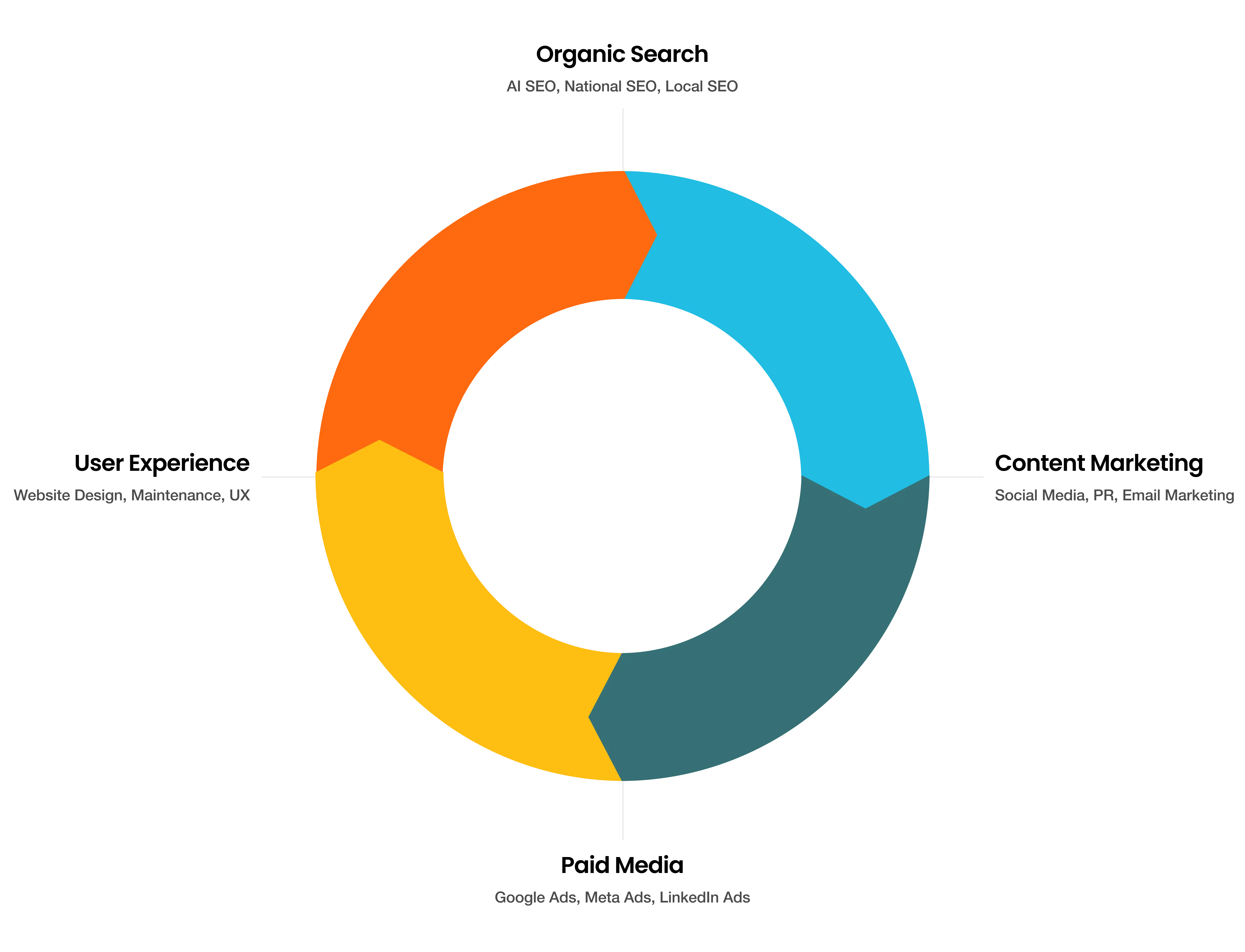
Organic search with AI SEO consultants.
- GEO optimization: Improve visibility in AI-driven platforms like ChatGPT and Perplexity.
- National SEO: Build authority for competitive, industry-defining keywords.
- Local SEO: Dominate “near me” and regional searches that capture high-intent leads.
Content marketing that amplifies AI SEO.
- Social media: Position your firm as a thought leader on LinkedIn.
- PR and syndicated news: Secure coverage that builds both authority and backlinks.
- Email marketing: Nurture leads and stay top-of-mind with decision-makers.
Paid media to accelerate results.
- Google Ads for demand capture.
- Meta Ads (Facebook/Instagram) for visibility and retargeting.
- LinkedIn Ads for precision targeting in B2B.
User experience that converts.
- Website design that inspires trust.
- UX improvements that make conversion seamless.
- Ongoing website maintenance to keep performance strong.
This is what separates us from typical AI SEO companies, we don’t just optimize your site and hope for the best. We integrate AI SEO into a broader ecosystem that builds authority, credibility, and steady lead flow.
Where our AI SEO consultants focus: AI + GEO.
At the heart of Growth 360 is our AI + GEO platform, designed to future-proof your visibility:
- AI-driven insights: Machine learning spots opportunities faster and adapts to algorithm shifts in real time.
- Geographic precision: Target the searches that matter in your market, from “management consultant New York” to “business litigation lawyer Phoenix.”
- LLM visibility: Optimize structured content and authority signals so your firm appears in AI-powered search results.
The result: consistent, high-quality inbound leads that fuel growth across every channel.
Why AI SEO isn’t replacing traditional SEO - it’s expanding it.
Every few years, you’ll hear, “SEO is dead.” The truth? SEO isn’t dead - it’s evolving.
- Google search is still the top driver of high-intent leads.
- Local and national SEO remain critical for discoverability.
- What’s new is that prospects also find firms through LinkedIn, PR coverage, YouTube, and yes - AI assistants like ChatGPT.
Our role as an AI SEO agency is to help you adapt to this expanded search ecosystem. Instead of competing in just one lane, we make sure your firm is discoverable across all of them.
What this means for professional service firms choosing AI SEO companies.
For consulting firms, law practices, and other professional advisors, visibility is everything. Our work with clients shows just how transformative AI SEO can be:
- Consulting firms: Keep billable hours billable while we generate a steady stream of inbound leads.
- Law firms: Grow ethically and predictably while staying compliant.
- Architects and advisors: Win larger, higher-value projects by dominating regional and industry-specific searches.
Other AI SEO companies might stop at rankings. We go further - building full growth systems that connect search to pipeline, revenue, and firm reputation.
Proof in action from our AI SEO consultants.
Clients using Growth Friday’s AI + GEO system as part of Growth 360 have already seen:
- 3x increase in qualified leads within 90 days.
- Lower reliance on high-cost PPC, freeing budget for brand-building.
- Higher conversion rates from search traffic, thanks to improved local and AI-powered visibility.
As one law firm client told us:
“This is the first time our SEO has felt like a reliable business driver, not a gamble.”
Final word: why Growth Friday is the AI SEO agency for firms that want clarity and growth.
Growth Friday isn’t just another vendor offering SEO tweaks. As a true AI SEO agency, we’re building future-ready systems that combine AI, GEO targeting, and holistic strategy. For firms comparing AI SEO consultants or evaluating AI SEO companies, the difference is clear:
- We integrate SEO into your full Growth 360 strategy.
- We combine AI-driven insights with human expertise.
- We focus on business outcomes—not just rankings.
If your firm is ready for predictable, scalable growth, Growth Friday is the partner you’ve been searching for.

Marketing for SaaS startups: How Growth Friday’s 360° approach drives scalable growth.
SaaS startups don’t grow the same way as an ecommerce store or a local business. Their marketing challenges are more complex and require a different mindset.
- Crowded markets: In almost every SaaS category, dozens of products are competing for the same audience.
- Longer buying cycles: Particularly in B2B, decisions involve multiple stakeholders and careful evaluation.
- Retention-driven growth: A trial sign-up doesn’t mean much unless users activate and renew.
- CAC pressure: Paid channels can scale quickly, but costs rise fast if organic channels don’t balance the equation.
This is why marketing for SaaS startups can’t rely on a single tactic. Running ads without a strong content strategy, or writing blog posts without a conversion-optimized site, leads to wasted effort. Success comes from treating every channel as part of a connected system.
The Growth 360 framework for SaaS startups.
At Growth Friday, we call that system the Growth 360 framework. It’s built to unify what too many startups approach in silos.
Here’s how it works:
Organic search and GEO.
- National SEO for competitive SaaS categories
- Local SEO when regional presence matters
- GEO optimization to ensure visibility in generative engines like ChatGPT and Perplexity
Content marketing and PR.
- SEO-driven social media content
- PR placements that build credibility in industry media
- Repurposing content across LinkedIn, email, and other channels
Paid media.
- Google Ads for high-intent searches
- LinkedIn Ads for account-based targeting
- Meta Ads for brand awareness and remarketing
User experience.
- Websites designed to build trust and reduce friction
- Conversion UX optimization for trials and demos
- Ongoing maintenance to keep sites fast, secure, and reliable
The result isn’t just more traffic. It’s a marketing engine that generates pipeline growth predictably and sustainably.
Case study 1: Lunafi — 681% growth with a SaaS SEO strategy.
The challenge.
Lunafi, a fintech SaaS startup, had the right product but low visibility. They weren’t ranking for the keywords that mattered, and their organic traffic was too limited to support growth.

Our Growth 360 solution.
- Designed a national SEO strategy focused on SaaS and fintech search terms
- Built content clusters mapped to the customer journey
- Improved site UX to make sure traffic converted into engaged users
The results.
- 681% increase in sessions within six months
- Top 3 rankings for high-intent target keywords
- A scalable content and SEO foundation that continues to deliver growth
Read the full Lunafi case study.
Case Study 2: Entrapeer — 256% growth with SaaS digital marketing.
The challenge.
Entrapeer, a SaaS platform connecting enterprises with startups, had product-market fit but little visibility. Their domain authority was weak, backlinks were scarce, and search rankings were almost nonexistent.

Our Growth 360 solution.
- Launched a national SEO campaign targeting enterprise SaaS queries
- Built an ongoing PR and backlink program to strengthen authority
- Enhanced user experience to streamline navigation and drive trial sign-ups
The results.
- 256% growth in active users within 12 months
- Domain Authority increase from 15 to 21
- Backlinks more than doubled, from 6,000 to 14,000
Read the full entrapeer case study.
The four pillars of marketing for SaaS startups.
Looking across these client stories, it’s clear that SaaS companies grow fastest when they invest across four core areas.
Organic search and SaaS SEO strategy.
- National SEO for competitive categories
- Local SEO for regionally focused SaaS products
- GEO optimization to capture visibility in AI-driven search engines
Why it works: SEO compounds over time, driving down CAC and building long-term visibility.
Content marketing and PR for SaaS growth.
- Long-form, SEO-driven articles that educate and build trust
- PR placements in industry outlets to establish credibility
- Repurposing content into LinkedIn posts, newsletters, and nurture campaigns
Why it works: SaaS startups can’t survive on awareness alone — they need authority. Strong content and PR provide it.
Paid media in SaaS digital marketing.
- Google Ads to capture bottom-of-funnel intent
- LinkedIn Ads for precise account-based targeting
- Meta Ads for brand awareness and retargeting
Why it works: Paid media accelerates growth while organic channels build momentum. The key is using ads to validate messaging, not as a crutch.
UX and conversion optimization for SaaS.
- Trust-building website design
- Frictionless trial and onboarding flows
- Continuous optimization with CRO testing
Why it works: Traffic is meaningless if it doesn’t convert. UX ensures growth efforts translate into real adoption and revenue.
Why SaaS startups need an integrated growth partner.
Many SaaS founders attempt to stitch together growth by hiring different specialists — a freelancer for SEO, a small PR shop, someone internal to run ads. The result is a patchwork of efforts that don’t connect, making it hard to track ROI and even harder to scale.
Growth Friday’s Growth 360 framework solves this by:
- Consolidating all growth levers under one accountable partner
- Providing transparent reporting tied to pipeline and revenue metrics
- Balancing short-term acceleration (paid ads) with long-term sustainability (SEO, content, UX)
This is how SaaS startups like Lunafi and Entrapeer achieved measurable growth in less time — and why integration matters more than ever in marketing for SaaS startups.
Key takeaways: Building a scalable SaaS digital marketing engine.
- Growth comes from systems, not silos
- Organic and paid should work together, not compete
- Authority lowers CAC and builds trust in competitive markets
- UX turns traffic into active users and paying customers
For SaaS startups, digital marketing isn’t about quick wins. It’s about building a growth engine that compounds and supports the business for years to come.
Ready to transform your marketing for SaaS startups?
At Growth Friday, we’ve seen firsthand how SaaS startups scale faster with a unified approach. From SEO and PR to paid media and UX, our Growth 360 framework gives startups the clarity, strategy, and execution needed to build a reliable growth pipeline.
Book your Growth Strategy Call to explore how we can help your SaaS scale with confidence.
Ready to finally grow with confidence?
At Growth Friday, we simplify digital marketing so you can focus on growing your professional service firm. Our team combines a full-channel, expert-led strategy with clear, actionable metrics to drive real results fast. Ready to transform your digital presence? Book your free strategy call today and discover 2–3 actionable wins to accelerate your growth.