
Similar blog posts

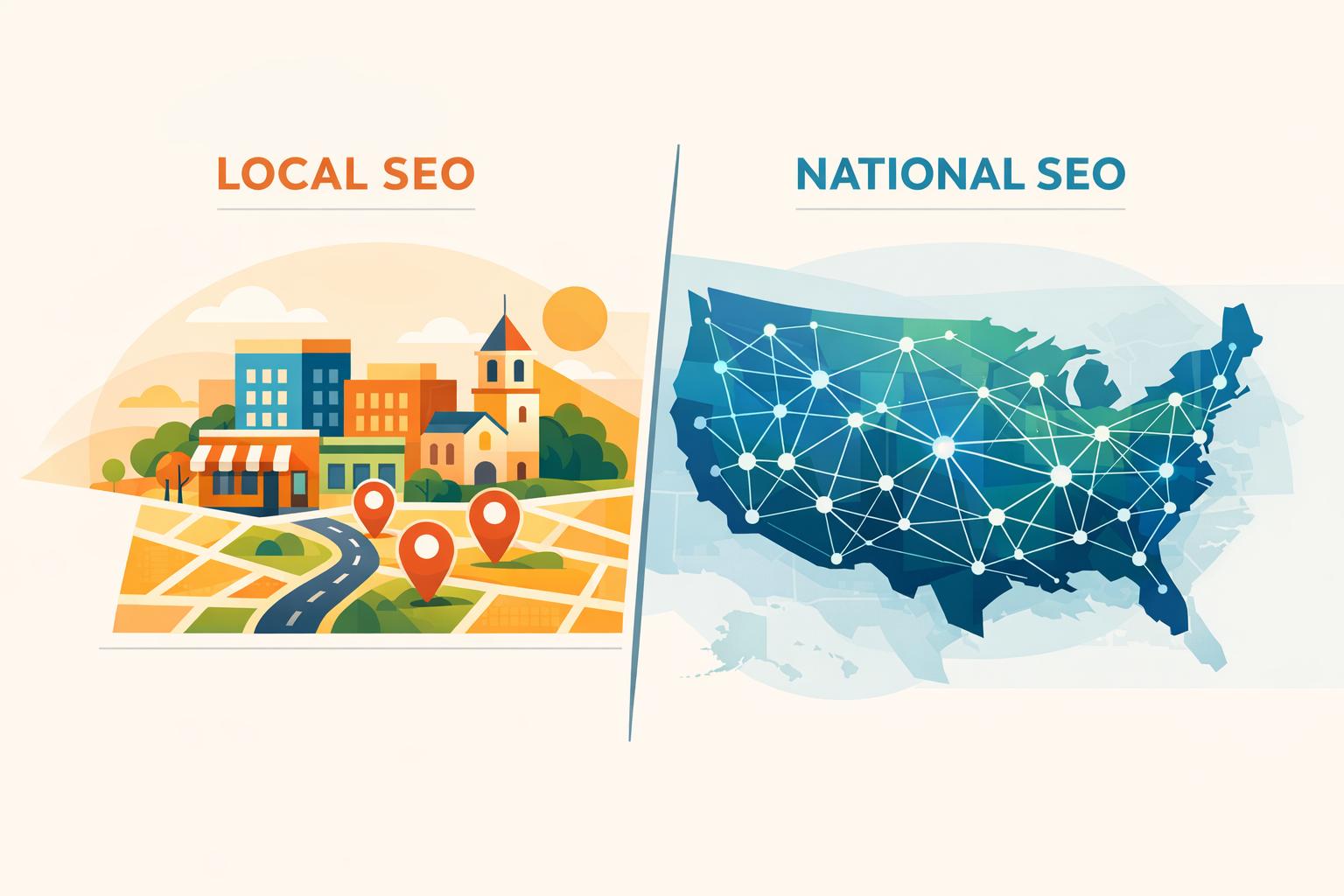
Local SEO vs National SEO: which strategy fits your firm.
Choosing between Local SEO and National SEO depends on your business model and audience location. Local SEO helps businesses attract nearby customers by focusing on location-based searches like "dentist near me." It’s ideal for firms with a physical presence and in-person services. National SEO, on the other hand, targets a broader audience across the U.S. using high-quality content and non-location-specific keywords like "tax planning tips." This approach suits businesses that operate remotely or serve clients nationwide.
Here’s a quick breakdown
If your goal is to dominate your local market, start with Local SEO. For businesses looking to scale nationally, focus on National SEO. Some firms may benefit from a hybrid approach, combining both strategies to maximize reach and growth.
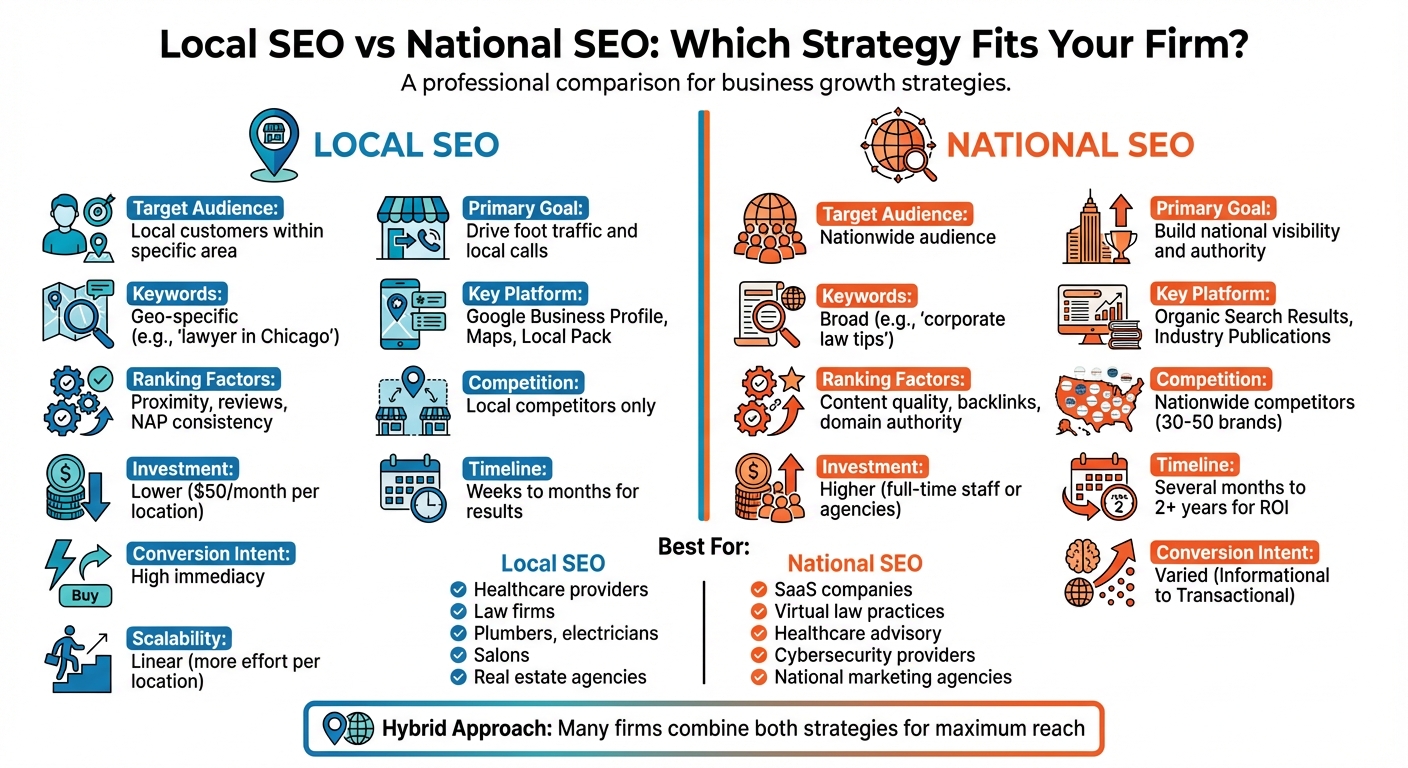
Main differences between Local SEO and National SEO.
Scope and target audience.
Local SEO zeroes in on customers within specific geographic areas, while National SEO casts a wider net, appealing to audiences across the entire country. For example, a dental practice in Austin, Texas, primarily competes with other local dentists rather than practices nationwide [1][2]. On the other hand, National SEO involves competing with similar businesses from coast to coast.
This geographic difference shapes the way businesses approach their marketing. Local SEO relies heavily on proximity - how close a business is to the searcher plays a major role in rankings [3][5]. In contrast, National SEO focuses on building authority through strategies like creating top-notch content and earning quality backlinks [1].
These variations in scope also lead to different approaches in keyword strategies and search result priorities.
Keyword strategy and search features.
Local SEO prioritizes location-based keywords such as "plumber in Chicago" or "near me." The goal? Landing a spot in Google’s Map Pack, which features a map and three top business listings front and center in search results [4][5]. To achieve this, businesses must optimize their Google Business Profile, ensuring accurate details like Name, Address, and Phone (NAP) are up-to-date. This emphasis on local accuracy sets it apart from broader strategies [1][6].
National SEO, by contrast, targets high-volume, non-location-specific keywords like "corporate law tips" or "tax planning strategies." Success here depends on ranking in traditional organic search results, which requires a mix of comprehensive content marketing and technical website optimization [1][5]. While local searches often lead to quicker conversions, national SEO is more about building long-term visibility across a variety of keywords.
Once keyword strategies are understood, it’s important to consider how competition and financial investment differ between these two approaches.
Competition and investment.
"Local SEO is easier than traditional SEO when you think of it in terms of needing to reach a small, geo-specific audience instead of a vast national or international one." – Miriam Ellis, Local Search Columnist, Search Engine Land
Competition levels vary significantly. Local SEO generally involves less competition since businesses are only vying with others nearby [7]. For instance, ranking for "track shoes in Boise" is far easier than ranking for the broader term "track shoes" [2]. However, managing multiple Google Business Profiles can add complexity, especially for businesses with several locations [2].
The cost of investment also differs. Local SEO is often more budget-friendly, with tools like Semrush Local starting at about $50 per month per location, plus ongoing costs for managing citations and generating reviews [1][3][6]. National SEO, on the other hand, requires a heftier investment. It often involves hiring full-time staff or specialized agencies to execute strategies over a period of at least two years [8]. Additionally, the timeline for results varies: local campaigns can yield noticeable improvements within weeks to months, whereas national campaigns may take several months or even years to deliver a solid return on investment [1][2].
These differences make it clear that choosing the right SEO strategy depends heavily on your business’s market focus and long-term goals.
When to use Local SEO.
Firms that benefit from Local SEO.
Local SEO is a perfect fit for businesses that interact with customers in person and operate from a physical location with a valid address and phone number. Keep in mind, P.O. boxes and virtual offices don’t count [6]. Businesses like healthcare providers - dentists, chiropractors, and pharmacies - or legal services such as law firms and solo attorneys, thrive with local SEO. Similarly, home and field services like plumbers and electricians benefit greatly, as customers often search for immediate, nearby solutions like "electrician near me."
Other industries like real estate agencies, auto repair shops, and personal care services (think salons and spas) also see strong results. These businesses rely on serving specific geographic areas, where proximity to the customer is key. Local SEO’s importance is backed by stats - over 99% of consumers read reviews on local business listings before deciding to visit [9].
"The golden opportunity for local businesses is that their competition is limited by specific geography." – Miriam Ellis, Local SEO Subject Matter Expert at Moz
Next, let’s dive into the core strategies that can elevate your local search visibility.
Core Local SEO tactics.
To succeed with local SEO, you need strategies tailored to businesses targeting specific locations. Start by claiming and verifying your Google Business Profile (GBP). Selecting the right primary category for your business is crucial - it helps Google understand what you offer. You can also add up to nine secondary categories to cover additional keywords [4][9]. Be sure your business name matches your real-world signage exactly to avoid potential violations [6].
Consistency is key when it comes to your NAP (Name, Address, Phone). Make sure these details are identical across your website, GBP, and directories like Yelp, Bing Places, or niche platforms like Findlaw or ZocDoc [6]. Even small discrepancies - like writing "Street" instead of "St." - can confuse search engines and hurt your rankings.
For businesses with multiple locations, create dedicated landing pages for each one. Use local keywords in your H1 tags and meta descriptions, such as city names, neighborhoods, or zip codes [4][6]. Adding LocalBusiness Schema markup to these pages helps search engines easily identify your business details like hours, address, and services [6][10].
Managing reviews is another critical piece. Monitor reviews daily, encourage customers to leave feedback, and respond promptly - ideally within a few days. This isn’t just about maintaining a good reputation; it’s about customer retention. In fact, 73% of unhappy customers are willing to give a business another chance if their negative review is addressed and resolved [9]. Plus, 92% of people see owner responses as a sign of excellent customer service [4], so ignoring reviews could mean missing out on potential revenue.
Ensure your business is listed in key local directories. Tools like Semrush Local, starting at $50 per month per location, can streamline this process and fix any inconsistencies [3]. To build backlinks, consider joining your local Chamber of Commerce, sponsoring community events, or teaming up with nearby businesses that aren’t direct competitors [4][9].
"The main takeaway here is that the more involved you are in the communities you serve, the more reason you will be giving local people to talk about and link to your business." – Miriam Ellis, Local Search Scientist, Moz
Measuring Local SEO success.
To gauge your local SEO efforts, keep an eye on your Local Pack rankings - the map-based results that appear at the top of Google searches. Use tools like the GBP Insights dashboard to monitor engagement metrics such as clicks-to-call, direction requests, and website visits [4][9]. Platforms like Semrush Map Rank Tracker or Local Falcon can help track your visibility in specific areas. Unlike traditional SEO, local rankings depend heavily on the searcher’s physical location at the time of their query.
Add UTM parameters to your GBP website link to distinguish traffic from your local listing in Google Analytics [9][5]. Keep an eye on your review velocity - how frequently you receive new reviews compared to competitors - and your average star rating. Social media is also a growing factor, with over 50% of consumers now turning to platforms like Facebook and Instagram for local business recommendations [9]. Track mentions, comments, and engagement on these channels. Lastly, use Google Search Console to analyze localized organic traffic and pinpoint which location-specific keywords are driving the most qualified visitors to your site [9][5].
When to use National SEO.
Firms that benefit from National SEO.
National SEO is ideal for businesses that aren’t tied to a specific location and can serve clients across the country. This strategy works particularly well for firms where expertise, availability, and the value of services take precedence over proximity. For example, SaaS consultancies, virtual law practices, healthcare advisory firms, cybersecurity providers, and national marketing agencies often thrive with National SEO because their reach extends nationwide [12].
If your business has outgrown its local market and you're ready to handle leads from across the U.S., National SEO can help you scale. However, it's worth noting that the competition is much tougher at this level. You're vying for one of only 10 spots on Google’s first page against 30 to 50 well-established national brands [11].
"National SEO targets people across the United States. It removes city names and regional modifiers and focuses on broad, high‐intent keywords." – Jason Holicky, Founder, Holicky Corporation
Once you’ve identified your target audience, implementing the right tactics becomes critical to building a national presence.
Core National SEO tactics.
Achieving national visibility requires a different set of strategies than local SEO. A great starting point is creating topic clusters - a structure where a primary pillar page focuses on a core subject and is supported by multiple detailed, interlinked articles. This signals to Google that your site offers comprehensive expertise on the topic [12]. Instead of targeting geo-specific keywords, prioritize broad, high-intent terms that appeal to a nationwide audience.
Technical optimization is equally important. Ensure your site has fast page loading times, mobile-friendly designs, and clean URL structures. Even minor technical issues can hurt your rankings in the highly competitive national SEO landscape [12]. Additionally, focus on building high-quality backlinks from reputable sources like industry publications, national associations, and research organizations. Unlike local SEO, national campaigns benefit more from these authoritative links than from local directories.
Keep in mind that the U.S. market isn’t uniform. Search results for the same national keyword can vary significantly by region due to differences in local buying behaviors and industry concentrations [12][13]. Tools like VPNs or SEO software can help you monitor how rankings fluctuate across states, revealing areas where your brand could use more visibility. Reputation management also plays a key role - boosting branded searches can signal trustworthiness to Google [12].
"National SEO, being broader, allows you to use broader search terms. This can make it harder to rank for because the competition is inevitably fiercer at this level." – Timothy Carter, Chief Revenue Officer, SEO.co
Measuring National SEO success.
To evaluate your National SEO efforts, focus on non-geo-modified keywords. For instance, track terms like "managed IT services" rather than "IT services in Dallas." Use tools like Google Search Console to monitor U.S. organic traffic and assess how well your content is performing nationally [12]. Measuring search impressions for national-level keywords can also provide valuable insights into your overall visibility.
Branded search volume is another important metric. An increase in searches for your company name indicates growing authority on a national scale. To get a clearer picture of your performance, calculate average rankings across ZIP codes [13]. Keep in mind that national rankings evolve slowly, so it’s crucial to focus on long-term trends rather than short-term fluctuations.
For service-based businesses, tracking high-value actions like form submissions, phone calls, or demo requests from a nationwide audience is essential. Additionally, monitor the growth of non-branded keyword clicks - this shows that people are discovering your services based on their needs, not just by searching for your name.
How to choose the right SEO strategy.
Factors to consider.
Start by assessing your business model and how you interact with customers. If your business relies on face-to-face interactions at a physical location (not a P.O. box or virtual office), Local SEO is the way to go. This allows you to fully utilize tools like Google Business Profile, which is essential for visibility in local searches [6].
Think about where your customers are. If most of them are in a specific city or neighborhood, Local SEO will help you reach them effectively. On the other hand, if your clients are scattered across the country and can be served remotely, National SEO might be a better fit. Also, consider the resources you have available. Local SEO involves continuous management of reviews, directory listings, and maintaining consistent NAP (Name, Address, Phone) data. National SEO, however, requires a higher investment in creating top-tier content and earning backlinks from reputable sources.
"Local SEO is harder than traditional SEO because of the added work involved... local brands must also strategize around these tactics, plus local search engine ranking factors, too." – Miriam Ellis, Local Search Subject Matter Expert
Align your SEO strategy with your business goals. If your priority is generating local calls, foot traffic, or immediate customer action, Local SEO is a solid choice. For increasing website traffic and building brand reputation on a larger scale, National SEO is more appropriate. Keep in mind that many larger brands are shifting their focus from rankings to broader goals like conversions and revenue, with 70% of their efforts now directed at these high-value outcomes [14].
Finally, consider how combining both strategies could expand your reach even further.
Combining Local and National SEO.
For businesses that serve both local and national markets, a hybrid SEO strategy can be incredibly effective. This approach is especially useful if you operate in multiple locations or have grown beyond a single city but still want to maintain strong local visibility. A common practice is to create a single national website that includes localized landing pages for each branch or location [7].
To streamline this process, use programmatic landing pages built on a template system. These pages allow you to scale efficiently while tailoring content for local audiences. For example, you can target keywords like "Service in [City]" for local searches and focus on broader industry topics for national visibility [1][3]. Keep a centralized spreadsheet to manage all location data, ensuring consistent information across your website and local directories [15].
"The key to successfully blending local, national, and global SEO strategies is to leverage the unique value each brings." – Joshua Saxon, Author, Semrush
This dual strategy helps you engage a wide range of customers - those looking for nearby solutions as well as those seeking broader expertise or remote services. Additionally, national marketers can adapt high-performing general content to make it more relevant for regional audiences [1].
Local SEO vs. National SEO (which is right For you?)
Conclusion.
Choosing the right SEO strategy comes down to aligning your firm's service model with how and where your customers interact with your business. If your focus is on serving clients face-to-face in a specific city or region, Local SEO can help you tap into local search traffic effectively [4]. On the other hand, if your services cater to a nationwide audience through online consultations or remote delivery, National SEO is the key to building the broader visibility and authority required to compete at scale.
The most successful firms tie their SEO efforts to clear, measurable goals that directly drive growth. By setting metrics that genuinely impact revenue, you can ensure your strategy stays focused on what matters most [6].
"No other factor will have a greater impact on our success than the quality of consumer experiences we provide our customers." – Miriam Ellis, Subject Matter Expert
For firms that serve both local and national markets - or operate across multiple locations - a hybrid SEO approach can be incredibly effective. This strategy allows you to maintain strong local visibility using optimized Google Business Profiles while simultaneously building national authority through high-quality content and backlinks. By integrating these efforts, your SEO strategy can directly support your growth objectives, no matter the scale.
Growth Friday specializes in helping professional service firms craft SEO strategies tailored to their market scope and business goals. Whether you need a focused local optimization plan, scalable national strategies, or a blend of both, our AI-driven marketing systems are designed to deliver results you can measure and sustain over time.
FAQs.
How can I decide if my business needs Local SEO or National SEO?
Choosing between Local SEO and National SEO comes down to your business's goals and the audience you serve. If your business operates within a specific city, neighborhood, or region - think dental offices, restaurants, or local service providers - Local SEO is your go-to strategy. It focuses on optimizing for "near me" searches and improving your presence on platforms like Google Business Profile. However, if your business serves customers across the country, such as an e-commerce store or a nationwide consulting firm, National SEO is the better option, as it targets broader, high-volume keywords.
Here are a few key questions to help guide your decision:
If you're focused on serving a specific area, start with Local SEO. This means optimizing your Google Business Profile and creating content tailored to your location. For businesses with a nationwide audience, National SEO is the way to go, with strategies like targeting competitive keywords and building a strong online presence. Many businesses ultimately choose to blend both approaches, balancing local dominance with national reach to maximize growth.
What are the cost differences between Local SEO and National SEO?
Local SEO is generally easier on the budget compared to National SEO, primarily because it zeroes in on a smaller geographic area and fewer keywords. In the U.S., most local SEO campaigns fall between $500 and $2,000 per month, with many small businesses finding effective services at the lower end of that spectrum.
On the flip side, National SEO aims for visibility across the entire country, often in fiercely competitive industries. That broader reach comes with a higher price tag - typically ranging from $2,500 to $10,000 or more per month. These costs account for the added complexity, including in-depth keyword research, creating a large volume of content, and extensive link-building efforts to secure national prominence.
Can a business use both Local SEO and National SEO strategies together effectively?
Businesses can absolutely blend Local SEO and National SEO strategies to boost their online visibility. This combination is particularly effective for organizations like franchises or multi-location businesses that need to connect with both local customers and a nationwide audience.
To make this work, start by focusing on Local SEO efforts. This includes optimizing your Google Business Profile and using location-specific keywords to improve visibility in local searches. At the same time, implement National SEO tactics, such as producing high-quality content that appeals to a broader audience and building a strong backlink profile to enhance your site's authority.
By aligning these strategies, you can effectively reach customers on both a local and national scale, creating opportunities for growth at every level.

February 2026 campaign updates, what is changing and why.
We are making a set of improvements to how we manage SEO and local visibility campaigns, and how we report progress back to you.
Instead of sending a long email thread, we wanted to publish one clear reference you can bookmark and share internally.
If you have questions after reading, reply to your most recent Growth Friday email and we will walk through what applies to your specific account.
Search is changing, and visibility now happens in more places.
Search is no longer a single list of ten blue links.
Today, potential customers may discover you through traditional search results (E.g. Google), map results, and AI assisted answers that summarize options before someone ever clicks a website.
That shift does not make fundamentals like trust, clarity, and authority less important. It makes them more important.
Our job is to make sure your firm shows up consistently, and credibly, wherever your buyers are looking.

How this fits into Growth 360.
Growth 360 is our end to end marketing system that aligns multiple channels into one unified plan, so strategy, execution, and accountability compound over time.
This February update focuses mostly on the Organic Search pillar, including Local SEO, plus reporting improvements that make performance easier to understand.
In plain terms, you should expect two things:
- More consistent visibility work across traditional search, local search, and AI assisted discovery.
- Clearer updates on what we are doing, why we are doing it, and what we are seeing.
What is changing in February.
Here is the headline list of improvements we are rolling out.
- Improved AI visibility work, focused on blog content that supports your primary service and product pages.
- Expanded Google Business Profile management, including weekly updates, review link enhancements, and more consistent optimization.
- Summary emails every two weeks, plus a monthly summary with your report.
- Client Portal upgrades, including new AI Visibility reporting and conversion tracking across channels, including calls.
Now let’s break these down.
Update 1, improved AI visibility with service supporting content.
AI assisted search experiences pull from content that is structured, specific, and trustworthy. In many cases, the brands that get mentioned are the brands that explain their expertise clearly and consistently over time.
In February, we are increasing our focus on content that supports your core money making pages.
What we are doing.
Depending on your campaign, this may include.
- Publishing blog content designed to reinforce your core services and the problems you solve.
- Strengthening internal links between blog posts and your service pages so search engines understand relevance.
- Refreshing existing pages so the most important content stays current.
- Improving page structure so your expertise is easier to parse and surface in AI assisted experiences.
- Continuing technical improvements that protect crawlability, speed, and indexing.
What you should see.
Over time, you should see a few practical changes.
- Blog topics that map more directly to services you want to sell.
- Cleaner site structure that helps both people and search engines navigate.
- More consistent alignment between what you do, what you publish, and what you want to rank for.
A quick note on expectations. AI visibility is still evolving, and results vary by industry and competition. Our goal is to build durable authority that supports both rankings and real inquiries.
Update 2, expanded Google Business Profile enhancements.
For many professional service firms, Google Business Profile is one of the highest leverage digital assets you own. It influences map visibility, branded searches, and how confident a potential customer feels when deciding who to call.

In February, we are upgrading our Google Business Profile workflow so it is more consistent, more active, and easier to measure.
What is included.
Here are the improvements you can expect as part of our expanded management process.
- Weekly Google Business Profile optimization audits.
- More consistent posting cadence that keeps your profile active and relevant.
- Improved photo and media workflows to strengthen trust and engagement.
- Enhanced review links you can share with customers to make review requests easier.
- Stronger coordination between your Google Business Profile activity and your social channels, where relevant.
- Ongoing optimization checks so your profile stays aligned with what you offer.
If your campaign includes social publishing, some Google Business Profile content may also be repurposed to platforms like Facebook, Instagram, and LinkedIn to create consistent signals across the web.
What we may need from you.
To get the best results from local visibility work, we may occasionally ask for.
- A few real photos each month, team, office, projects, or behind the scenes.
- Confirmation of your priority service lines for the month.
- Any updates to hours, service areas, phone numbers, or business descriptions.
If you are in a regulated industry or have specific compliance requirements, tell us what needs to be reviewed before publishing, and we will follow that process.
Update 3, clearer reporting cadence.
We want you to feel informed without feeling buried in dashboards.
Starting in February, you will receive.
- A short summary email every two weeks.
- A monthly report summary that ties actions to outcomes and next priorities.
What the every two week summary includes.
Each summary is designed to be skimmed in under three minutes.
- What we completed.
- What we are working on next.
- What we are seeing in performance indicators.
- Any questions or approvals we need from you.
Update 4, Client Portal upgrades and better conversion tracking.
We are also improving how performance is tracked and presented in the Client Portal.
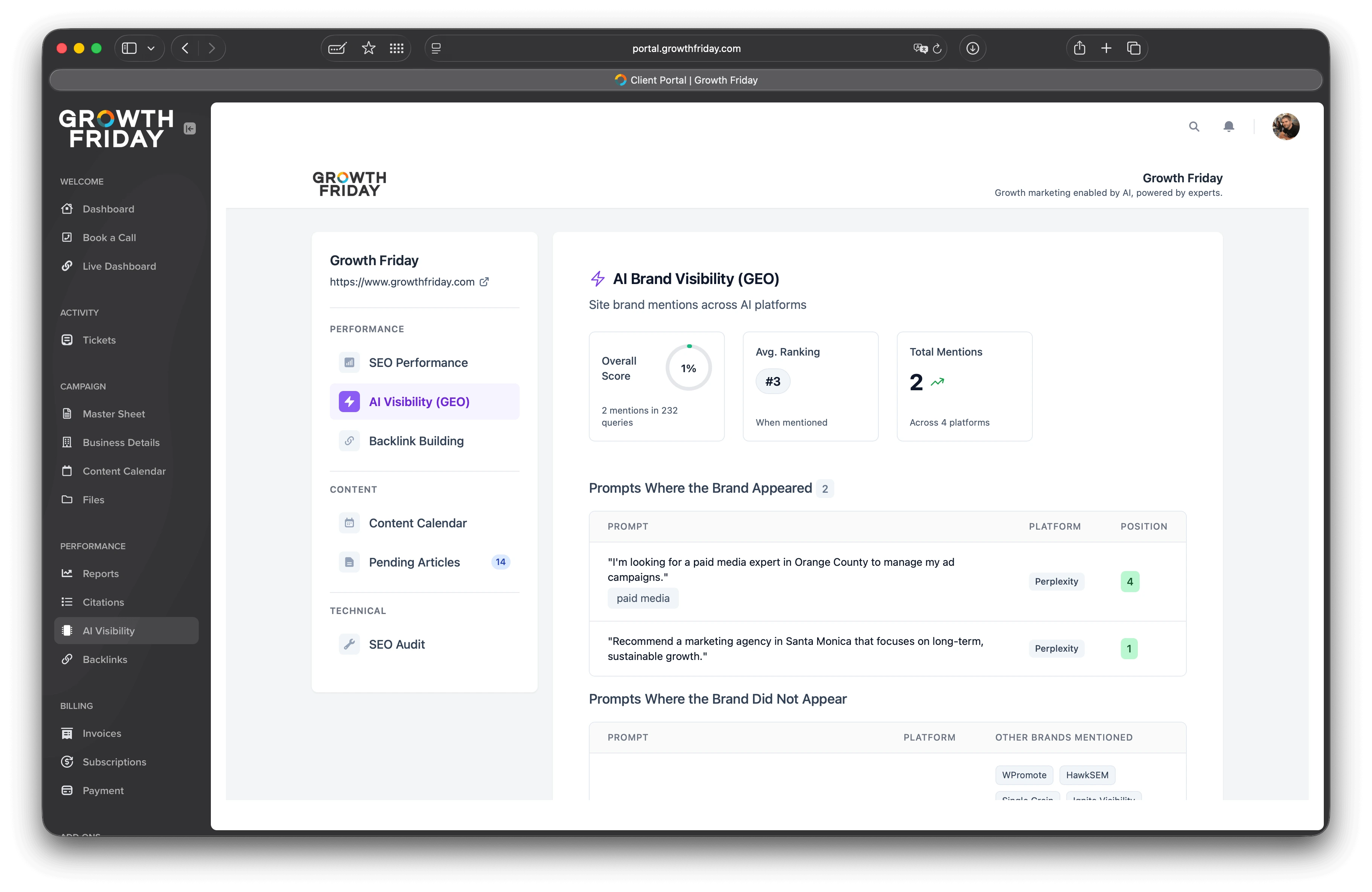
AI Visibility reporting.
You will see a new AI Visibility section that helps answer questions like.
- Are we surfacing for the topics that matter to our business.
- Which themes are gaining traction.
- Where we need stronger supporting content to earn visibility.
This is meant to be practical and directional, not hype.
Conversion tracking across channels, including calls.
In addition to visibility metrics, we are improving conversion tracking so you can better connect marketing effort to real outcomes.
Depending on your setup, this can include.
- Form submissions.
- Call tracking and call conversions.
- Key actions like bookings or contact clicks, when configured.
If anything in your tracking setup needs to be updated to support these improvements, we will let you know.
Timeline for February.
Here is how this typically rolls out through the month.
Week 1.
- Confirm priorities and any new messaging focus.
- Begin Google Business Profile workflow enhancements.
- Start publishing and updating content based on the February content plan.
Week 2.
- Continue content production and on page improvements.
- Implement reporting cadence changes.
- Begin surfacing AI Visibility reporting in the Client Portal.
Weeks 3 and 4.
- Iterate based on early signals and engagement.
- Continue weekly local activity.
- Deliver the first every two week summary update, then continue on cadence.
Common questions.
Do I need to do anything right now.
Not necessarily. If we need access, approvals, or assets, we will ask directly and keep it simple. If you want to be proactive, the most helpful thing you can do is tell us which service line you want to prioritize in February.
Does this change my scope or pricing.
These are improvements to how we deliver and report. If anything affects your specific scope, we will communicate it directly and clearly.
How will you measure AI visibility.
We track a mix of indicators that show whether your brand and expertise are becoming more discoverable in AI assisted experiences, then tie that back to traditional SEO performance and conversions where possible.
Will weekly Google Business Profile updates replace website SEO.
No. Your website remains the foundation of authority and conversion. Local activity strengthens trust and local relevance, but it works best when paired with strong on site content and technical SEO.
When should I expect results.
Marketing results are never instant, and they vary by competition, industry, and starting point. The goal of these improvements is to increase consistency, visibility, and measurability so momentum compounds over time.
What to do next.
If you want us to prioritize a specific service, location, or offer in February, reply to your latest Growth Friday email and tell us what to focus on.
If you just want to stay in the loop, keep an eye out for the every two week summaries and the updated Client Portal reporting.
Thank you for trusting Growth Friday. We are excited about these improvements, and we are here if you want to talk through them.