
Local SEO
January 10, 2026

Local SEO vs National SEO: which strategy fits your firm.

TL;DR

Local SEO wins for in-person firms; National SEO suits scalable remote services; compare audience, costs, tactics, and hybrid options.

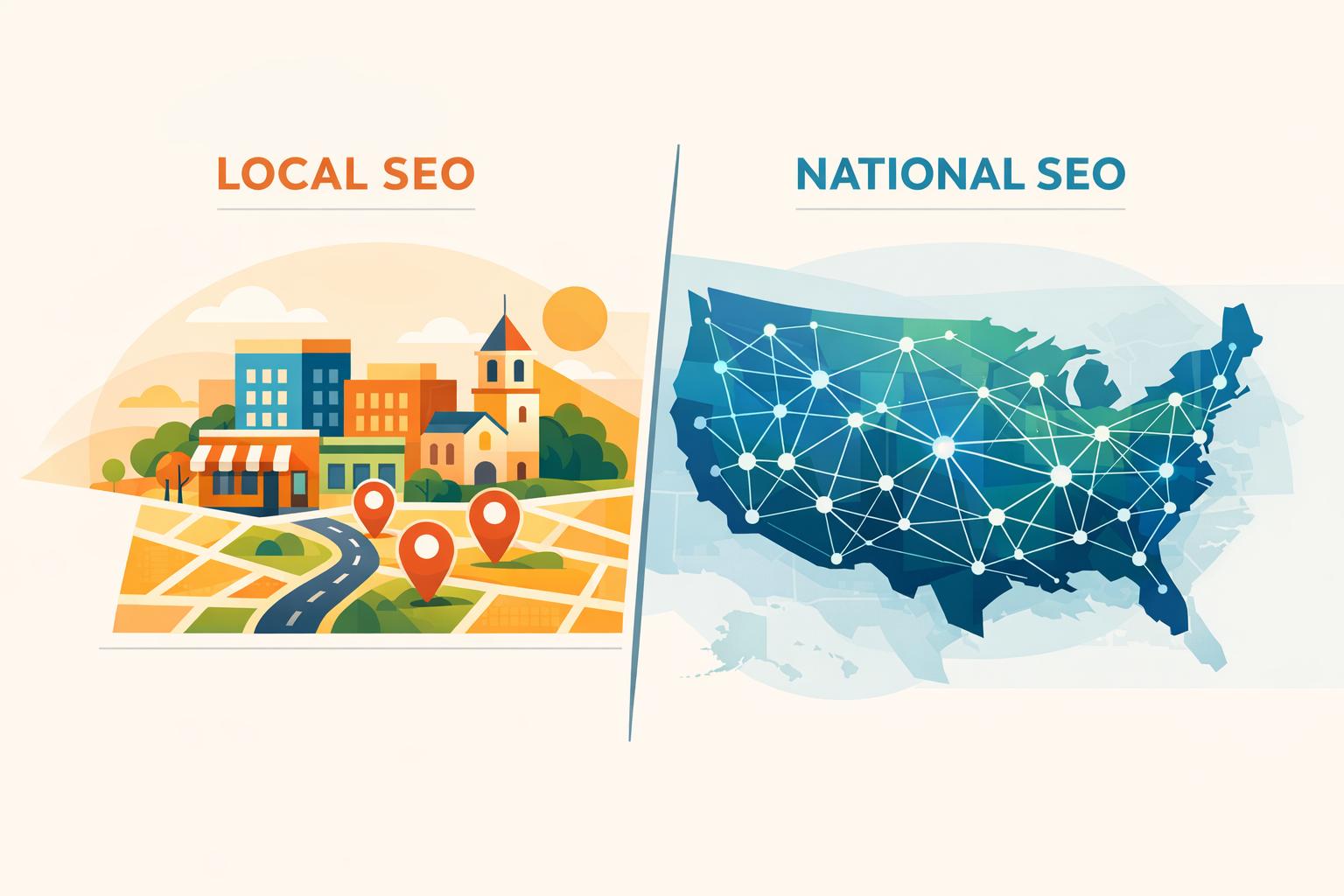
Choosing between Local SEO and National SEO depends on your business model and audience location. Local SEO helps businesses attract nearby customers by focusing on location-based searches like "dentist near me." It’s ideal for firms with a physical presence and in-person services. National SEO, on the other hand, targets a broader audience across the U.S. using high-quality content and non-location-specific keywords like "tax planning tips." This approach suits businesses that operate remotely or serve clients nationwide.

Here’s a quick breakdown

If your goal is to dominate your local market, start with Local SEO. For businesses looking to scale nationally, focus on National SEO. Some firms may benefit from a hybrid approach, combining both strategies to maximize reach and growth.
Local SEO vs National SEO: Key Differences and Strategy Comparison

Main differences between Local SEO and National SEO.

Scope and target audience.

Local SEO zeroes in on customers within specific geographic areas, while National SEO casts a wider net, appealing to audiences across the entire country. For example, a dental practice in Austin, Texas, primarily competes with other local dentists rather than practices nationwide [1][2]. On the other hand, National SEO involves competing with similar businesses from coast to coast.

This geographic difference shapes the way businesses approach their marketing. Local SEO relies heavily on proximity - how close a business is to the searcher plays a major role in rankings [3][5]. In contrast, National SEO focuses on building authority through strategies like creating top-notch content and earning quality backlinks [1].

These variations in scope also lead to different approaches in keyword strategies and search result priorities.

Keyword strategy and search features.

Local SEO prioritizes location-based keywords such as "plumber in Chicago" or "near me." The goal? Landing a spot in Google’s Map Pack, which features a map and three top business listings front and center in search results [4][5]. To achieve this, businesses must optimize their Google Business Profile, ensuring accurate details like Name, Address, and Phone (NAP) are up-to-date. This emphasis on local accuracy sets it apart from broader strategies [1][6].

National SEO, by contrast, targets high-volume, non-location-specific keywords like "corporate law tips" or "tax planning strategies." Success here depends on ranking in traditional organic search results, which requires a mix of comprehensive content marketing and technical website optimization [1][5]. While local searches often lead to quicker conversions, national SEO is more about building long-term visibility across a variety of keywords.

Once keyword strategies are understood, it’s important to consider how competition and financial investment differ between these two approaches.

Competition and investment.

"Local SEO is easier than traditional SEO when you think of it in terms of needing to reach a small, geo-specific audience instead of a vast national or international one." – Miriam Ellis, Local Search Columnist, Search Engine Land

Competition levels vary significantly. Local SEO generally involves less competition since businesses are only vying with others nearby [7]. For instance, ranking for "track shoes in Boise" is far easier than ranking for the broader term "track shoes" [2]. However, managing multiple Google Business Profiles can add complexity, especially for businesses with several locations [2].

The cost of investment also differs. Local SEO is often more budget-friendly, with tools like Semrush Local starting at about $50 per month per location, plus ongoing costs for managing citations and generating reviews [1][3][6]. National SEO, on the other hand, requires a heftier investment. It often involves hiring full-time staff or specialized agencies to execute strategies over a period of at least two years [8]. Additionally, the timeline for results varies: local campaigns can yield noticeable improvements within weeks to months, whereas national campaigns may take several months or even years to deliver a solid return on investment [1][2].

These differences make it clear that choosing the right SEO strategy depends heavily on your business’s market focus and long-term goals.

When to use Local SEO.

Firms that benefit from Local SEO.

Local SEO is a perfect fit for businesses that interact with customers in person and operate from a physical location with a valid address and phone number. Keep in mind, P.O. boxes and virtual offices don’t count [6]. Businesses like healthcare providers - dentists, chiropractors, and pharmacies - or legal services such as law firms and solo attorneys, thrive with local SEO. Similarly, home and field services like plumbers and electricians benefit greatly, as customers often search for immediate, nearby solutions like "electrician near me."

Other industries like real estate agencies, auto repair shops, and personal care services (think salons and spas) also see strong results. These businesses rely on serving specific geographic areas, where proximity to the customer is key. Local SEO’s importance is backed by stats - over 99% of consumers read reviews on local business listings before deciding to visit [9].

"The golden opportunity for local businesses is that their competition is limited by specific geography." – Miriam Ellis, Local SEO Subject Matter Expert at Moz

Next, let’s dive into the core strategies that can elevate your local search visibility.

Core Local SEO tactics.

To succeed with local SEO, you need strategies tailored to businesses targeting specific locations. Start by claiming and verifying your Google Business Profile (GBP). Selecting the right primary category for your business is crucial - it helps Google understand what you offer. You can also add up to nine secondary categories to cover additional keywords [4][9]. Be sure your business name matches your real-world signage exactly to avoid potential violations [6].

Consistency is key when it comes to your NAP (Name, Address, Phone). Make sure these details are identical across your website, GBP, and directories like Yelp, Bing Places, or niche platforms like Findlaw or ZocDoc [6]. Even small discrepancies - like writing "Street" instead of "St." - can confuse search engines and hurt your rankings.

For businesses with multiple locations, create dedicated landing pages for each one. Use local keywords in your H1 tags and meta descriptions, such as city names, neighborhoods, or zip codes [4][6]. Adding LocalBusiness Schema markup to these pages helps search engines easily identify your business details like hours, address, and services [6][10].

Managing reviews is another critical piece. Monitor reviews daily, encourage customers to leave feedback, and respond promptly - ideally within a few days. This isn’t just about maintaining a good reputation; it’s about customer retention. In fact, 73% of unhappy customers are willing to give a business another chance if their negative review is addressed and resolved [9]. Plus, 92% of people see owner responses as a sign of excellent customer service [4], so ignoring reviews could mean missing out on potential revenue.

Ensure your business is listed in key local directories. Tools like Semrush Local, starting at $50 per month per location, can streamline this process and fix any inconsistencies [3]. To build backlinks, consider joining your local Chamber of Commerce, sponsoring community events, or teaming up with nearby businesses that aren’t direct competitors [4][9].

"The main takeaway here is that the more involved you are in the communities you serve, the more reason you will be giving local people to talk about and link to your business." – Miriam Ellis, Local Search Scientist, Moz

Measuring Local SEO success.

To gauge your local SEO efforts, keep an eye on your Local Pack rankings - the map-based results that appear at the top of Google searches. Use tools like the GBP Insights dashboard to monitor engagement metrics such as clicks-to-call, direction requests, and website visits [4][9]. Platforms like Semrush Map Rank Tracker or Local Falcon can help track your visibility in specific areas. Unlike traditional SEO, local rankings depend heavily on the searcher’s physical location at the time of their query.

Add UTM parameters to your GBP website link to distinguish traffic from your local listing in Google Analytics [9][5]. Keep an eye on your review velocity - how frequently you receive new reviews compared to competitors - and your average star rating. Social media is also a growing factor, with over 50% of consumers now turning to platforms like Facebook and Instagram for local business recommendations [9]. Track mentions, comments, and engagement on these channels. Lastly, use Google Search Console to analyze localized organic traffic and pinpoint which location-specific keywords are driving the most qualified visitors to your site [9][5].

When to use National SEO.

Firms that benefit from National SEO.

National SEO is ideal for businesses that aren’t tied to a specific location and can serve clients across the country. This strategy works particularly well for firms where expertise, availability, and the value of services take precedence over proximity. For example, SaaS consultancies, virtual law practices, healthcare advisory firms, cybersecurity providers, and national marketing agencies often thrive with National SEO because their reach extends nationwide [12].

If your business has outgrown its local market and you're ready to handle leads from across the U.S., National SEO can help you scale. However, it's worth noting that the competition is much tougher at this level. You're vying for one of only 10 spots on Google’s first page against 30 to 50 well-established national brands [11].

"National SEO targets people across the United States. It removes city names and regional modifiers and focuses on broad, high‐intent keywords." – Jason Holicky, Founder, Holicky Corporation

Once you’ve identified your target audience, implementing the right tactics becomes critical to building a national presence.

Core National SEO tactics.

Achieving national visibility requires a different set of strategies than local SEO. A great starting point is creating topic clusters - a structure where a primary pillar page focuses on a core subject and is supported by multiple detailed, interlinked articles. This signals to Google that your site offers comprehensive expertise on the topic [12]. Instead of targeting geo-specific keywords, prioritize broad, high-intent terms that appeal to a nationwide audience.

Technical optimization is equally important. Ensure your site has fast page loading times, mobile-friendly designs, and clean URL structures. Even minor technical issues can hurt your rankings in the highly competitive national SEO landscape [12]. Additionally, focus on building high-quality backlinks from reputable sources like industry publications, national associations, and research organizations. Unlike local SEO, national campaigns benefit more from these authoritative links than from local directories.

Keep in mind that the U.S. market isn’t uniform. Search results for the same national keyword can vary significantly by region due to differences in local buying behaviors and industry concentrations [12][13]. Tools like VPNs or SEO software can help you monitor how rankings fluctuate across states, revealing areas where your brand could use more visibility. Reputation management also plays a key role - boosting branded searches can signal trustworthiness to Google [12].

"National SEO, being broader, allows you to use broader search terms. This can make it harder to rank for because the competition is inevitably fiercer at this level." – Timothy Carter, Chief Revenue Officer, SEO.co

Measuring National SEO success.

To evaluate your National SEO efforts, focus on non-geo-modified keywords. For instance, track terms like "managed IT services" rather than "IT services in Dallas." Use tools like Google Search Console to monitor U.S. organic traffic and assess how well your content is performing nationally [12]. Measuring search impressions for national-level keywords can also provide valuable insights into your overall visibility.

Branded search volume is another important metric. An increase in searches for your company name indicates growing authority on a national scale. To get a clearer picture of your performance, calculate average rankings across ZIP codes [13]. Keep in mind that national rankings evolve slowly, so it’s crucial to focus on long-term trends rather than short-term fluctuations.

For service-based businesses, tracking high-value actions like form submissions, phone calls, or demo requests from a nationwide audience is essential. Additionally, monitor the growth of non-branded keyword clicks - this shows that people are discovering your services based on their needs, not just by searching for your name.

How to choose the right SEO strategy.

Factors to consider.

Start by assessing your business model and how you interact with customers. If your business relies on face-to-face interactions at a physical location (not a P.O. box or virtual office), Local SEO is the way to go. This allows you to fully utilize tools like Google Business Profile, which is essential for visibility in local searches [6].

Think about where your customers are. If most of them are in a specific city or neighborhood, Local SEO will help you reach them effectively. On the other hand, if your clients are scattered across the country and can be served remotely, National SEO might be a better fit. Also, consider the resources you have available. Local SEO involves continuous management of reviews, directory listings, and maintaining consistent NAP (Name, Address, Phone) data. National SEO, however, requires a higher investment in creating top-tier content and earning backlinks from reputable sources.

"Local SEO is harder than traditional SEO because of the added work involved... local brands must also strategize around these tactics, plus local search engine ranking factors, too." – Miriam Ellis, Local Search Subject Matter Expert

Align your SEO strategy with your business goals. If your priority is generating local calls, foot traffic, or immediate customer action, Local SEO is a solid choice. For increasing website traffic and building brand reputation on a larger scale, National SEO is more appropriate. Keep in mind that many larger brands are shifting their focus from rankings to broader goals like conversions and revenue, with 70% of their efforts now directed at these high-value outcomes [14].

Finally, consider how combining both strategies could expand your reach even further.

Combining Local and National SEO.

For businesses that serve both local and national markets, a hybrid SEO strategy can be incredibly effective. This approach is especially useful if you operate in multiple locations or have grown beyond a single city but still want to maintain strong local visibility. A common practice is to create a single national website that includes localized landing pages for each branch or location [7].

To streamline this process, use programmatic landing pages built on a template system. These pages allow you to scale efficiently while tailoring content for local audiences. For example, you can target keywords like "Service in [City]" for local searches and focus on broader industry topics for national visibility [1][3]. Keep a centralized spreadsheet to manage all location data, ensuring consistent information across your website and local directories [15].

"The key to successfully blending local, national, and global SEO strategies is to leverage the unique value each brings." – Joshua Saxon, Author, Semrush

This dual strategy helps you engage a wide range of customers - those looking for nearby solutions as well as those seeking broader expertise or remote services. Additionally, national marketers can adapt high-performing general content to make it more relevant for regional audiences [1].

Local SEO vs. National SEO (which is right For you?)

Conclusion.

Choosing the right SEO strategy comes down to aligning your firm's service model with how and where your customers interact with your business. If your focus is on serving clients face-to-face in a specific city or region, Local SEO can help you tap into local search traffic effectively [4]. On the other hand, if your services cater to a nationwide audience through online consultations or remote delivery, National SEO is the key to building the broader visibility and authority required to compete at scale.

The most successful firms tie their SEO efforts to clear, measurable goals that directly drive growth. By setting metrics that genuinely impact revenue, you can ensure your strategy stays focused on what matters most [6].

"No other factor will have a greater impact on our success than the quality of consumer experiences we provide our customers." – Miriam Ellis, Subject Matter Expert

For firms that serve both local and national markets - or operate across multiple locations - a hybrid SEO approach can be incredibly effective. This strategy allows you to maintain strong local visibility using optimized Google Business Profiles while simultaneously building national authority through high-quality content and backlinks. By integrating these efforts, your SEO strategy can directly support your growth objectives, no matter the scale.

Growth Friday specializes in helping professional service firms craft SEO strategies tailored to their market scope and business goals. Whether you need a focused local optimization plan, scalable national strategies, or a blend of both, our AI-driven marketing systems are designed to deliver results you can measure and sustain over time.

FAQs.

How can I decide if my business needs Local SEO or National SEO?

Choosing between Local SEO and National SEO comes down to your business's goals and the audience you serve. If your business operates within a specific city, neighborhood, or region - think dental offices, restaurants, or local service providers - Local SEO is your go-to strategy. It focuses on optimizing for "near me" searches and improving your presence on platforms like Google Business Profile. However, if your business serves customers across the country, such as an e-commerce store or a nationwide consulting firm, National SEO is the better option, as it targets broader, high-volume keywords.

Here are a few key questions to help guide your decision:

If you're focused on serving a specific area, start with Local SEO. This means optimizing your Google Business Profile and creating content tailored to your location. For businesses with a nationwide audience, National SEO is the way to go, with strategies like targeting competitive keywords and building a strong online presence. Many businesses ultimately choose to blend both approaches, balancing local dominance with national reach to maximize growth.

What are the cost differences between Local SEO and National SEO?

Local SEO is generally easier on the budget compared to National SEO, primarily because it zeroes in on a smaller geographic area and fewer keywords. In the U.S., most local SEO campaigns fall between $500 and $2,000 per month, with many small businesses finding effective services at the lower end of that spectrum.

On the flip side, National SEO aims for visibility across the entire country, often in fiercely competitive industries. That broader reach comes with a higher price tag - typically ranging from $2,500 to $10,000 or more per month. These costs account for the added complexity, including in-depth keyword research, creating a large volume of content, and extensive link-building efforts to secure national prominence.

Can a business use both Local SEO and National SEO strategies together effectively?

Businesses can absolutely blend Local SEO and National SEO strategies to boost their online visibility. This combination is particularly effective for organizations like franchises or multi-location businesses that need to connect with both local customers and a nationwide audience.

To make this work, start by focusing on Local SEO efforts. This includes optimizing your Google Business Profile and using location-specific keywords to improve visibility in local searches. At the same time, implement National SEO tactics, such as producing high-quality content that appeals to a broader audience and building a strong backlink profile to enhance your site's authority.

By aligning these strategies, you can effectively reach customers on both a local and national scale, creating opportunities for growth at every level.

Similar blog posts

Growth 360
July 7, 2026

Best Healthcare Marketing Agencies for Professional Service Firms

Healthcare marketing has rapidly evolved due to digital transformation, and medical practices, hospitals, and health systems that fail to adapt risk losing patients to competitors who show up first. Healthcare marketing agencies help organizations attract patients and build brands across every digital and traditional touchpoint - from search engines and social media to referral networks and community outreach.

But healthcare isn't like other industries. Patient acquisition campaigns are essential for healthcare providers, yet every campaign must navigate HIPAA compliance, FDA advertising regulations, professional referral dynamics, and patient privacy requirements that don't exist in other sectors. Agencies possess deep knowledge of healthcare's unique regulatory environment, and the best ones turn that knowledge into a competitive advantage for their clients.

This guide evaluates seven agencies based on their ability to serve healthcare organizations as professional service firms - practices, clinics, and systems where trust, credibility, and long-term patient relationships drive revenue. We focused on healthcare expertise, compliance knowledge, proven patient acquisition results, and transparent reporting.

Over 30,000 subscribers read weekly healthcare marketing blogs to stay current on what works. This article cuts through the noise and gives you a practical framework for choosing the right partner.

A medical professional in a white coat is intently reviewing patient data on a tablet inside a modern, well-lit clinic, highlighting the integration of healthcare digital marketing and technology in patient education and engagement. This scene reflects the essential role of healthcare marketing agencies in enhancing the efficiency of healthcare services.

How We Chose the Best Healthcare Marketing Agencies

Choosing a healthcare digital marketing agency requires more than scanning a "top 10" list. We evaluated agencies across six practical dimensions that matter most to professional service healthcare firms.

Healthcare industry experience and regulatory compliance expertise. Agencies must understand HIPAA and FDA compliance standards. We prioritized agencies with documented compliance protocols, Business Associate Agreements (BAAs), and clinical content review processes. Agencies ensure compliance with healthcare regulations like HIPAA and FDA - the ones that can't prove it didn't make the list.

Proven patient acquisition and referral generation results. Agencies should provide case studies demonstrating success in similar healthcare contexts. We looked for specific metrics: new patient volume, cost per lead, conversion rates, and referral marketing outcomes - not vanity metrics like impressions or page views.

Digital marketing capabilities across search, content, and paid media. Healthcare marketing requires tailored messaging for multiple audiences - patients, referring physicians, payers, and community stakeholders. We evaluated capabilities across organic search, content marketing, paid search, social media, and marketing automation platforms.

User experience and website design for healthcare practices. Agencies use data analytics to optimize healthcare marketing strategies, but the website itself needs to convert. We assessed whether agencies deliver fast, accessible, mobile-first sites with clear trust signals and HIPAA-compliant lead capture.

Transparency in reporting and performance measurement. Agencies use data analytics to optimize marketing strategies and measure ROI. We favored agencies that report on patient acquisition metrics - not just clicks - and use multi-touch attribution rather than last-click models.

Understanding of professional service firm dynamics. Healthcare marketing operates differently from consumer goods or e-commerce. Patient journeys are longer, trust signals matter more, and referral marketing from other providers often drives the highest-value cases. We prioritized agencies that understand these dynamics.

Top 7 Healthcare Marketing Agencies for Professional Service Firms

1. Growth Friday

Growth Friday is a holistic digital marketing agency specializing in professional service firms, including medical practices, dental clinics, and specialty healthcare providers. Founded in 2017 and based in Los Angeles with offices in Santa Barbara and Miami, Growth Friday brings an integrated approach to healthcare digital marketing through its Growth 360 system - a connected framework covering organic search, content marketing, paid media, and user experience.

Why It Stands Out: Growth Friday's AI-powered Growth 360 system covers all four marketing pillars with performance-based commitments. Rather than siloing SEO from paid media or content from UX, every channel is designed to compound on the others. This integrated approach mirrors what top-performing healthcare marketing campaigns require: improvements in one channel amplify results across all others.

Best For: Healthcare practices seeking integrated marketing systems with transparent reporting and measurable outcomes. Practices tired of fragmented vendors and disconnected dashboards will find the unified approach especially valuable.

Key Strengths:

Possible Limitations: Growth Friday's focus spans professional services broadly rather than healthcare exclusively, which means pharmaceutical companies or medical device manufacturers with highly specialized regulatory needs may require additional compliance depth. As a newer agency compared to some healthcare-specific competitors, the historical track record in certain specialty verticals is still growing.

2. Cardinal Digital Marketing

Cardinal Digital Marketing is a healthcare-focused performance marketing agency built to drive patient acquisition at scale. With deep expertise in multi-location healthcare systems, Cardinal has become a go-to agency for regional hospital networks and growing practice groups.

Why It Stands Out: Cardinal Digital Marketing specializes in patient acquisition campaigns for healthcare providers, combining local search optimization with patient review management and conversion rate optimization. Their case studiesshow an 82% increase in new traffic for a national orthodontic group and a 294% increase in new patients for a plastic surgery MSO through an optimized multi-brand PPC strategy.

Best For: Regional hospital systems and multi-location healthcare practices needing scalable patient acquisition. Agencies use local search optimization to enhance patient acquisition efforts, and Cardinal excels here.

Key Strengths:

  • Local SEO dominance with Google Business Profile optimization across multiple locations
  • Patient review generation and reputation management
  • Conversion rate optimization for healthcare websites
  • Scalable paid media strategies for multi-location healthcare providers
  • Patient acquisition strategies that include managing online reviews and SEO

Possible Limitations: Cardinal's focus sits primarily on patient acquisition rather than comprehensive branding or service line marketing. Healthcare organizations needing deep brand strategy, creative development, or pharmaceutical marketing experience may need to supplement with additional partners. Their strength is performance marketing, not brand positioning.

3. Healthcare Success

Healthcare Success is a full-service healthcare marketing firm with a long track record of integrated partnerships. Founded in 2006, they've built a reputation as a leading healthcare marketing agency for organizations wanting a dedicated, long-term marketing partner rather than a transactional vendor.

Why It Stands Out: Healthcare Success delivers comprehensive marketing programs that span digital and traditional channels. Their case studies include a family practice that went from one new patient per day to over 250 new patients per month through integrated strategies combining SEO, paid digital advertising, and website improvements. A well-executed marketing strategy increases patient acquisition - and Healthcare Success has the receipts to prove it.

Best For: Healthcare organizations wanting a dedicated long-term marketing partner for strategy and campaign execution across digital and traditional advertising.

Key Strengths:

  • Full-service capabilities spanning digital marketing, branding, and content creation
  • Deep healthcare industry knowledge across multiple specialties
  • Integrated marketing campaigns that combine brand strategy with performance marketing
  • Strong strategic communications and patient education content
  • Experience with both private medical practices and larger health systems

Possible Limitations: Comprehensive programs from a specialized healthcare marketing agency often come at a premium. Implementation timelines for full-service engagements may be longer than what practices seeking quick wins prefer. Healthcare organizations with smaller budgets may find the investment steep.

A diverse team is engaged in a collaborative meeting within a bright office, surrounded by marketing materials and analytics dashboards displayed on screens, highlighting their focus on healthcare marketing strategies and patient engagement initiatives. The atmosphere reflects a dynamic approach to digital marketing in the healthcare industry, emphasizing brand strategy and performance marketing.

4. Ignite Visibility

Ignite Visibility is a top-rated digital marketing agency with strong healthcare vertical expertise, known for award-winning SEO and social media capabilities. They serve healthcare clients alongside clients in other industries, bringing cross-industry innovation to healthcare marketing services.

Why It Stands Out: Ignite Visibility combines search engine optimization expertise with social media marketing at a level that few healthcare marketing companies can match. Their approach to healthcare content marketing emphasizes visibility across search engines and social platforms simultaneously, helping healthcare professionals build brand visibility where patients are actively researching.

Best For: Healthcare practices needing comprehensive digital marketing with emphasis on search visibility and social media engagement. Practices in competitive markets where online visibility directly drives patient volume.

Key Strengths:

  • Award-winning SEO expertise with proven results in competitive healthcare markets
  • Social media marketing that builds patient engagement and community presence
  • Paid advertising across Google, Meta, and other platforms
  • Content creation that supports both patient acquisition and provider marketing
  • Strong analytics and performance measurement across marketing initiatives

Possible Limitations: Ignite Visibility serves multiple industries, so healthcare specific expertise may vary by team member assigned to your account. Practices requiring deep HIPAA compliance specialization or pharmaceutical marketing experience may need to verify the team's regulatory knowledge before engaging.

5. Parker White

Parker White is a branding-focused marketing agency that serves healthcare and lifestyle brands with strategic brand positioning and long-term brand development. They combine brand strategy with creative development to help healthcare organizations differentiate in crowded markets.

Why It Stands Out: In healthcare, where many organizations offer similar services, brand positioning becomes a competitive advantage. Parker White excels at helping healthcare brands articulate what makes them different - through visual identity, messaging frameworks, and patient-centric storytelling that builds trust before a patient ever calls.

Best For: Healthcare organizations needing brand strategy, visual identity development, and market positioning. Practices in competitive landscapes where differentiation is the primary challenge.

Key Strengths:

  • Strategic brand positioning and competitive analysis
  • Visual identity design that communicates clinical credibility
  • Patient-centric messaging and creative development
  • Long-term brand development for healthcare companies looking to build lasting market presence
  • Understanding of how healthcare organizations differentiate through brand experience

Possible Limitations: Parker White's focus on branding means they may have limited digital execution capabilities for performance marketing, paid search, or marketing automation. Healthcare practices needing a full-stack digital marketing partner may find the scope narrower than expected. If your primary goal is patient acquisition rather than brand building, a performance-first agency may be a better fit.

6. SmartSites

SmartSites is one of America's highest-rated digital marketing agencies, with over 1,000 five-star reviews and comprehensive digital marketing services that include healthcare capabilities. Their track record of client satisfaction and competitive pricing makes them accessible to a wide range of healthcare providers.

Why It Stands Out: SmartSites brings proven digital marketing execution at a price point that works for private medical practices and mid-market healthcare organizations. Managing online reputation is crucial for healthcare marketing success, and SmartSites' client satisfaction record suggests they practice what they preach.

Best For: Healthcare practices seeking proven digital marketing expertise with strong client satisfaction and competitive pricing. Practices that need solid digital marketing execution without the premium pricing of healthcare-only agencies.

Key Strengths:

  • High client satisfaction backed by extensive review profiles
  • Comprehensive digital services including SEO, PPC, web design, and social media
  • Competitive pricing relative to specialized healthcare marketing agencies
  • Established track record across thousands of engagements
  • Strong website design and UX capabilities

Possible Limitations: SmartSites is a general digital marketing agency rather than a specialized healthcare marketing agency, which means deep regulatory knowledge around HIPAA, FDA compliance, and healthcare advertising may not be as robust. Healthcare clients with complex compliance requirements should verify the team's experience with healthcare regulations before committing.

7. CMI Media Group

CMI Media Group is a specialized pharmaceutical and biotech marketing agency with deep FDA compliance expertise and enterprise-scale capabilities. They serve a different segment of the healthcare sector - pharmaceutical companies, biotech firms, and medical device manufacturers - with regulated marketing campaigns and patient support programs.

Why It Stands Out: CMI brings specialized expertise that few healthcare marketing companies possess: the ability to run compliant marketing campaigns for pharmaceutical companies and medical device manufacturers under strict FDA oversight. Their strategic communications capabilities extend to health plans, digital health platforms, and provider marketing within the pharma ecosystem.

Best For: Pharmaceutical companies, biotech firms, and medical device manufacturers needing FDA-compliant marketing campaigns, patient support programs, and enterprise-scale campaign execution.

Key Strengths:

  • FDA compliance expertise and regulatory marketing knowledge
  • Deep pharmaceutical and biotech marketing experience
  • Patient support programs and patient education content
  • Enterprise-scale capabilities for large healthcare companies
  • Experience with medical devices, health plans, and complex healthcare data

Possible Limitations: CMI's enterprise focus comes with higher pricing that puts them out of reach for most private medical practices. Their pharmaceutical industry focus means limited experience with provider-level patient acquisition, local SEO, or the referral marketing dynamics that matter most to medical practices and health systems. If you're a clinic or hospital system, CMI is likely not the right fit.

A healthcare administrator is seated at a modern desk in a medical office, intently reviewing marketing performance reports on a laptop. The scene highlights the integration of healthcare marketing strategies and digital tools essential for optimizing patient engagement and enhancing brand visibility within healthcare organizations.

How to Choose the Right Healthcare Marketing Agency

Choosing an agency with relevant healthcare experience improves marketing effectiveness. But "relevant" means different things depending on your sector, compliance requirements, and goals. Here's how to narrow the field.

Choose Based on Your Healthcare Sector

Different healthcare sectors demand different specialized expertise. A boutique healthcare marketing agency serving aesthetic practices needs to understand elective, self-pay patient dynamics - where every marketing dollar must generate measurable revenue. Hospital systems need agencies that can manage multi-location local SEO, service line marketing, and physician referral marketing at scale. Pharmaceutical companies need FDA expertise that most practice-level agencies simply don't have.

Professional service healthcare practices - clinics, specialty groups, dental practices - benefit from agencies that understand both healthcare and professional services dynamics, such as a top marketing agency in Santa Monica for professional services. These firms need agencies that can manage the internal marketing of clinical credibility while executing external patient acquisition and referral generation. If your practice operates in a specialty like medical spa marketing, the agency needs to understand elective market dynamics, competitive saturation, and the higher patient lifetime value that justifies premium marketing investment; a partner offering specialized marketing for medical spas can better navigate these nuances.

Agencies help navigate complex patient journey mapping effectively, but only if they understand the specific journey your patients take - from symptom search to provider comparison to booking.

Choose Based on Compliance Requirements

Healthcare marketing requires compliance with unique regulations and privacy requirements. Agencies must ensure compliance with healthcare regulations to avoid penalties - and the consequences can range from ad account suspensions to legal action.

For medical practices and health systems, HIPAA compliance is non-negotiable. Your agency needs secure data handling, BAAs, and compliant lead capture forms. For pharmaceutical companies and medical device manufacturers, FDA advertising rules around claims, substantiation, and side effect disclosures add another layer.

Specialized agencies reduce risks and enhance credibility for healthcare organizations. Ask potential agencies about their compliance protocols, clinical content review processes, and whether they've had compliance issues in the past. Agencies that can't answer these questions confidently shouldn't be handling your healthcare advertising.

Recent data shows that privacy changes - iOS tracking limitations, cookie deprecation, browser restrictions - are making compliant analytics harder. Agencies using server-side tracking and Conversion APIs have recovered up to 34% of lost optimization signal, which directly impacts paid media performance. The competitive landscape is shifting toward agencies that can maintain measurement accuracy while respecting patient privacy.

Choose Based on Marketing Goals

Patient acquisition, brand building, and referral generation require different approaches - and different agency strengths.

If your primary goal is patient acquisition, look for agencies with documented cost-per-lead benchmarks, conversion rate data, and healthcare marketing campaigns tied to actual patient volume. Healthcare marketing agencies track patient acquisition performance through analytics, and the best ones report on downstream metrics like appointments booked, not just form fills.

If brand positioning is the priority - perhaps you're entering a new market or launching a new service line - a branding-focused agency may be the better investment. Agencies that combine brand strategy with performance execution are rare but increasingly valuable.

Agencies create campaigns designed to turn online interest into appointments. Effective healthcare marketing improves online visibility for medical practices. But the gap between "visibility" and "patients" is where most marketing efforts fail. Agencies should integrate with existing practice management and CRM systems so that marketing data flows into operational data, giving you a complete picture of what's working.

Healthcare marketing agencies offer a range of services including branding and analytics - but no single agency is equally strong at everything. Understand your goals, then match them to the agency's core strengths.

Which Option Is Best for You?

Choose Growth Friday if you need a holistic AI-powered marketing system with transparent reporting for your healthcare practice. Growth Friday's Growth 360 system integrates organic search, content marketing, paid media, and UX design into a single connected system with performance-based commitments. It's built for professional service firms - including healthcare practices - that want measurable outcomes without the fragmentation of multiple vendors.

Choose Cardinal Digital Marketing if your priority is local patient acquisition and multi-location scalability. Cardinal's strength in local SEO and review management makes them a strong fit for regional hospital systems and growing practice groups.

Choose Healthcare Success if you want a comprehensive healthcare marketing partner for long-term growth across both digital and traditional advertising. Their deep industry knowledge and full-service capabilities support many healthcare organizations through sustained strategic partnerships.

Choose Ignite Visibility if search visibility and social media are your top priorities in a competitive market. Their SEO and social media capabilities can help healthcare practices build brand visibility and patient engagement simultaneously.

Choose Parker White if brand positioning and visual identity are your primary concerns. Parker White helps healthcare organizations differentiate through strategic brand development and patient-centric creative.

Choose SmartSites if you need solid digital marketing execution with proven client satisfaction at competitive pricing. Similar healthcare organizations have found success with their comprehensive approach.

Choose CMI Media Group if you're a pharmaceutical company, biotech firm, or medical device manufacturer needing FDA-compliant marketing expertise at enterprise scale.

The image shows the exterior of a modern medical practice featuring large windows and a professional design, with several patients entering the building. This inviting atmosphere reflects the healthcare industry's focus on patient engagement and the importance of a well-designed space for healthcare organizations.

Final Thoughts

The healthcare industry demands more from its marketing partners than almost any other sector. Between HIPAA and FDA compliance, multi-audience messaging, professional referrals, and long patient decision cycles, the margin for error is thin. Healthcare marketing agencies help improve patient acquisition through targeted strategies - but only when they bring the right mix of healthcare expertise, digital capabilities, and regulatory awareness.

Agencies provide services including digital marketing, branding, and content creation - the fundamentals are table stakes. What separates the best healthcare marketing agencies from the rest is their ability to connect marketing spend to real patient growth, maintain compliance under pressure, and build systems that compound over time rather than campaigns that fade.

The right choice depends on your healthcare sector, your goals, and your budget. A top healthcare marketing agency for a pharmaceutical company looks nothing like the right healthcare marketing agency for a multi-location orthopedic practice.

For professional service healthcare practices seeking integrated, transparent, and performance-based marketing systems, Growth Friday's approach stands apart. Every channel works together, reporting is tied to real outcomes, and the system is built to scale with your practice - not just run campaigns in isolation.

Healthcare marketing doesn't need to be complicated. It just needs to be built to perform.

Ready to see what an integrated marketing system can do for your healthcare practice? Schedule a discovery call and we'll walk through it together.

Read more
Growth 360
July 7, 2026

Industrial Digital Marketing: How Industrial Companies Can Turn Complex Buying Cycles into Predictable Revenue

The industrial sales rep who built a career on handshake deals, trade show booths, and mailed catalogs is still valuable. But the world around that rep has fundamentally shifted. In 2025 and 2026, the majority of industrial research happens online before a sales call ever takes place, even in heavy equipment, OEM, and MRO sectors.

Industrial marketing requires substantial online research before contacting sales personnel, and the data confirms it: a recent analysis of industrial equipment sales cycles found that the full buyer journey stretches to roughly 379 days, yet the seller-visible portion averages only about 130 days. That means your prospective customers are evaluating you for months before you know they exist.

Engineers and procurement managers no longer start their search by calling a distributor. They start on Google, LinkedIn, and YouTube, looking for detailed technical information, spec sheets, application guides, and peer recommendations. A 2025 survey found that over 55% of B2B buyers say they know "a lot" or "extensive" about a vendor before making first contact.

Industrial digital marketing is the application of digital marketing tactics to long, technical, B2B buying cycles, built around the reality that your target audience includes engineers, plant managers, safety directors, and procurement officers who research differently than consumers. Industrial digital marketing emphasizes building trust and demonstrating technical expertise at every stage of that research.

This article covers what a successful industrial marketing strategy looks like in practice: the channels that matter (search engine optimization, content marketing, email marketing, paid media), how to align digital efforts to the buying cycle, common mistakes to avoid, and how Growth Friday supports industrial businesses ready to build predictable pipeline. If your RFQs still depend on a handful of trade shows and referrals, you're already behind peers who decided to embrace digital marketing three to five years ago.

The image depicts an industrial manufacturing facility where workers are actively operating large machinery on the factory floor, showcasing the dynamic environment of industrial businesses. This scene highlights the importance of effective industrial marketing strategies to attract potential customers and enhance digital presence in a competitive market.

The Role of Digital Marketing in the Industrial Sector

Multi-Stakeholder Sales Cycles

Industrial digital marketing is not B2C tactics pasted onto factories. It is a system built around multi-stakeholder, high-value deals where the sales cycle can stretch a year or longer and a single RFQ might be worth six or seven figures. Digital marketing allows real-time customer engagement with the specific professionals who influence those deals: engineers defining specifications, maintenance leaders managing uptime, and procurement officers comparing suppliers.

Audience Targeting

Industrial marketing addresses complex buying groups rather than individual consumers, and audience targeting in industrial digital marketing allows for specific decision-maker engagement across those groups. Marketing for industrial companies increases online visibility among these stakeholders long before they appear in your CRM. Integrated digital channels like search, email, LinkedIn, PPC, and thoughtful industrial website design support account-based selling and complex solution sales by delivering the right information to the right persona at the right stage.

Analytics and AI

Industrial digital marketing utilizes measurable analytics and data-driven targeting so that every touchpoint, from a spec sheet download to a webinar registration, can be connected to pipeline and revenue, especially when supported by a holistic, strategy-first digital marketing system. AI is increasingly used to analyze customer data in industrial marketing, helping teams detect which accounts are actively researching and when to involve sales.

Establishing Brand Authority with Technical Buyers

Technical buyers judge authority differently than consumer audiences. They don't care about follower counts or viral posts. They care about tolerance data, CAD downloads, installation guides, application notes, and compliance documentation. High-quality content includes technical guides and white papers that address buyer pain points, and regularly sharing that content builds brand authority that compounds over time. Industrial digital marketing focuses on detailed technical specifications and case studies because that is what earns trust from engineers evaluating vendors.

Content marketing positions an industrial company as a trusted engineering partner, not just a vendor. Application guides, troubleshooting articles, failure analysis posts, and design calculators give technical buyers reasons to return to your site and share your resources with colleagues on the buying committee. Content quality is crucial for effective SEO in industrial marketing because search engines reward depth and relevance, and so do the humans reading the results.

Engaging on LinkedIn enhances credibility in the industrial sector, especially when engineers or technical subject matter experts are featured alongside the marketing team. Niche publications, industry forums, and professional platforms extend reach further. Authority shortens long sales cycles because buying teams feel safer putting an "expert" onto their shortlist, and that confidence often translates into faster decisions and stronger relationships.

Benefits of Digital Marketing for Industrial Companies

The purpose of a digital marketing strategy for industrial companies is predictable, qualified pipeline, not vanity metrics. When executed well, industrial digital marketing delivers concrete outcomes that manufacturing companies and industrial suppliers can measure and defend to leadership.

Faster Sales Cycles

Companies using digital marketing see faster sales cycles because buyers arrive at the first conversation already educated and partially convinced. Digital marketing can create faster sales cycles for industrial companies by ensuring the right content is available at every stage.

  • One industrial SEO campaign produced a 4.6× increase in organic sessions and a 3.2× increase in inbound RFQs within six months.
  • Another combined SEO and PPC to drive a 533% increase in RFQ submissions for a steel fabricator.
  • More qualified leads come in, reducing reliance on a few star sales reps to carry the revenue number.

Affordability and Budget Tracking

  • Digital channels are often more affordable and allow for precise budget tracking.
  • Digital efforts provide real-time data on engagement and return on investment.
  • Expect SEO leading indicators in three to six months and PPC tests delivering actionable data in 30 to 60 days.

Integrated Reporting

Integrated reporting helps industrial leadership justify marketing budgets to finance and ownership with actual pipeline numbers, not impressions, and modern AI-powered marketing technology stacks make this kind of visibility and accountability much easier to maintain.

Improved Customer Engagement and Relationship Building

Email marketing helps maintain connections with leads and clients across a buying cycle that can last six to 18 months or longer. Lead nurturing is crucial as industrial buying cycles can last months or longer, and digital marketing strategies often utilize email campaigns to educate leads over time.

Imagine an industrial valve manufacturer running a quarterly "failure analysis" email series: each edition offers maintenance tips and root-cause data relevant to shutdown season planning. That series keeps the brand top-of-mind for months before the buyer is ready to issue a purchase order.

Personalized communication enhances customer experiences and loyalty, and personalized communication is key to successful industrial marketing. Segmenting lists by role (engineer vs. procurement manager) and lifecycle stage (new lead vs. active project vs. existing customer) ensures every message feels relevant rather than generic.

Responding quickly to customer inquiries fosters trust and loyalty, whether that inquiry arrives via form submission, email reply, or LinkedIn message. Engaging customers on social media builds long-term relationships by creating ongoing dialogue outside the formal sales process. Marketing automation tools can score engagement behaviors like CAD downloads or calculator usage and alert the sales team when interest crosses a threshold, bridging the gap between the marketing process and the sales journey.

Digital vs. Traditional: Why Industrial Companies Must Modernize

Successful industrial companies combine digital and traditional marketing approaches. Trade shows and plant visits work best when amplified and followed up by digital marketing, turning a brief conversation into a structured nurture sequence.

The hard realities are undeniable: shrinking travel budgets, remote engineering teams, and younger technical buyers who would rather download a PDF than call a salesperson first. A digital marketing strategy is not "extra" for industrial businesses. It is now where the earliest 60 to 80 percent of research and vendor shortlisting happens.

Common Challenges Without a Digital Marketing Strategy

A clear digital marketing strategy is essential for industrial companies, and the absence of one creates problems that compound over time:

  • Websites go invisible because no one has invested in search engine rankings.
  • Product pages become outdated, listing specs from three generations ago.
  • Unbranded PDFs circulate inside prospective customer organizations with no trace back to the originating supplier.
  • Leads from RFQ forms go untracked, making it impossible to know which marketing efforts actually generate leads.
  • The most dangerous outcome is being specified out of a project before sales ever hears of it.
  • Ignoring SEO can prevent potential customers from finding industrial companies altogether.
  • Industrial companies often face long sales cycles complicating marketing efforts, and without a digital strategy, reps waste time on poor-fit leads and pricing-only conversations that result from weak differentiation online.
  • Many industrial companies ignore mobile optimization in their strategies, even as field technicians research from mobile devices and tablets during site visits.

Mistakes Industrial Companies Make When They "Try Digital"

  • Copying SaaS or consumer playbooks. Chasing social media followers instead of RFQs might look like progress, but it doesn't generate demand or fill pipeline for industrial products.
  • Treating the website as a digital brochure rather than building a conversion-optimized, searchable technical resource center. A robust website is essential for industrial digital marketing because it functions as the hub for every other channel.
  • Ignoring SEO entirely. Over 200 ranking factors influence industrial SEO success, and companies that skip this work ensure their potential customers find competitors instead.
  • Running PPC on broad, non-technical keywords, burning budget on clicks from people who will never submit an RFQ.
  • Neglecting mobile usability. Field engineers and traveling procurement managers research from phones and tablets, and a site that doesn't render schematics or spec sheets on smaller screens loses credibility instantly.
  • Not measuring results properly, leading leadership to conclude that "internet marketing doesn't work in our industry." Reviewing proven digital marketing case studies and results helps industrial teams see what is possible with disciplined measurement.

A structured marketing plan with clear key performance indicators reverses these mistakes and provides the evidence to sustain investment.

An engineer is intently reviewing technical specifications on a tablet while surrounded by various industrial equipment in a spacious warehouse. This scene highlights the integration of digital marketing strategies in the industrial sector, emphasizing the importance of digital tools for enhancing productivity and communication in industrial businesses.

Key Elements of an Effective Industrial Digital Marketing Strategy

An effective industrial digital marketing strategy is a documented framework, not a collection of ad-hoc campaigns improvised month to month. The framework starts with understanding your buyers, aligns to the buying cycle, selects the right channel mix, and measures rigorously with closed-loop reporting.

Industrial businesses should organize their strategy around four pillars:

  • Goals tied to pipeline and revenue
  • Ideal customer profiles and buying committee mapping
  • A coordinated channel mix
  • Measurement systems that connect digital marketing efforts to actual deals

This is much like a holistic digital marketing framework for professional services adapted to industrial realities. Terminology matters here: define your ideal customer profile by industry, plant size, geography, and application type. Map the buying committee. Build reporting that follows leads from first click to closed deal. This is the foundation that separates marketing strategists from teams that simply post content and hope for the best.

Aligning with the Industrial Buying Cycle

The typical industrial buying cycle moves through distinct stages:

  1. Problem identification
  2. Requirements and specification
  3. Vendor shortlisting
  4. Technical evaluation
  5. Trial or pilot
  6. Award and onboarding

For capital equipment, this process spans three to 12 months. For consumables or MRO, one to three months is more common.

Specific content types map to each stage:

  • Early research: how-to videos, failure analysis articles, and educational blog posts that help buyers define their problem.
  • Mid-cycle: ROI calculators, case studies, and comparison guides support evaluation.
  • Late-cycle: compliance documentation, reference lists, and pricing guidance close the gap.

Collaboration between sales and marketing can enhance lead quality and opportunity generation by ensuring content serves each persona on the buying committee: the engineer defining specs, the safety director checking compliance, the finance leader reviewing total cost. Account-Based Marketing focuses on treating high-value accounts individually, tailoring outreach based on what the buying committee actually needs at each stage of the buying process.

Core Digital Marketing Tactics for Industrial Businesses

No single channel wins alone. The power comes from a coordinated system where website visitors find valuable content through search, deepen engagement through email and social media marketing, and convert through optimized user experiences. Growth Friday's four pillars, Organic Search, Content Marketing, Paid Media, and User Experience, map directly onto industrial use cases where each channel reinforces the others.

Your Industrial Website as a 24/7 Technical Sales Rep

Your website is not a brochure. It is a 24/7 technical sales presence that should house spec sheets, CAD files, application notes, FAQ content, pricing guidance, and RFQ forms. Industrial website design must prioritize fast page loads, intuitive navigation by product family and application, and clear paths to request a quote or talk to an engineer.

Think of a pump manufacturer whose "select-a-pump" configurator sits on their homepage and captures quality leads by matching visitors to the right product before they ever pick up the phone.

Mobile responsiveness and field-friendly design matter more than most industrial companies realize. Engineers on site visits need to pull up diagrams on tablets without pinching and zooming. Educate potential customers with well-organized product pages and clear calls to action, then measure what matters: bounce rate on spec pages, time on product content, and RFQ completion rate. These are the KPIs that tell you whether your digital presence is working.

SEO for Industrial Companies

SEO helps industrial businesses appear in search results when buyers search for specific part numbers, standards like ISO or ASME, or application-specific problems. Over 200 ranking factors influence SEO performance, and SEO strategies must adapt to ongoing changes in search algorithms. National SEO captures queries like "stainless steel sanitary valves" while local SEO serves regional searches like "CNC repair in Houston."

Long-tail, technical queries drive disproportionate value. A search like "high temperature PTFE lined butterfly valve 150 psi" has low monthly volume, but the buyer behind that query is deep in specification mode and ready to engage, making it an ideal target for tightly managed Google Ads campaigns for high-intent searches. One chemical manufacturer optimized over 1,200 product pages with spec-driven content and generated $2.4M in pipeline from organic traffic with a 5.8× increase in qualified RFQs.

SEO can improve lead generation for industrial companies at a cost per lead that drops over time as content compounds. Ongoing work includes technical fixes, content expansion, schema markup for products, and website content optimizationas search evolves.

Industrial Content Marketing: From Spec Sheets to Thought Leadership

Content marketing is crucial for establishing authority in industrial sectors, and many of the same principles that power effective content marketing for professional service firms apply directly to technical audiences. But content marketing for industrial companies goes beyond simple datasheets. It means creating application-level content that clarifies how, where, and why to use industrial products in real-world conditions.

  • Application guides
  • Troubleshooting trees
  • Design checklists
  • "Mistakes to avoid" posts
  • Video walk-throughs of installations

These give buyers reasons to trust your expertise.

Consistent content supports both SEO and sales enablement. When your sales team can send a detailed application guide to a buying committee instead of a generic brochure, the conversation advances faster. One industrial company generated 38 qualified RFQs in 10 months through organic search alone, with average deal values 2.4× higher than leads sourced via trade shows.

Align content calendars with seasonality: shutdown periods, construction seasons, and regulatory deadlines in 2025 and 2026 all create content opportunities that resonate with manufacturing customers.

Email Marketing and Lead Nurturing for Long Sales Cycles

Email marketing is how you stay relevant through long, stop-start industrial projects without constant sales pressure. Effective industrial email themes include:

  • Maintenance tips
  • Regulatory update summaries
  • New material compatibility charts
  • Webinar invites

The goal is to create content that educates rather than hard sells: "how to reduce unplanned downtime by 12%" resonates far more than "buy now."

Segmenting lists by role and lifecycle stage increases relevance dramatically. An engineer evaluating materials needs different content than a procurement officer comparing pricing. Nurture sequences built around the buying cycle keep your brand in front of the right people at the right time, and marketing automation tools can trigger alerts when engagement patterns suggest a lead is ready for sales outreach. This approach turns email into a lead generation engine that supports the entire sales process.

Paid Media: PPC and LinkedIn Ads for Industrial Buyers

PPC allows businesses to purchase ads for search results, capturing high-intent traffic around tightly scoped industrial keywords and part numbers. Nearly 70% of industrial marketing leaders use PPC, and over 70% of industrial marketing leaders use PPC advertising because it works when done correctly. PPC can generate leads faster than SEO efforts, delivering actionable data within 30 to 60 days.

PPC campaigns can include:

  • Text ads
  • Display ads
  • Video ads
  • Shopping ads
  • Banner ads

A targeted PPC campaign can complement SEO efforts by covering gaps while organic rankings build.

LinkedIn Ads reach influencers and decision-makers by job title, industry, and company size. LinkedIn is effective for connecting with purchasing decision-makers in manufacturing sectors, making it an ideal platform for promoting high-value content like calculators, design guides, and webinar registrations. LinkedIn campaign manager gives you precise control over who sees your message. The key is avoiding broad, expensive keywords and focusing on exact-match and phrase-match queries tied to real RFQ language. Growth Friday's Paid Media pillar manages campaigns for measurable ROI, not just clicks.

A professional is intently reviewing marketing analytics data displayed on a computer monitor in a modern office setting, focusing on digital marketing strategies tailored for industrial companies. The analysis likely involves key performance indicators that inform the marketing efforts and tactics aimed at reaching potential customers effectively.

Social Media and Industry Platforms

For industrial businesses, social media marketing is about quality over volume. A focused LinkedIn presence and YouTube channel consistently outperform scattered efforts across every platform. LinkedIn serves as the primary channel for thought leadership and ABM targeting, while YouTube handles demos, how to videos, and training content, and Meta platforms like Facebook and Instagram can support remarketing and awareness through well-structured Meta Ads management campaigns. Industry forums and niche directories build credibility and generate backlinks that strengthen search engine rankings.

Repurpose content aggressively:

  • Turn a technical blog post into a LinkedIn post series
  • Repackage a webinar into short video clips

Feature engineers or technical SMEs occasionally to build trust with peer audiences on professional platforms. For time-strapped marketing teams, focus on one or two primary digital channels and execute them well rather than spreading thin across platforms that don't reach your target audience.

Using Data, Analytics, and AI in Industrial Digital Marketing

This is the bridge between "we're posting content" and "we know what actually drives RFQs and revenue." Industrial marketers should track website behavior, campaign performance, and CRM data in one coherent view using tools like google analytics and integrated dashboards. The INFUSE Voice of the Buyer 2026 report emphasizes that buyers expect anticipatory, high-value content and that companies delivering it gain a measurable edge.

AI can identify patterns in search data, content performance, and account engagement that human analysts miss. Growth Friday's AI-powered Growth 360 system uses these capabilities to prioritize opportunities and refine campaigns in real time. The focus should always be on what metrics matter to plant managers and CFOs: cost per qualified opportunity, pipeline influenced by channel, and revenue attributed to digital marketing efforts, not impressions or page views.

Industrial KPIs: What to Measure and Report

Industrial digital marketing should be managed with the same rigor as production KPIs. The metrics that matter include:

  • Organic visits to core product pages
  • RFQs by source
  • Quote-to-close rate by channel
  • Cost per marketing qualified lead
  • Opportunity value influenced by content

Distinguishing between marketing-sourced and marketing-influenced revenue is essential for long buying cycles where multiple touchpoints contribute to a deal.

Recommend monthly dashboards for the marketing team and quarterly, simplified views for executive leadership. A realistic example: after six months, one industrial company saw organic RFQs increase 35% while paid cost-per-lead dropped 22%, providing clear evidence that digital marketing efforts were delivering industrial growth. This kind of reporting transforms the conversation from "what did marketing spend?" to "what did marketing produce?" and makes marketing success visible across the organization.

Building an Industrial Digital Marketing Plan Step by Step

This is a practical "first 90 to 180 days" roadmap for an industrial company either starting or formalizing its digital marketing strategy. The sequence matters: diagnose current state, define goals, build foundations, then expand into advanced marketing tactics. Aligning internal stakeholders and content resources takes time, but companies that follow this process consistently see measurable pipeline growth within a year.

  1. Clarify Goals, ICPs, and Buying Committees
    • Start with workshops or internal interviews to define ideal customer profiles by industry, plant size, geography, and application type.
    • Map the buying committee: who initiates research, who evaluates technical fit, who owns budget, and who signs.
    • Set two or three measurable goals for the first 12 months, such as "increase RFQs from target sectors by 30%" or "double more organic traffic to top 20 product pages."
    • Ensure alignment between sales, marketing, and leadership on what defines a "qualified" lead. This alignment between the sales team and marketing team is what separates industrial companies that generate leads predictably from those that keep guessing.
  2. Fix the Foundations (Website, Tracking, and Messaging)
    • Before scaling traffic, ensure the website loads quickly, communicates positioning clearly, and captures leads effectively.
    • Set up analytics, call tracking, and form tracking so that every RFQ and contact form can be attributed to a source.
    • Consistent messaging matters: who you serve, what problems you solve, and how you're different from competitors in the digital space.
    • Prioritize fixes that directly affect conversion, such as simplifying RFQ forms and clarifying product categorization for website visitors. These conversion foundations are exactly what Growth Friday's UX and web design work focuses on.
  3. Launch and Optimize Priority Campaigns
    • Start with a focused set of initiatives: high-intent SEO pages for top industrial products, a core content series addressing common application problems, and one or two tightly targeted paid campaigns using online advertising on Google and LinkedIn.
    • Run 30 to 90 day test cycles for PPC and LinkedIn with clear hypotheses and success criteria, following best practices from data-driven Google Ads management for service firms and adapting them to industrial keywords and RFQ language.
    • Establish a monthly review cadence where marketing and sales compare lead quality and refine targeting.
    • Add FAQs, refine CTAs, and scale what works to additional product lines or geographies. Discipline and patience matter in industrial markets where the sales cycle is measured in quarters, not days.
A diverse team of professionals is collaborating around a sleek conference table in a modern industrial office, discussing strategies for digital marketing tailored to industrial businesses. The atmosphere is focused and dynamic, reflecting their commitment to developing successful industrial marketing strategies that resonate with their target audience.

Putting It All Together with Growth Friday

Growth Friday is a B2B digital marketing agency that understands complex, professional-service-like sales cycles, directly applicable to industrial companies selling high-stakes solutions, drawing on experience as a results-driven marketing agency in Santa Monica. Our Growth 360 system integrates four connected pillars into one industrial digital marketing strategy: Organic Search for specification-driven visibility, Content Marketing for authority and nurture, Paid Media for capturing high-intent demand, and User Experience for converting interest into qualified pipeline, often supported by strategic PR and syndicated news campaigns that expand reach and credibility in technical markets.

What sets us apart:

  • Performance-based commitments
  • Transparent reporting
  • AI-powered insights
  • Experience coordinating across fragmented digital marketing services that industrial companies often struggle to manage internally

Consider the trajectory of a typical industrial supplier that moves from ad-hoc marketing tactics to an integrated system. In the first 90 days, foundations are fixed and priority campaigns launch. By month six, organic traffic and RFQs begin climbing. By month 12, the company has a repeatable, measurable system producing industrial sales that no longer depend on trade show luck or a single rep's Rolodex.

If you're ready to turn your digital presence into a predictable source of qualified pipeline, request a discovery call and we'll review your current industrial digital marketing strategy and identify quick-win opportunities together.

Marketing for industrial companies doesn't need to be complicated. It just needs to be built to convert.

Read more
Growth 360
July 7, 2026

Med Spa Marketing: A Complete 2026 Playbook for Patient Growth

This is a practical, channel-by-channel med spa marketing guide built for owners and managers who want measurable results in 2026 - whether you run a single location or a growing multi-location group. This guide is for med spa owners, managers, and marketing leads seeking actionable strategies to grow their patient base in 2026. The strategies here are designed to work in today's competitive landscape, where educated patients, AI-powered search, and tighter regulations have changed the rules.

Med spa marketing refers to the strategies and tactics used to attract, convert, and retain patients for medical spa services, including both digital and offline channels.

Key Takeaways

  • The fastest wins usually come from fixing your med spa's website and google business profile, tightening local seo, and improving follow-up systems before spending more on ads.
  • Combining digital marketing (SEO, paid ads, email marketing, social media) with targeted direct mail and local partnerships produces the strongest lead generation for med spas.
  • Consistent tracking of KPIs - calls, consult requests, cost per lead, revenue per patient - is essential to decide which marketing efforts to scale or cut.
  • The med spa industry is projected to reach nearly $50B by 2030, but new client visits dropped 11% year-over-year, making retention and conversion optimization more important than ever.
  • This framework is designed so a single-location med spa and a multi-location group can both adapt the same playbook.

Why Med Spa Marketing in 2026 Is Different

The U.S. medical spa industry has surged past $24B in 2026, growing at roughly 14.3% annually. Injectables, laser treatments, and body contouring have moved from luxury to mainstream - and with over 11,000 med spas already operating and projections of 14,400 by 2028, competition is fierce in most metro and suburban markets.

What's changed is how patients find and evaluate you. AI search through tools like Gemini and ChatGPT surfaces answers differently. Stricter ad policies on Meta and Google limit medical claims. And patients are more educated than ever - before booking, they verify credentials, study before and after photos, read reviews, and consume educational content. The best med spa in your market is no longer the one with the biggest billboard. It's the one with the strongest online proof.

This guide covers strategy first, then walks through every concrete channel: local seo, paid advertising, email marketing, direct mail strategies, social media marketing, local influencers, and more.

Clarify Your Med Spa's Positioning and Ideal Patient

Marketing strategy starts with clear positioning and audience definition - not tactics. Identifying demographics helps define ideal clients for med spas, and market research tools provide insights into audience preferences before you spend a dollar on ads.

Define your primary patient segments with specifics:

  • 25–35 cosmetic early adopters: "prejuvenation" seekers, household income $75K+, active on TikTok and Instagram, drawn to preventive treatments
  • 35–55 anti-aging maintenance: highest LTV segment, household income $100K+, interested in injectables, RF microneedling, and chemical peels
  • 18–28 acne and scarring: price-sensitive but high-volume, responsive to educational content and financing options
  • Male patients: now roughly 29% of the market and growing at 16% annually, preferring performance-focused messaging over traditional aesthetic framing

Map psychographics alongside demographics: appearance goals, procedure fears (pain, downtime, cost), and lifestyle habits. A busy professional values same-day appointments and minimal downtime. A stay-at-home parent may prioritize flexible scheduling and gradual results.

Choose a clear unique value proposition and use it everywhere. "Doctor-only injectables" positions differently than "luxury experience under $500 per visit." Consider a med spa in Scottsdale targeting affluent women 35–55 with luxury anti-aging - their channel mix leans toward Instagram galleries, referral programs, and VIP events. Compare that to an Austin clinic focused on acne scarring for young professionals - they'd invest more heavily in TikTok, SEO content around acne treatments, and aggressive package pricing. Positioning shapes every channel decision that follows.

The image depicts a modern med spa reception area characterized by a clean, minimalist design, abundant natural light, and comfortable seating, creating an inviting atmosphere for clients. This welcoming space is ideal for attracting new clients and enhancing the overall patient journey in the med spa industry.

Build a High-Converting Med Spa Website

Your med spa's website is the digital front desk - usually the first impression for anyone searching Botox, filler, or laser treatments. High-quality before-and-after photos are powerful marketing assets for aesthetic practices, and 74.8% of patients won't even consider a practice that lacks a gallery. Video content increases engagement and helps explain complex treatments, making it essential for high-ticket service pages.

Essential pages every med spa website needs:

  • Home, about the medical director, provider bios
  • Detailed service pages for every core offering (Botox, filler, laser hair removal, body contouring, chemical peels, facials, memberships)
  • Pricing or "starting at" transparency, FAQs
  • Before-and-after gallery with consented high quality photos
  • Client testimonials (written and video)
  • Blog, contact page, and online booking

Each high-ticket procedure - CoolSculpting, RF microneedling, IPL - should have its own landing page built as a mini sales funnel: benefits, indications, FAQs, before-and-after photos, and a prominent call to book a consult, all supported by strong website content optimization aligned to your core keywords and patient questions. These service pages function as micro-funnels that attract qualified prospects.

Website conversion checklist:

  • Mobile-first design with page load under 3 seconds
  • Prominent click-to-call buttons on every page
  • Online booking integration (reduce friction to zero)
  • Live chat or AI assistant for 24/7 lead capture
  • HIPAA-compliant forms for intake and virtual consult requests
  • Clear service descriptions that speak to outcomes, not clinical jargon

Local SEO: Own "Best Med Spa Near Me" Searches

Local search is the top driver of new patients for med spas. When someone searches "Botox near me" or "laser hair removal Austin," ranking in the top three map-pack results captures the bulk of consults. Specialized local SEO serviceshelp attract high-intent patients searching nearby, and SEO strategies boost online visibility across every service you offer.

On-page optimization basics:

Incorporate location-specific keywords to improve local seo. Every service page title should follow the pattern: "Austin Botox Injections | XYZ Med Spa" - city + service + brand in titles, H1s, meta descriptions, and URL slugs.

Create separate SEO-optimized pages for each core service in each service area. If you serve Scottsdale and Phoenix, you need distinct pages for "Botox in Scottsdale" and "Botox in Phoenix" with unique content, not duplicated templates.

Technical local SEO essentials:

  • Add LocalBusiness and MedicalBusiness schema markup
  • Embed Google Maps on contact and location pages
  • Maintain strict NAP (name, address, phone) consistency across site footer, contact page, directories, and your google business profile

Quick example: Reworking a generic title tag from "Our Services | ABC Med Spa" to "CoolSculpting Body Contouring in Denver | ABC Med Spa" immediately improves visibility for a high-intent local search. Optimizing for local search increases visibility in service-area searches and helps you attract qualified leads searching for exactly what you offer.

Optimize and Leverage Your Google Business Profile

Creating a google business profile boosts local search rankings - it's the single most important free asset for local businesses in the med spa industry. For competitive markets, working with professional Google Business Profile optimization services can accelerate visibility, reviews, and call volume. Regular customer reviews enhance local seo performance and directly influence your Map Pack position.

Complete your profile thoroughly:

  • Primary category: "Medical spa"; secondary: "Skin care clinic"
  • Full services list matching your website service pages
  • Description using main keywords naturally
  • Hours, attributes (parking, wheelchair access), and appointment links

Upload professional exterior, interior, staff, and treatment-room photos. Add before-and-after images within Google's guidelines. Use Posts weekly to highlight monthly specials, new services, and events - each linking back to a dedicated landing page.

Build a repeatable review generation system:

  • Send follow-up texts and emails with direct google review links within 24 hours of treatment
  • Train front-desk staff with a simple script: "We'd love your feedback - can I send you a quick link?"
  • Target adding 25 new reviews per location every quarter

Content Marketing That Educates and Converts

Content marketing builds authority and trust with your audience. It's the engine powering your SEO rankings, email marketing topics, and social media calendar. A structured content cluster strategy helps you organize topics around core pillars so patients and search engines understand your expertise. Educational content builds more trust than purely promotional posts - and it helps engage potential clients across every stage of the patient journey.

Build a content calendar with 2–4 blog posts per month:

  • Answer specific patient questions: "How long does Botox last in the forehead?" "Morpheus8 vs. traditional microneedling in 2026"
  • Create treatment comparison articles and seasonal guides ("Pre-summer laser hair removal checklist - April 2026")
  • Develop evergreen guides covering new services like exosome therapy or post-GLP-1 body contouring

Repurpose one long-form article into multiple formats:

  • Instagram carousels summarizing key points
  • TikTok scripts for 60-second treatment explainers
  • Email newsletter features with clear book-now buttons
  • FAQ handouts for the waiting room

Video content boosts engagement and builds trust with potential patients - even a 90-second provider Q&A outperforms a static blog post on social. Ensure all clinical content is reviewed by a licensed provider for accuracy and compliance, especially given tightening state regulations around marketing claims.

The image depicts a professional filming setup in a clean clinical treatment room, where educational video content is being produced for a med spa. The environment is organized and bright, showcasing the space's focus on aesthetic procedures and client education, essential for attracting new clients and enhancing online visibility.

Social Media and Local Influencer Collaborations

Social media marketing helps attract medical spa clients effectively across Instagram, TikTok, and Facebook. Strategic social media marketing services can help you develop content pillars, posting cadences, and engagement systems that fit your team capacity. Social media advertising helps introduce services to new audiences who aren't yet searching but match your target audience profile. Social media ads target users based on demographics and interests, making them ideal for awareness and nurture.

Baseline posting plan (4–5 posts per week):

  • Before-and-after transformations (consented, realistic)
  • Short educational reels explaining treatments
  • Q&A clips with providers addressing common fears
  • Behind-the-scenes content showing your team and culture

Engaging content ideas include before-and-after transformations and Q&A sessions - these consistently outperform promotional posts. Use local hashtags (#austinmedspa, #denverbotox) and geotagging to reach your local audience.

Local influencer strategy:

Influencer partnerships can enhance local reach and client trust. Identify micro-influencers with 5K–25K local followers, strong engagement rates, and content that aligns with your brand values. A simple campaign structure: offer a complimentary treatment in exchange for authentic content featuring a unique promo code. Track redemptions and bookings tied to each code. Local influencers with genuine followings in your service area deliver better ROI than national accounts with inflated numbers.

Email Marketing and Patient Nurture Sequences

Email marketing campaigns can drive repeat business effectively - and email marketing can drive repeat business for med spas at a fraction of the cost of acquiring new patients. Personalized campaigns increase patient loyalty and repeat business, making email one of the highest-ROI channels available.

Build and segment your lists:

Segmenting email lists can provide tailored offers for past patients. Core segments include new leads, first-time patients, VIP members, and lapsed patients (12+ months since last visit). CRM-driven workflows improve patient nurturing and appointment readiness across each segment.

Key automated sequences:

  • Welcome series for new subscribers (introduce services, share gallery, offer consult)
  • Post-treatment care and cross-sell emails (skincare following a chemical peel)
  • Birthday and half-birthday offers with exclusive promotions
  • Reactivation campaigns for lapsed patients

Automated trigger marketing ensures consistent engagement with clients, and automated follow-up systems enhance patient engagement and retention. Personalized campaigns nurture leads and encourage repeat business at every stage.

Send 1–2 monthly newsletters featuring new technology, limited-time offers, and educational content. Subject lines that work: "3 Ways to Make Your Botox Last Longer" or "Spring 2026 Laser Event - Spots Limited." Keep appointment reminders and promotional emails distinct so your list doesn't treat your messages as junk mail.

Direct Mail Strategies That Work in 2026

Targeted direct mail is still effective for med spas, especially for reaching affluent neighborhoods and new move-ins who aren't yet in your digital funnel. It's not constant contact with everyone in a ZIP code - it's precision targeting.

Build mailing lists based on:

  • ZIP codes within your service radius
  • Household income thresholds ($100K+)
  • Home values and age demographics

Formats that perform:

  • Oversized postcards for grand openings, seasonal promos, and new technology launches
  • VIP invitation mailers for existing med spa clients (exclusive events, early access to new services)
  • "Welcome to the neighborhood" offers for new movers with a clear call to book

Integrate direct mail with digital channels: add QR codes linking to booking pages, unique offer codes for tracking, and URLs that tie offline responses to your analytics. Strategic partnerships with local businesses facilitate cross-promotions - co-branded mailers with a local fitness studio or bridal shop can lower costs and expand reach.

Example: A January body contouring postcard campaign tied to New Year's resolutions, mailed to 5,000 homes in high-income ZIPs, with a QR code leading to a CoolSculpting landing page. Track redemptions against cost to calculate true ROI.

Hosting educational events - open houses, skin-care demo days - can introduce practices to new audiences and pair naturally with direct mail invitations.

Paid Advertising: Google Ads, Meta, and Beyond

Paid advertising helps med spas expand their reach effectively while SEO and content marketing compound over time. Paid ads can generate high-quality leads when campaigns are structured around conversion, not vanity metrics, especially when guided by performance-focused paid media management that continuously tests audiences, creative, and offers.

Google Ads strategy:

Google Ads allows targeting of potential clients actively searching terms like "lip filler near me" or "best med spa Dallas." Build search campaigns around high-intent keywords with dedicated landing pages, call extensions, and location targeting. PPC ads can drive traffic for specific treatments - separate campaigns for injectables, body contouring, and laser services prevent budget dilution. Partnering with specialized Google Ads management services can help you structure campaigns, optimize bids, and align ad spend with real patient revenue. Consider testing Google display advertising for remarketing to website visitors who didn't book.

Meta (Facebook and Instagram) ads:

Use before-and-after carousels, video testimonials, and limited-time offers targeting specific age ranges, genders, and local radiuses. Social media ads on these platforms excel at warming up potential clients who aren't actively searching but match your ideal profile.

Budgeting guidelines:

  • Start with a test budget of $1,000–$3,000 per channel per month
  • Focus on cost per consult or cost per new patient, not clicks
  • Comply with ad platform policies: avoid exaggerated claims, use realistic language, and skip banned medical terms
A person is focused on reviewing advertising performance data on a laptop in a sleek, modern office, analyzing metrics that could enhance the marketing strategy for local businesses, particularly in the med spa industry. The setting conveys a professional atmosphere conducive to improving brand visibility and attracting new clients through effective digital marketing efforts.

Reputation Management and Social Proof

Consistent and recent reviews build consumer trust and improve visibility - about 83% of patients use Google reviews when choosing a med spa, and practices without strong social proof lose potential clients before a single consult request.

Create a system where staff asks happy patients for a google review immediately after treatment, supported by SMS and email links. Set a concrete target: 25 new reviews per location every quarter.

Responding to reviews:

  • Thank positive reviewers specifically (without revealing treatment details or PHI)
  • Address negative reviews professionally, invite offline resolution, and never disclose patient information
  • Respond within 24–48 hours to signal active management

Collect written client testimonials, video testimonials, and consented before-and-after images for use across your website, social media platforms, direct mail, and paid ads. These assets compound in value over time and help you attract qualified prospects across every channel.

Patient Experience and Retention Programs

The most profitable med spas maximize lifetime value. With median LTV reaching $8,000–$10,000+ for treatment-heavy patients, keeping clients coming back costs a fraction of finding new ones. Referral programs can generate lower acquisition costs than paid advertising - make referrals part of your standard patient experience.

Key touchpoints to optimize:

  • Phone etiquette and online chat responsiveness
  • Consult flow: set expectations clearly, review treatment history, and present personalized plans
  • Treatment-day hospitality and post-care follow-up

Retention programs that retain clients:

  • Monthly facial memberships or toxin banks
  • Skincare product discounts for members
  • Referral program with rewards for both referrer and new patient
  • SMS reminders at 90 days post-Botox, annual skin-check nudges

About 85% of U.S. med spas now offer membership programs, projected to reach 94% by 2028. Personalized campaigns increase patient loyalty and appointment bookings through consistent engagement. Use post-visit surveys or NPS-style questions to identify service gaps and generate improvement ideas.

A medical provider engages warmly with a patient in a comfortable treatment room, fostering a supportive atmosphere for discussing aesthetic procedures. This setting highlights the importance of personalized care in the med spa industry, aiming to attract new clients and enhance brand visibility through effective marketing strategies.

Tracking KPIs and Using Analytics

Med spa marketing decisions must be data-driven in 2026. Rising ad costs and competition mean every dollar needs accountability, and measurable results are the only way to know what's working. Many of the same principles found in comprehensive dental marketing systems apply here: integrated channels, clear KPIs, and tight feedback loops.

Scaling From Single Location to Multi-Location Med Spa

Multi-location marketing adds complexity. Each location needs its own google business profile, localized landing pages with city-specific content, and testimonials from that community. Brand visibility should feel unified, but messaging must be localized.

Centralize shared functions - creative production, analytics, paid ad setup, and core brand messaging - but localize offers, promotions, and neighborhood references. Stagger promotional calendars so locations aren't competing against each other for the same offers.

Example: Rolling out RF microneedling across three locations. Launch marketing at one location first: create the landing page, run a 30-day paid campaign, collect before-and-after photos and testimonials. Use those learnings - messaging, pricing, channel mix - to expand to locations two and three with proven creative and realistic benchmarks.

Building Your 12-Month Med Spa Marketing Plan

A written, calendar-based marketing strategy beats ad-hoc promotions every time. A thriving business runs on systems, not impulses.

Structure your 12-month roadmap:

  • Quarterly goals: e.g., "+30 new patients per month by Q4 2026"
  • Core channels: local seo, google ads, email marketing, social media, direct mail
  • Budget: 5–10% of revenue for established practices, 15–20% for aggressive long term growth

Quarterly campaign focuses help med spas align marketing efforts with seasonal patient needs and maximize impact. In Q1, emphasize new year body contouring and skin renewal promotions to capture clients motivated by fresh starts and resolutions. Q2 should spotlight pre-summer laser hair removal and sun damage prevention, targeting patients preparing for warmer weather. During Q3, focus on back-to-school acne programs and aesthetic procedures tailored for fall events, appealing to clients seeking treatment after summer. Finally, in Q4, promote holiday gift cards and VIP membership drives to boost year-end sales and encourage loyalty.

Maintain a monthly review rhythm to track key performance indicators (KPIs), refine offers, test new creative content, and phase out underperforming tactics. While a med spa marketing agency can accelerate this process with proven playbooks, ad creative, and analytics support, this framework is effective whether executed in-house or with partners.

For example, an integrated one-month campaign in April might include publishing a blog post titled "Pre-Summer Laser Hair Removal Checklist," sending an email blast to your client base, posting four Instagram Reels featuring provider Q&As, and mailing postcards to 3,000 targeted homes with a QR code linking to the booking page. Tracking consults from each source allows you to measure the effectiveness of inbound marketing and direct mail working together for sustainable growth.

Publish a blog post ("Pre-Summer Laser Hair Removal Checklist"), send an email blast to your client base, post 4 Instagram Reels featuring provider Q&As, and mail postcards to 3,000 targeted homes with a QR code to the booking page. Track consults from each source. That's inbound marketing and direct mail working together for sustainable growth.

The med spas growing fastest in 2026 aren't doing more - they're doing the right things in the right order. Start with your foundation, measure everything, and let data tell you where to invest next.

-----

Frequently Asked Questions About Med Spa Marketing

How much should a med spa spend on marketing each month?

A common benchmark: 5–10% of monthly revenue for established med spas, 15–20% for new or aggressively growing practices. A practice generating $100K/month might allocate $7,000–$10,000 across website maintenance, SEO, google ads, social media ads, and direct mail. Split budget across foundational efforts (website, local seo, google business profile), predictable channels (paid ads, email), and experimental tests (local influencers, events). The American Med Spa Association and other industry resources confirm these ranges align with high-performing practices.

How long does it take to see results from med spa marketing?

Paid ads and an optimized google business profile can generate high intent patients within days to weeks. SEO and content marketing typically take 3–6 months to produce strong organic gains. Set expectations internally so your team understands which tactics are fast wins versus long-term brand builders. The right strategy accounts for both timelines - over a decade of industry data confirms that practices combining short-term and long-term channels grow most consistently.

Do I really need both digital marketing and direct mail?

Most med spas get the best ROI from a hybrid approach. Digital marketing handles ongoing improve visibility, retargeting, and a steady stream of paying customers. Selective direct mail works for neighborhood saturation, reaching family members and new movers, and driving response for special promotions. Start digital-first, then layer in 2–4 targeted direct mail drops per year tied to major offers or new technology launches. The goal is to create content and campaigns that reach your right audience through multiple touchpoints.

What marketing channels work best for cash-based med spa services?

High-intent channels - local seo, google ads, and your google business profile - produce the most immediate consults for services like injectables and body contouring. Partnering with local SEO specialists ensures these channels are fully optimized and working together. Social media, email marketing, and influencer partnerships excel at nurturing interest, building trust, and driving returning clients and add-on services. Together, these effective strategies attract more clients across every stage of the patient journey.

Should I handle med spa marketing in-house or hire an agency?

In-house teams offer more control and can handle day-to-day social posts, email, and review management. A med spa marketing agency brings deep expertise in SEO, paid ads, and advanced analytics - plus tools and speed that are hard to replicate internally. Many practices use a hybrid model: internal team manages constant contact with patients and community, while a specialist handles spa marketing strategy, campaign optimization, and reporting. Either way, demand clear KPIs and monthly reporting so your marketing efforts deliver measurable results and help you build a client base of ideal clients who become returning clients.

Read more